
When she died Tuesday at 86, Claudette Colvin’s obituary likely didn’t find its way onto many newspaper front pages or receive prime placement on the websites so many of us flock to for the news of the day.
Hers isn’t a household name. Her role in history isn’t likely taught in secondary schools. But what she did more than seven decades ago is well worth knowing, remembering and, especially today, learning from.
On March 2, 1955, the 15-year-old, who was a member of the NAACP Youth Council, boarded a packed bus to head home from high school in her native Montgomery, Alabama. As buses legally were racially segregated during those dark days of history in the American South, the bus driver demanded Colvin and a group of her fellow Black friends give up their seat in the back of the bus to white passengers who had just boarded.
Colvin refused. Police were called. Colvin was arrested. A judge later sentenced her to probation.
“I told them that history had me glued to the seat,” Colvin said of her refusal to move in 2021.
One day short of nine full months later, on Dec. 1, 1955, Rosa Parks was arrested for a similar offense, refusing to relinquish the seat in which she sat at the request of a driver wishing to accommodate incoming white passengers. Then the secretary of the local chapter of the NAACP, Parks was arrested, sparking both the Montgomery Bus Boycott and the Civil Rights movement.
Parks’ name is etched into history. Her role in the movement is taught in schools. Her actions are remembered. But it is indisputable that Colvin’s brave act of resistance in the face of wrong proved to be a catalyst of sorts for Parks’ actions.
Both the peaceful form of protest and the dignified resolve both women showed on those buses should serve as an example today for Americans who seem perpetually frustrated by the state of the nation.
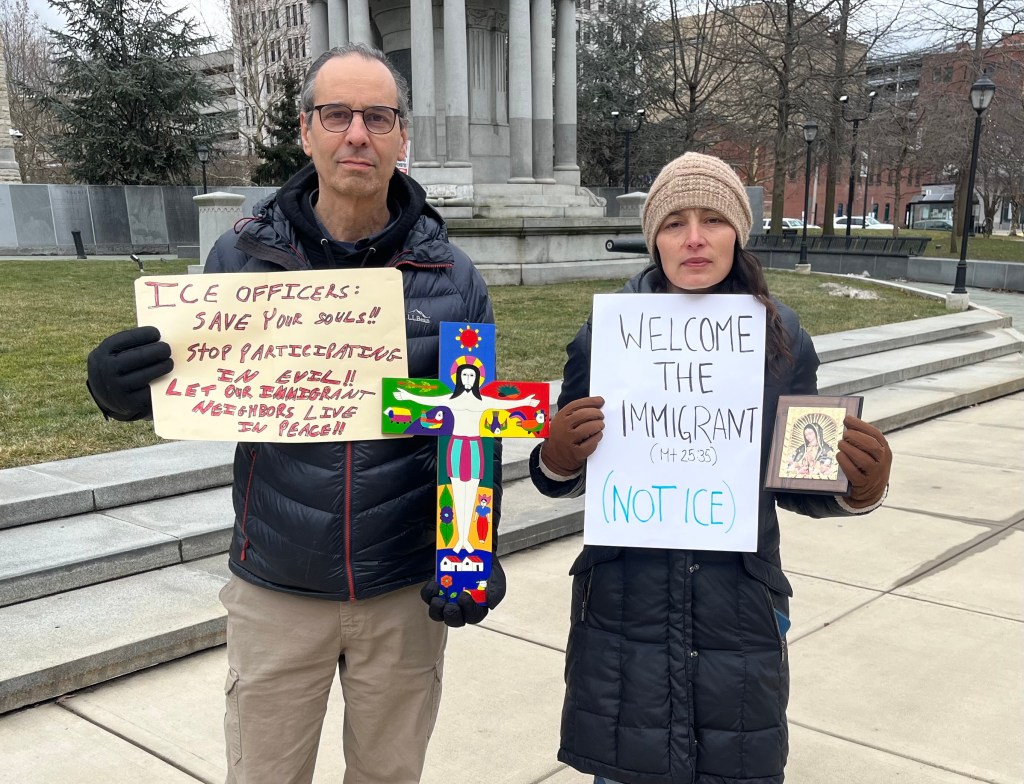
Protests have been staged nationwide since the killing of Renee Good during an incident with U.S. Immigration and Customs Enforcement officer Jonathan Ross on a Minneapolis street on Jan. 7, with outraged Minnesotans demanding the federal government withdraw ICE from the state and others throughout the rest of the nation insisting this type of law enforcement is not characteristic of the America they want.
Locally, around 80 people gathered at Courthouse Square in Scranton, Lackawanna County, to stand up for immigrants and against ICE raids nationwide. Another protest— organized by the Schuylkill County Democratic Committee and set for 4 p.m. on Jan. 20 at Garfield Square on West Market Street in Pottsville — will feature a candlelight vigil to honor those caught up in ICE raids and speak out against ICE operations.
“We do not need to accept what is happening in our country and in our own community,” Sister Suzie Armbruster, I.H.M., of Scranton, said while offering a prayer at the Lackawanna County protest. “We stand strong and believe that good people overtake evil.”
Too often these days, we are quick to dismiss the effect peaceful protest can have on impacting change. Especially if the effort is sustained and consistent.
Convincing arguments for the effectiveness of peaceful protest have been made at critical times in history by the likes of Gandhi, Susan B. Anthony and, during the Civil Rights movement, Martin Luther King Jr. At Harvard, political science professor Erica Chenoweth studied the relative effectiveness of nonviolent and violent movements and developed what is now known as the 3.5% rule.
Stating it simply, Chenoweth found both that nonviolent protest is twice as effective in achieving goals, and mobilizing 3.5% of the population behind the cause has historically succeeded in effecting change. Obviously, there’s no guarantee smaller protests won’t be initially ignored, passed off as the action of malcontents.
But that’s how all change starts. By being ignored. Until the numbers grow. Until the voices get too loud. Maybe it doesn’t happen overnight. Maybe it takes months, even years. But not going away, continuing to demand, has long been the best path to change for people frustrated with the actions of government.
Impatience, in all forms, is too often the death of meaningful change, as Colvin, Parks and so many others taught us in the battle for decency and equality.