
More than two dozen people participated in a multiyear scheme to fix basketball games in the NCAA and the Chinese professional league, federal prosecutors in Philadelphia alleged Thursday — a conspiracy that affected dozens of games and involved tens of thousands of dollars in bribes and millions in fraudulent bets.
Twenty basketball players and six so-called fixers were charged in federal court in Philadelphia with crimes including bribery, conspiracy, and wire fraud, according to U.S. Attorney David Metcalf, who described the case as “historic.”
Metcalf said the fixers — professional gamblers or others with ties to the basketball world — would recruit players to underperform in forthcoming games, then bettors would wager against that player’s team. Players were bribed for their efforts, Metcalf said, while gamblers ultimately collected millions of dollars in illicit winnings.
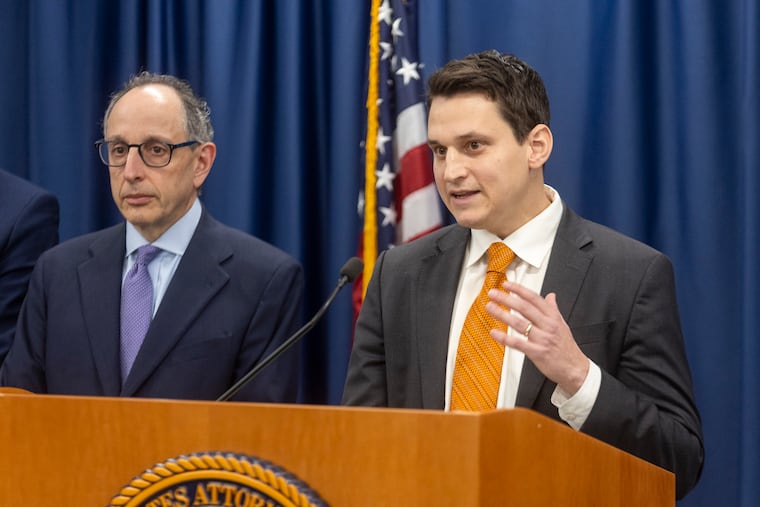
“When criminals rig the outcome of games for the purpose to lose … we all lose,” said Metcalf, who spoke at a morning news conference alongside officials including Andrew Bailey, deputy director of the FBI, and Wayne Jacobs, the FBI’s top official in Philadelphia.
Players involved included Antonio Blakeney, a onetime Chicago Bulls player who later played for the Jiangsu Dragons in China, prosecutors said, as well as a number of Division 1 college players from programs including Tulane University, Nicholls State University, Northwestern State University, and North Philadelphia’s La Salle University.
In all, prosecutors said, the scheme involved 39 players on more than 17 Division 1 NCAA teams, with bettors wagering huge sums on at least 29 games. Some of the bets were placed at Rivers Casino in Philadelphia.
The allegations are similar in theme to those leveled last fall against NBA players including the Miami Heat’s Terry Rozier, who has also been federally charged with altering his performance to benefit gamblers.
One of the gamblers charged Thursday was Shane Hennen, a former Philadelphia resident and prolific high-stakes sports bettor who had already been charged alongside Rozier and was accused of participating in that scandal as well.
At that time, the charges against Hennen — and the earlier dismissal of Temple University guard Hysier Miller — were rumored to extend to a more far-reaching probe into the NCAA.
Metcalf said the new investigation was distinct from that case, which is being prosecuted in New York. In that matter, Metcalf said, Rozier and others were accused of providing confidential information to bettors — such as a player’s injury status — to help boost the odds of a wager succeeding.
In the newest case, Metcalf said, players were directly participating in the conspiracy — and benefiting from it, even as they sought to help their teams lose.
“There is a really important difference between wagering on predicted outcomes [based on] insider information, and wagering on determined outcomes — outcomes that you control,” Metcalf said. “The former is a crime against sports betting markets. The latter is a crime against the sport itself … and that’s what makes it different and, in my opinion, worse.”
An American scheme in China
In a unique twist, prosecutors said, the scheme targeting one of America’s most popular sports was launched in China.
According to the indictment, Hennen and another professional gambler, Marves Fairley, recruited Blakeney — then playing for the Jiangsu Dragons — to join their so-called point-shaving scheme in 2022.
Blakeney at the time was a top scorer in the Chinese Basketball Association. And, according to the indictment, Hennen and Fairley offered him bribes in exchange for deliberately underperforming and hurting his team’s chances of winning.
After he agreed, prosecutors said, Hennen and Fairley placed large bets at the Rivers Casino sportsbook in Fishtown, known as “BetRivers.” In one instance, prosecutors said, the men wagered $198,300 on the Guangdong Southern Tigers to beat the Dragons in a March 6, 2023, game.
Blakeney averaged 32 points a game that season, but scored just 11 in the contest, which the Dragons lost, 127-96.
Hennen was apparently pleased with his new investment. Later that spring, the indictment said, he sent a text to another schemer offering reassurance about a game involving Blakeney.
“Nothing gu[a]rantee[d] in this world,” Henner wrote, ”but death taxes and Chinese basketball.”
A spokesperson for Rivers Casino declined to comment on the case.
After the season, Fairley left $200,000 in cash in a Florida storage unit Blakeney controlled, the indictment said. In intercepted text messages, Hennen and Fairley also described “giving $20,000” to other players recruited by Blakeney to fix matches during his absence.
The Chinese betting ring then became a template, prosecutors alleged — one that the conspirators used to begin rigging games much closer to home.
Targeting NCAA games
In 2024, prosecutors said, Hennen and Fairley recruited college basketball trainers Jalen Smith and Roderick Winkler to help rig NCAA games. Prosecutors said the trainers’ status in the basketball world gave them access to, and credibility with, NCAA athletes.
The men then used that influence to recruit about 20 players from a variety of schools to participate in the point-shaving operation, prosecutors said.
Several players had ties to the Philadelphia region, including former Temple University forward Elijah Gray, who was approached while playing at Fordham; Micawber “Mac” Etienne, who was approached at DePaul but later played for La Salle; and Delaware State University point guard Camian Shell, who is alleged to have thrown games while at North Carolina A&T State University. C.J. Hines, a current player on Temple’s roster, was also charged with taking bribes in 2024, when he was playing at Alabama State, court documents show. A Temple spokesperson said Thursday that the university was “reviewing this new information” and noted that Hines has not played for the Owls due to ongoing eligibility questions.
The scheme worked much as in China, prosecutors contended: Hennen and Fairley would bribe players to throw games, then place bets on their opponents.
But the gamblers took a less visible role this time, the indictment said, generally sending brief texts to a number of people who could place high-stakes bets on their behalf.
“Queens ny -1 first half and money line,” Hennen texted a straw bettor, seeking to place a $20,000 bet that the Queens University Royals would cover the first-half spread by at least 1½ points in a March 1, 2024, game against Kennesaw State.
The men let Smith handle much of the dirty work, the indictment said. In one example, he texted with Kennesaw State players Simeon Cottle and Demond Robinson the day of a game.
“I need both of y’all on FaceTime with me twice today,” he wrote. “Just to make sure y’all good and really locked in … [This] money guaranteed, ima be at the game with the money.”
In some cases, Smith is alleged to have flown to Philadelphia to pay players their bribes. In other instances, the indictment said, Smith was intensely involved with pressuring players to underperform even while games were progressing.
In March 2024, for example, the indictment said, Smith texted DePaul’s Etienne that his teammates who were playing well needed to “chilllll [the f—] out.”
In another episode, the indictment said, he wrote to to Alabama State players Shawn Fulcher and Corey Hines, saying: “Lose by 6 full game no excuses,” then sent a photo of a large stack of cash.
When the players complained that they were struggling to throw the game because their opponent — the University of Southern Mississippi — was “so bad,” Smith sent an all-caps response, the indictment said.
“LET [the Southern Mississippi players] LAY IT UP,” he wrote.
Sports impacted by ‘monetization’
While Hennen is accused of orchestrating many of his crimes in Philadelphia, the indictment painted a more limited picture of his role with local teams.
In 2024, for example, Smith and Blakeney attempted to recruit players from La Salle to join the scheme for a game against St. Bonaventure, the indictment said. But prosecutors did not name any La Salle players as having done so, and they said all the bets Hennen and Fairley placed on the game were unsuccessful.
A spokesperson for La Salle said Thursday that the university would cooperate with all investigations into the matter, and that “neither the university, current student-athletes, or staff are subjects of the indictment.”
Metcalf said the “monetization” of college sports in recent years — and the proliferation of legalized sports gambling across the country — “furthered the enterprise in this case.”
And he said that although college athletes can now be legally paid for their name, image, and likeness, some of those who participated in this scheme were targeted because they did not feel they were making enough money in that new landscape.
Metcalf said many Americans are drawn to sports because they offer a venue for teams and players to participate in honest competition.
“This,” Metcalf said, “totally flies in the face of all of that.”
Staff writer Isabella DiAmore contributed to this article.