As up to 15,000 nurses across New York City go on strike over the lack of pay increases, minimum staffing levels, possible discontinuation of health care benefits, and lack of workplace protections, we are reminded that the role of nurses is often overlooked within the medical field when compared to the more front facing role of doctors. Over the past few decades in Philadelphia and the surrounding counties, there have been a number of threatened strikes, Yet, only one, the Filipino Nurses’ Strike of 1973, became an international incident.
By Friday, August 3, 1973, Hahnemann Hospital had cancelled its involvement in an education exchange program that had attracted Filipino nurses since 1960 to the Philadelphia region. The program supplemented shortfalls in local staffing, trained recent nursing school graduates on American medical procedures, and provided them with enough experience to be an asset to the medical field upon their return to the Philippines. The rapid end of the program was the result of a nurses’ dispute, mainly over fair wages. Hahnemann Hospital president Edward Wharton Sober Jr. brought to light the issues of discrimination and nationalism that caused many people, including Philippines President Ferdinand Marcos Sr., to question and reexamine the roles of Filipino nurses within the United States.
The initial Exchange Visitor Program (EVP) was developed in 1948 with the creation of the U.S. Information and Education Act that same year. According to the book Empire of Care: Nursing and Migration in Filipino American History by Catherine Ceniza Choy, “During the mid-twentieth century, exchange programs acted as vehicles for transforming nursing into an international profession.” Along with this trend came increases in both personal and family wealth via remittances and socioeconomic status.

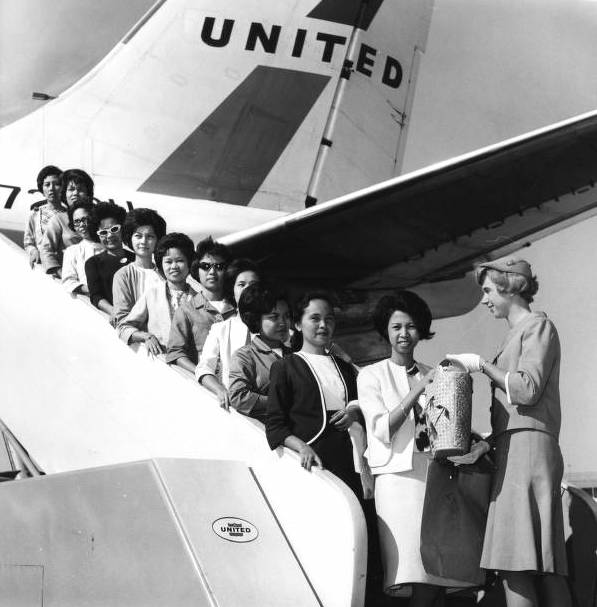
11 nurses from the Philippines arrive at Philadelphia International Airport for a one-year training program at Presbyterian Hospital. | Photo courtesy of Special Collections Research Center, Temple University Libraries
By the 1960s, travel agencies increasingly began to assist with the paperwork, promotion, and logistics of settling nurses in various foreign cities. Philadelphia, New York, Los Angeles had already established enclaves of Filipino nurses who had migrated years prior. People were advised by friends and families to go through training to become registered nurses (RN) in the Philippines and participate in the EVP.
Almost immediately, issues arose in U.S. hospitals as nurses felt abused. “Some supervisors exploited exchange nurses by assigning them to work the least desirable work shifts, knowing that the exchange nurse’s visa status depended on her sponsorship from the hospital,” wrote Choy. Other abuses ranged from last-minute shift changes to double shifts over extended periods, while white nurses received the optimal shifts, leaving Filipino nurses to believe that they would always receive “the dirty jobs.”
The almost two-month-long standoff with Hahnemann Hospital began with issues regarding housing for Filipino nurses. A formal statement by the hospital’s administration on May 14, 1973 ordered resident nurses to move from the 14th floor to the 16th floor of the Philadelphia Athletic Club at 306–320 N. Broad Street (demolished in 1991) in favor of plans to open a health services center at that location. Two options were given to resident nurses: either move to the 5th floor of the Nurses’ Residence at 15th and Vine Streets, which staff stated did not have cooking facilities and separated Filipino nurses from each other, or seek shelter elsewhere. Those not interested in moving were given until June 29 to move out.
Shocked by the wording of the letter, the nurses decided to unite to get justice. According to Marcela Muneses, president of the Filipino Exchange Nurses Association (FENA), “At first, we were tongue-tied, but now we had chosen to fight back.” Muneses, along with 74 other nurses, including Corazon C. Cabeguin, Asuncion E. Cuesta, and Emerita A. Zalavarria, delivered their own demands to hospital administrators Asher Barmish and Elspeth Anderson on Monday, June 4, 1973. Their demands included an increase in yearly starting salary from $7,195 to $8,190 to be more in line with wages of white nurses, allow FENA members continue to live at the Philadelphia Athletic Club, tighter security at the club, family insurance coverage under Blue Cross and Blue Shield, hospital coverage against legal liabilities, two-thirds sick pay during sick, disability, and maternity leave, coverage under worker’s compensation laws, health benefits extended to incoming exchange nurses, and fairness in how shifts and duties are distributed.

This photograph from 1968 shows Philippine nurses standing around a seated Consuelo C. Aguilar while she blows candles out on a cake. | Photo courtesy of Special Collections Research Center, Temple University Libraries
In a June 9, 1973 Philadelphia Daily News article, FENA nurses reportedly began to hold solidarity rallies outside of the hospital. The article stated, “It was unfair that American-born registered nurses made what they felt was a considerably higher salary.” According to a Hahnemann Hospital spokesperson at the time, an American nursing graduate started at $8,568 per year, but Filipino nurses, categorized as in training with an education curriculum, were paid $6,880. After three months they received $7,195. If they stay at least a year, Filipino nurses had the option of a second year at $7,810. The nurses stated that they were never given an education curriculum.
A FENA newsletter dated June 12, 1973, stated that negotiations with administrator Barmish faltered as most requests that nurses move were rejected. In response, the counteroffer was that the nurses’ residences would be upgraded with kitchens, and movers would assist in some of the nurses’ transition to an alternative location. The issue of worker’s compensation did not receive a response. Administrator Anderson’s response to shift assignments noted that nurses who did not accept their assignments “will be disciplined.” The 75 Filipino nurses were advised not to speak with the press as it was “an internal hospital matter” and not to distribute flyers. Some of the nurses stated that they were threatened with deportation.
By June 15, as the topics of exploitation and discrimination became prominent, Foreign Affairs Secretary Carlos P. Rómulo contacted the U.S. Ambassador of the Philippines, Eduardo Z. Romualdez, to learn if the nurses’ claims were accurate. A request was made to let Jose Naldo, labor attaché of the Philippine Embassy in Washington, step in and speak to both sides directly. After the initial meeting, he determined that the matter could be resolved soon. As protests and rallies continued, Local 1199C Union, AFL-CIO, the Philadelphia Committee for Concerned Filipinos, and other organizations began to show their support for FENA.
By late June, the Filipino nurses won their housing demand. They were allowed to stay on the upper floors of the Athletic Club with the bottom floor still planned for a conversion to a health services center. Yet, in regard to other demands, hospital administrators did not budge, leading to a deadlock. At a June 23 meeting, Hahnemann Hospital did not allow its nurses to let representatives speak on their behalf, stating that FENA is not a union.

A Filipino nurse protesting Hahnemann Hospital’s unfair labor policies by handing out flyers. | Photo: Joseph J. Conley, Philadelphia Inquirer, June 13, 1973
As negotiations stalled, the number of striking nurses decreased to 72. Approached by the press regarding the lack of momentum, Roger S. Hunt, director of Hahnemann Hospital, was quoted as saying that meetings were being boycotted by the nurses. In response, the nurses’ spokesperson stated, “Hunt insisted on a general meeting in the administration office, while the nurses wanted a meeting in a neutral spot.” Consequently, a formal statement by the hospital was made regarding the nurses’ futures. “We will excuse any [nurse] from her contractual obligations to Hahnemann if she wishes to transfer to another approved program or return to her home.” In response, Muneses said, “We had been threatened before with the termination of the [EVP] program.”
Conditions remained the same into August when the decision was made to officially cancel the Filipino nurse exchange program in November 1973, leaving 49 of the 72 remaining nurses with only one year of employment. The remaining staff were allowed to finish their two years of training. Muneses called this decision a “cop out” and attempted to reverse the decision. In the aftermath, nurses who tried to transition to other hospitals later learned they would not be accepted elsewhere, fueling claims that they were blacklisted. Others returned to the Philippines.
The fallout of the strike and the termination of the nurses’ exchange program resulted in criticism about how the program was used to shore up gaps in work schedules and undesirable shifts. Although the State Department did not supervise the program, it did allow the Board of Nursing Examiners in each state to supervise it and verify that nurses were receiving training. However, Cora Cabeguin, a Filipino nurse at Hahnemann Hospital was billed $738 for a one-way flight from the travel agency that assisted her after Cabeguin’s arrival to the United States. President Marcos eventually cancelled the Philippine government’s involvement in the program and did not allow students or nurses to fly to the U.S. for the purpose of education under the H-Visa.