
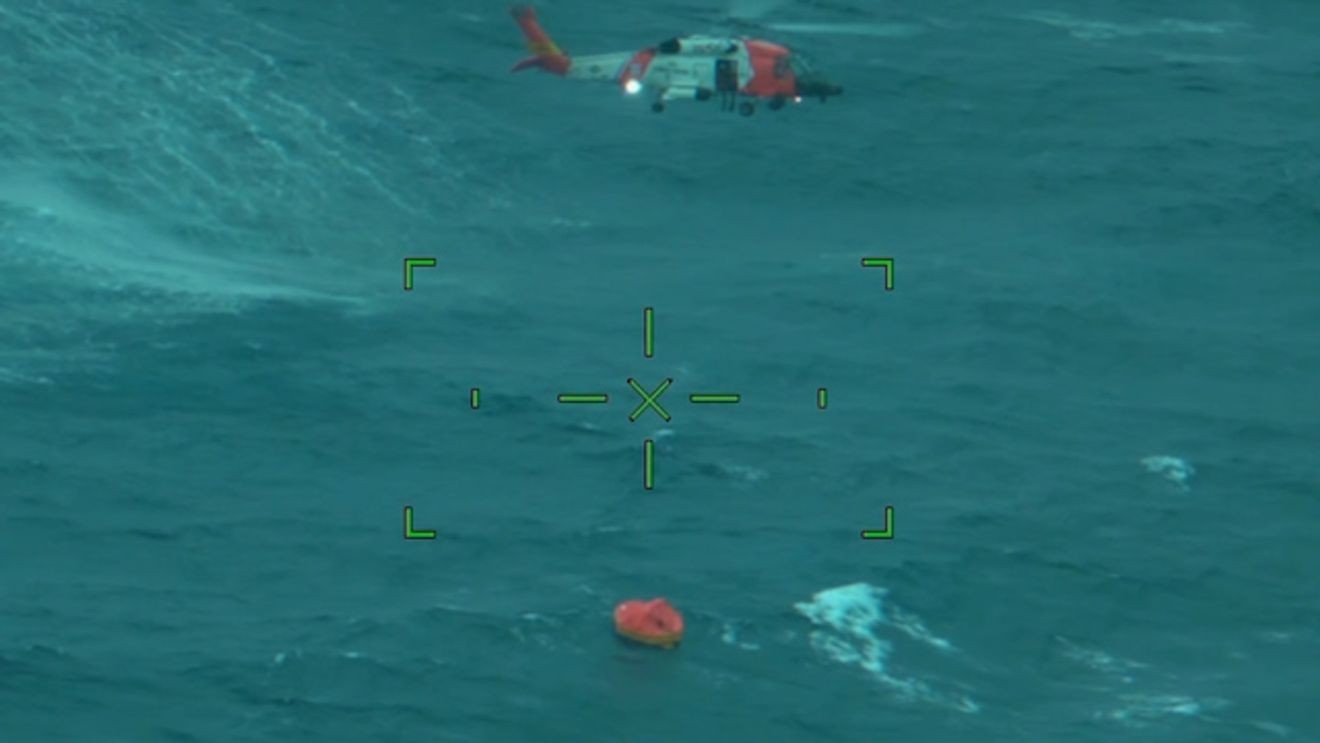
A sailor, whose mother and grandparents are from Scranton, is sharing his story months after a dramatic Coast Guard rescue hundreds of miles offshore.
Despite extreme conditions and a sinking vessel, everyone on board made it out safely, thanks to experience, preparation, and a coordinated military rescue.
Zachary Doerr caught the sailing bug at a young age. The Butler, Pennsylvania native grew up sailing with his father, Tom, studied naval architecture at the Webb Institute, and now works full-time in yacht design and structural engineering. Zach’s mom, Lori Kornfeld Doerr, is from Scranton, as are his grandparents, the late Harold and Helene Kornfeld.
He’s raced across open oceans, including two winning trips to Bermuda.
But last November, a leak in one compartment of the boat, put his experience to the test.
Doerr and four others set out on November 3rd to deliver a sailboat from Connecticut to the Bahamas for the winter season. Conditions worsened quickly. By Tuesday morning, the crew was dealing with sustained winds near 40 knots, gusting to 50, and building seas.
Despite the rough weather, the boat was still moving, until an engine alarm sounded.
When Doerr checked the port engine compartment, he found more than two feet of water already inside. The rest of the vessel appeared dry, but when the crew returned, the water level had doubled, now covering the engine.
Two engineers onboard immediately went to work, rigging additional pumps and passing buckets to manually remove water. The crew fought to keep the flooding contained to that single compartment, continuing to sail through conditions.
Eventually, the effort wasn’t enough.
With the engine flooded, sails disabled, and waves growing more violent, the boat became increasingly unstable.
“Now we’re sitting with our engine compartment flooded, so we had no motor. We have no sails. We’re dead in the water,” Doerr said. “The waves were just tossing us around.”
As one crew member stayed in contact with the Coast Guard, initially advising them the situation was serious but manageable, the flooding suddenly worsened.
“I heard this swooshing sound,” Doerr said. “When I checked again, the water had flooded out of the compartment and was three feet above the floor in the rest of the boat.”
That’s when the decision was made.
“He looks at it, his eyes go wide, and he goes back to the phone and says, ‘Actually, I think we’re going to need someone out here,’” Doerr said.
Just before 2 a.m., the crew inflated their life raft. By 3 a.m., they had abandoned the boat completely, watching it drift away in the dark.
“You get a pang of anxiety when you see the water,” he said. “But until we were in the life raft, you’re not really thinking about ‘what if.’ You’re focused on the tasks that need to get done.”
The Coast Guard launched a rescue effort, dispatching aircraft from Air Station Elizabeth City. Because of the extreme distance, nearly 280 miles offshore, crews coordinated with the USS George H.W. Bush, an aircraft carrier positioned roughly halfway between land and the stranded sailors.
The helicopter refueled on the carrier both on the way to the rescue and again on the return trip, making the long-range operation possible. When the helicopter finally arrived, the wait felt endless.
“A life raft is not pleasant. Almost all of us were seasick. Almost all of us were a least a little bit cold. So yeah, the last half hour knowing roughly when the helicopter would show up, the last half hour felt like an eternity just waiting.”
All five sailors were hoisted to safety in good health. They were briefly brought aboard the aircraft carrier, given medical evaluations and dry clothes, before being flown back to shore.
“We got to go on this aircraft carrier, and they took us to a room, and they gave us a quick medical evaluation and gave us dry clothes and set us on our way. So that was pretty cool. There’re not many people outside the navy who get to be on an active-duty aircraft carrier.”