
By SHANNON O. WELLS
In Rio de Janeiro, Brazil, a traveling multimedia exhibit, co-conceived and curated by a Pitt faculty member, on the history of the global slave trade is taking on a life of its own.
In addition to educating and informing, “In Slavery’s Wake: Making Black Freedom in the World” has sparked a growing dialogue about the larger questions of slavery.
“We had several institutions in Rio that decided to join the big wave of discussion about slavery, and they made their programming also related to the topic,” said Keila Grinberg, director of the Center of Latin American Studies and professor in the Dietrich School’s Department of History. “This is a really … a big movement here, of people talking about the slave past.
“The main feedback that I get is from teachers. There is a big involvement of K-12 teachers,” she added, noting the special programming provided for teachers to replicate the exhibit with their own students. “It is really important and good to see how they have been involved with this topic.”
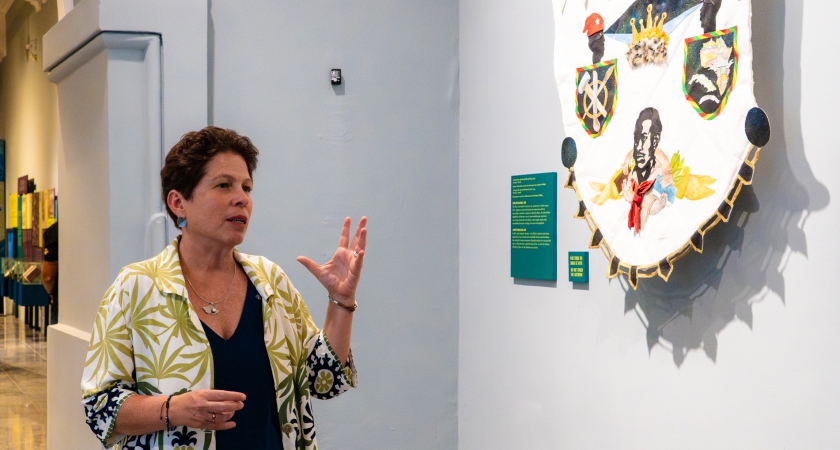
An immersive, multimedia exhibit, “In Slavery’s Wake” prominently features decade of community-engaged scholarship and research by Grinberg, highlighting the histories and the legacies of racial slavery and colonialism.
“There are films, screens that you can touch and access different media, panels, objects, interviews, and of course, photographs,” she said. “It’s really very, very dynamic.”
Debuting in 2025 at the Smithsonian Institution’s National Museum of African American History and Culture in Washington, D.C., the exhibit evolved from the Global Curatorial Project. The network of scholars, curators and community educators worked collectively and collaboratively to create “critical new knowledges and innovative forms of public history about the historical experiences and the contemporary legacies of racial slavery and colonialism,” its mission statement says.
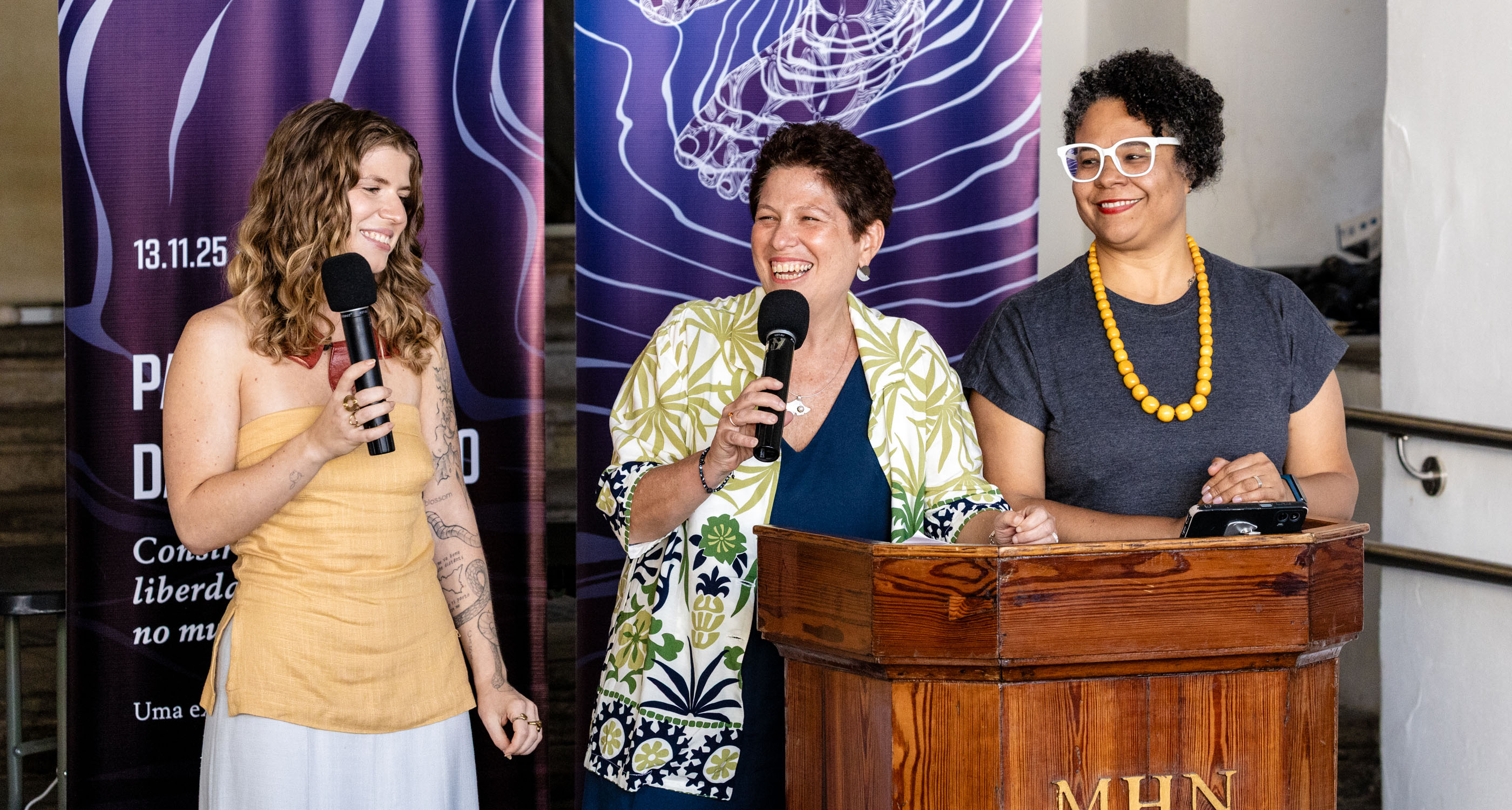
Last November, Brazil’s Museum of National History in Rio became the exhibit’s second stop on a tour of the four continents that defined the transatlantic slave trade. Other stops include Cape Town, South Africa; Dakkar, Senegal; and Liverpool, England.
The exhibit draws an average of 400 visitors per day, Grinberg noted. “And it’s by far the most visited traveling exhibit since they start counting. … Even without schools, it’s been really, really visited by the public.
“The main feedback that I get is from teachers … and it is really important and good to see how they have been involved with this topic,” she added, noting that the exhibit’s content has been replicated on Instagram and other social media platforms. “This is just really circulating a lot.”
As a specialist on trans-Atlantic slavery, Grinberg started working with the Smithsonian Museum of African American History and Culture on the project’s design.
“I was involved first as a person who was based in Rio. When I came to Pitt in 2021, I brought this as one of my main activities,” she said. “Then we were able to involve the Center for Latin American Studies as one of the organizers and sponsors of the of the activities.
“This is a long process that started 10 years ago, but became increasingly more important in the past, let’s say four years.”
Grinberg called the exhibit both the first and most comprehensive of its kind.
“I think it’s very important to highlight the role that slavery played within all these countries that have been involved,” she said. “For the American public, it’s really important to show the similarities of the experiences of people that lived in the African diaspora that are very similar to the one lived by African Americans.
“This is really about showing how global is the process of, not just enslavement, but claims for freedom, rights for freedom. … We want people to engage with the past, to recognize the importance of the past in our lives, and really to value that.
“There’s something we should learn, but there’s also an emotional link that is very, very important to our identity,” she added. “And I guess it’s more important than ever.”
Last fall, several exhibits co-sponsored by Pitt and the Center of Latin American Studies opened across Rio. Along with “In Slavery’s Wake,” which opened on Nov. 12, was “Unfinished Conversations,” a community engagement and oral history series led largely by the Ruth J. Simmons Center for the Study of Slavery and Justice at Brown University and the Center for the Study of Global Slavery at the National Museum of African American History and Culture.
In between two exhibit openings, Grinberg helped organize a two-day seminar at the National Archives exploring the theme of history, memory and slavery reparations.
A third exhibit then opened to visitors of the National Archives based on the stories of enslaved women. “Senhora Liberdade (Our Lady of Freedom): Women Defy Slavery,” is based on 10 “freedom lawsuits” initiated by enslaved women who sued their “owners” in 19th-century Brazil. The exhibit will come to the Pitt’s Hillman Library this fall.
“Those lawsuits happen in other places, including the U.S.,” Grinberg noted. “This is really something that the public does not know. And it always attracts a lot of attention. Think about how an enslaved person, especially an enslaved woman 200 years ago, could go to the courts and say, ‘Hey, I shouldn’t be enslaved.’”
Grinberg, whose has based her academic career on these topics, said she read more than 400 legal cases and selected 10.
“I asked the workers from the National Archives, who are mostly black women, to share their vision about those stories that they were listening to for the first time,” she said, noting the exhibit includes a film of those interviews. “What are their feelings, their thoughts when they hear that the place that they work has all these stories that they have never heard about, but those are stories about their own past.
“It’s different layers of women challenging slavery.”
Viewing “In Slavery’s Wake” exhibits as an observer, Grinberg said she “just likes having a sense of listening to what people say.”
“In one sense, it’s really interesting how much interest people have in the past, how connected they are to slavery, either in terms of traumatic experiences, or really recognizing why we still face some of the challenges that we face today.
“At the same time, it’s also very, very moving and rewarding to see how people engage emotionally with the content that we are displaying.”
Shannon Wells is a University Times reporter. Reach him at shannonw@pitt.edu.
Have a story idea or news to share? Share it with the University Times.
Follow the University Times on Twitter and Facebook.