
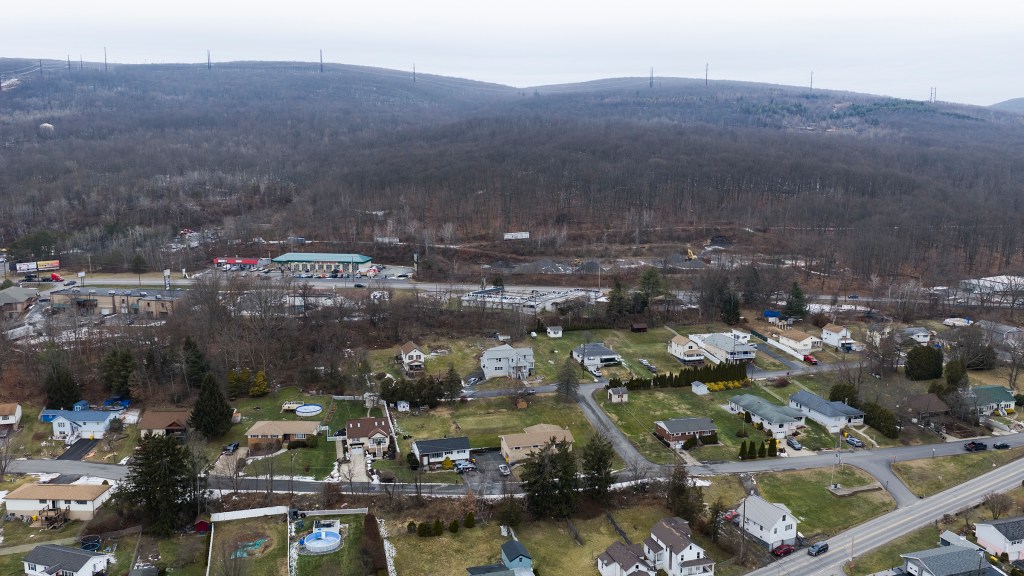
A proposed data center campus will rise above Business Route 6 in Archbald while pumping in up to 3.3 million gallons of water per day and using more electricity than the region’s largest natural gas power plant can produce.
The Wildcat Ridge Data Center Campus became Lackawanna County’s first data center proposal when representatives approached Archbald officials in January 2025 to tout a $2.1 billion investment into data centers for artificial intelligence, but there was little information on how the project would impact local utilities. A 777-page conditional use application submitted to the borough last month provides the clearest picture of just how much water and electricity are needed to sustain 5.66 million square feet of data centers near Archbald’s Eynon and Sturges sections. If Archbald Borough Council approves the project, Brooklyn-based Cornell Realty Management LLC wants to build 14 data centers across 574.2 mountainside acres, including former mine land, along Business Route 6 and Route 247, or Wildcat Road. The commercial section of the campus also calls for a grocery store, an office building and mixed-use building.
The campus would use 1,600 megawatts of power, and to offset its water demands that top out at 3.3 million gallons per day, the data center campus is exploring tapping into the mine water below as a source of cooling for its computers.
Isaac Hagar, managing partner of Cornell Realty Management LLC, 347 Flushing Ave., Suite 800, Brooklyn, New York, is listed as the applicant in the Dec. 15 application.
The location quickly drew scrutiny from residents who urged Archbald officials to restrict data centers to industrial land across the Casey Highway. The opposition came amid Archbald’s efforts to amend its zoning to define, regulate and designate where data centers can be built. The Wildcat Ridge property is zoned for residential and conservation uses, and it was previously proposed to have a housing community with nearly 2,000 multifamily residential units, an additional 120 residential lots and 1.2 million square feet of commercial space. Borough council gave Wildcat Ridge the zoning relief it needed to move forward with the conditional use process when it adopted a data center zoning ordinance in November that made data centers conditional uses in multiple overlay districts throughout the town. As conditional uses, developers are required to attend a public hearing and adhere to a slew of conditions established by the borough in order to receive approval from council.
While other data centers in Archbald were able to move forward under legacy zoning by applying prior to the zoning amendment, the Wildcat Ridge Data Center Campus needed zoning relief due to the land’s residential and conservation zoning.
Following Wildcat Ridge’s initial proposal, and driven by both increased demand for artificial intelligence as well as local access to high-tension power lines and high-speed fiber optic internet lines, Archbald received applications for four more data center campuses — giving the town the highest concentration of data centers in the region with 44 buildings across five campuses. More data centers are proposed in Clifton and Covington townships, Dickson City, Jessup and Ransom Twp. Plans for up to four data centers in Blakely were also proposed and subsequently withdrawn.
Archbald Borough Council will hold a public hearing on Wildcat Ridge’s conditional use application Jan. 28 at 6 p.m. in the Valley View High School auditorium, 1 Columbus Drive, Archbald, according to a public notice published Tuesday in The Times-Tribune.
Council President Dave Moran declined to comment due to pending legal action.
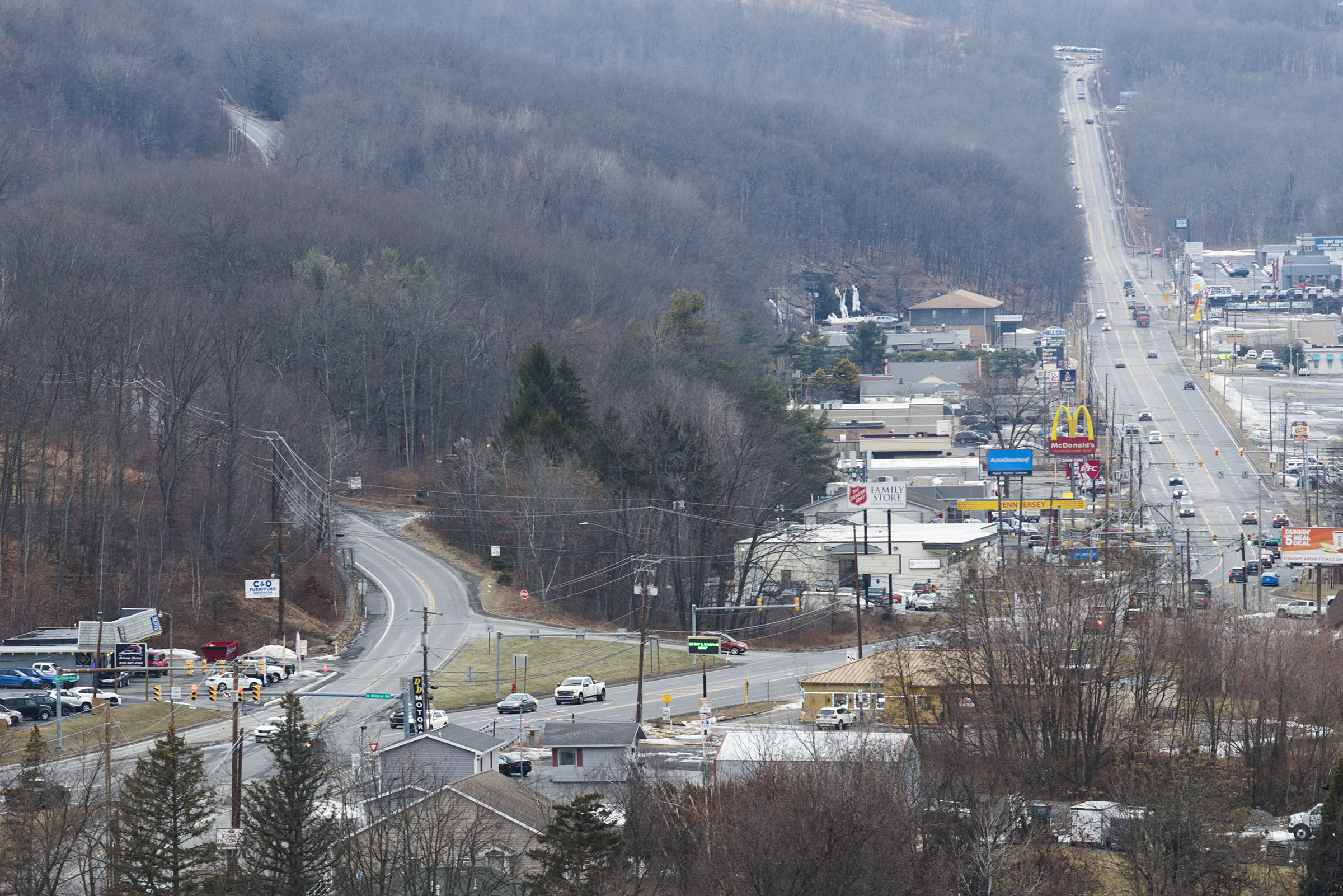
An aerial view of Route 6 looking north in Archbald Friday, January 9, 2026. (SEAN MCKEAG / STAFF PHOTOGRAPHER)
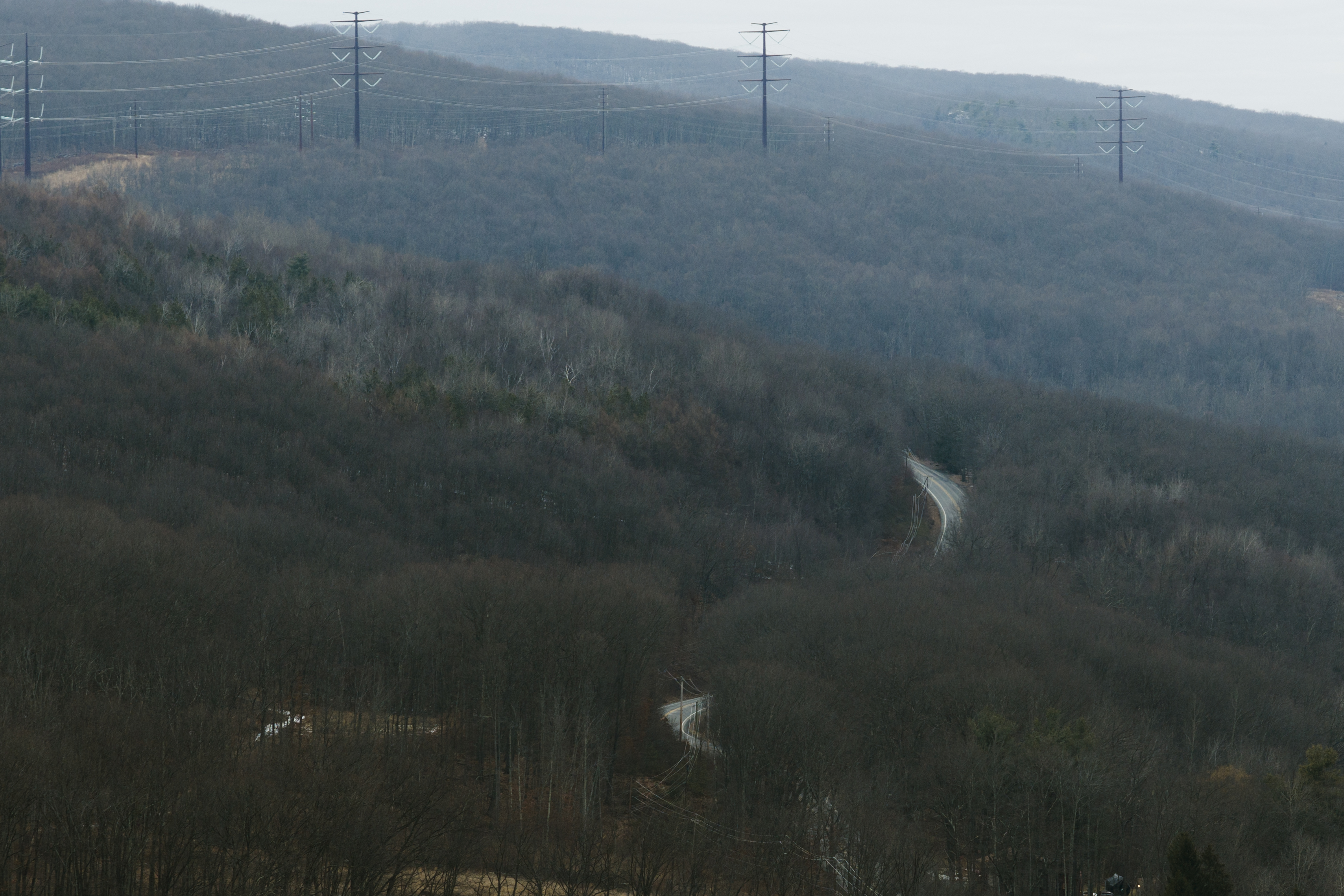
Wildcat Road winds up the mountain looking north towards a section of power lines in the Eynon section of Archbald Friday, January 9, 2026. (SEAN MCKEAG / STAFF PHOTOGRAPHER)
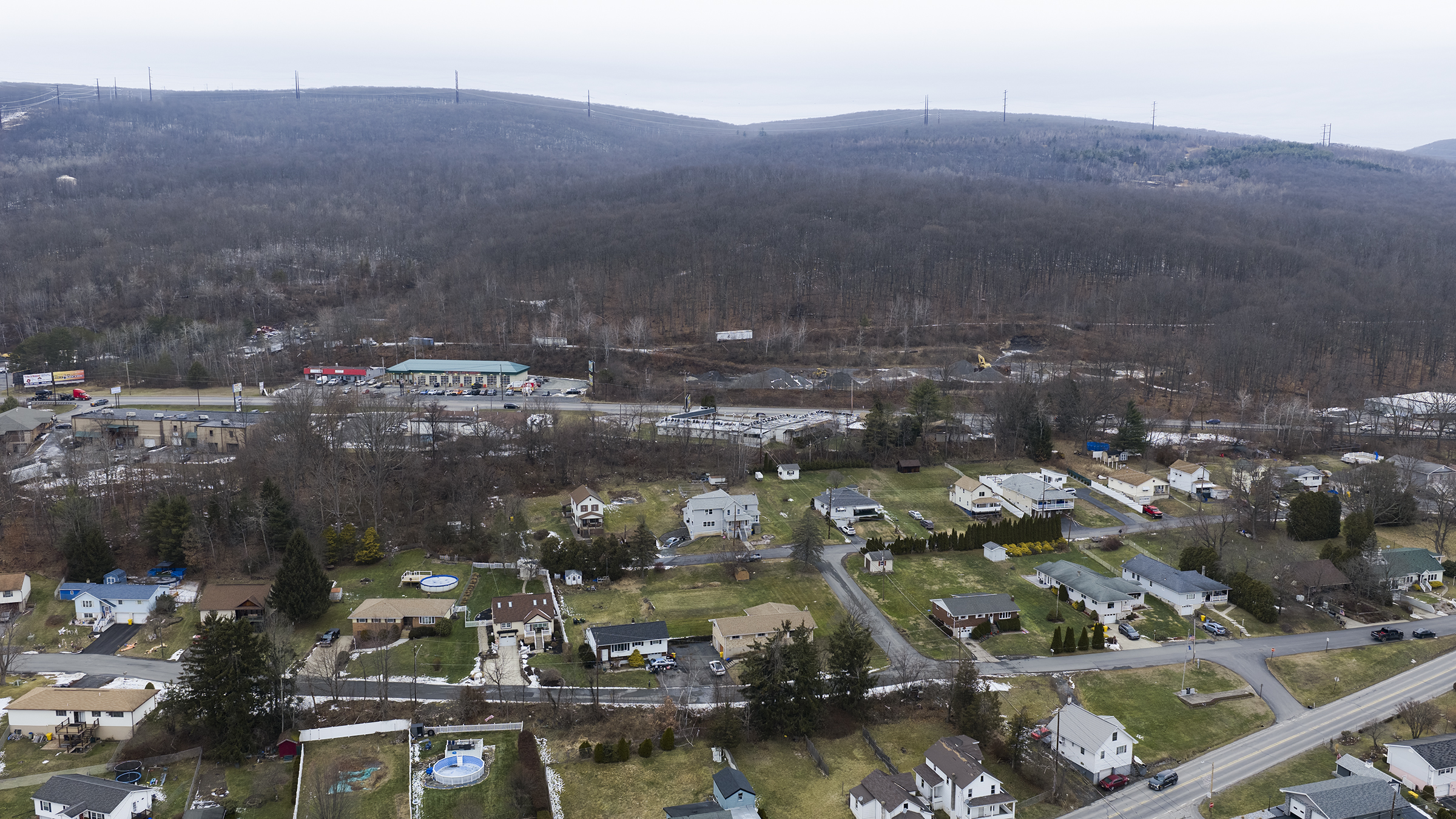
An aerial view of the Sturges neighborhood of Archbald Friday, January 9, 2026. (SEAN MCKEAG / STAFF PHOTOGRAPHER)
Show Caption
1 of 3
An aerial view of Route 6 looking north in Archbald Friday, January 9, 2026. (SEAN MCKEAG / STAFF PHOTOGRAPHER)
Expand
What is Wildcat Ridge?
Composed of 14 two-story data centers, each up to 80 feet tall with a 202,340-square-foot footprint, the Wildcat Ridge Data Center Campus is one of the largest campuses proposed in Lackawanna County. The site is bounded by a PPL Electric Utilities access road across to its west near the Blakely border, continuing east along Business Route 6 until its split with Wildcat Road, and then moving up Wildcat for more than half a mile. The project is divided into an 11-data-center north campus and a three-data-center south campus. Tinklepaugh Creek flows between the north and south campuses, according to a site master plan included with the application.
Every data center would have 40 emergency generators, each with its own 1,000-gallon diesel fuel reservoir, totaling 560 generators, in addition to 60 cooling devices for computer hardware known as chillers on every rooftop. The generators and utility yards will face west up the mountain to reduce the potential for noise pollution, and the chillers would be screened, according to the application.
The master plan also depicts two substations — a 326,000-square-foot primary user substation and a 69,000-square-foot secondary user substation — a 3.75 million gallon water storage tank that would be about 101 feet in diameter, and a 33,000-square-foot admin and logistics building. Written descriptions of the water tower in the application describe it as 3 million gallons.
Just below the data centers, Cornell Realty Management plans to build 316,000 square feet of commercial space. Plans show a 50,000-square-foot grocery store with 1,800 square feet of retail space; two four-story, 85,000-square-foot buildings, with one mixed use and the other an office; and a 96,000-square-foot surface parking lot with about 360 spaces. Archbald officials have long looked to revive the town’s struggling Business Route 6 corridor in Eynon, which never recovered after the closure of the popular Sugerman’s shopping center in 1995, and Cornell’s plans promise to help accomplish that.
“Cornell Realty Management is committed to revitalizing the once vibrant commercial zone along the Business Rte. 6 corridor,” the company said in its application.
The entire campus would generate an estimated 2,500 new vehicle trips per day, representing a 13.6% increase in local traffic volume, according to the plans.
There will be a western entrance on Business Route 6 in Eynon near Terrace Drive, and there will be an east entrance on Wildcat Road after its split with Business Route 6.
The campus would create 1,280 permanent “high-wage” jobs divided into three shifts operating 24 hours a day, seven days a week, according to a project summary. The developers estimate the project would generate more than $44 million annually in revenue for local governments, with $7.4 million going to Archbald, $21.8 million to the cash-strapped Valley View School District, and $15.2 million to Lackawanna County. The developer also promises “significant investment” into both local STEM and career and technical education programs, with scholarships, internships and equipment donations, as well as fully funding any emergency responder training and specialized equipment.
The property owners selling their land to make way for the campus are: Pine Line Inc., Timothy J. Seaman, James L. and Michael A. Booth, and Archbald Ventures LLC, according to the application. Pine Line sold 249.87 acres of the land to Archbald Ventures LLC of Suffern, New York, for $4 million in February 2024, with Jeffrey and Alan Rudalavage signing the deed on behalf of Pine Line as president and secretary, respectively.
Water demands
The Wildcat Ridge Data Center Campus will use a daily average of 598,000 gallons of water, with a daily maximum of 3,310,149 gallons, according to the conditional use application. The developer attributes the range to the impact that temperature has on data center cooling systems between summer and winter, meaning the campus will use the most water when temperatures are hottest. At peak demand, the campus would require more water per minute than the average American family uses in a week. The campus would require just shy of 2,300 gallons per minute at 3.3 million gallons per day. The average American family uses about 300-plus gallons per day, according to the U.S. Environmental Protection Agency.
An existing 4-inch water main owned by Pennsylvania American Water would service the site.
As a condition required for its approval, the data center developer included a will-serve letter from PAW, though the utility notes in its Nov. 18 letter, “It is understood that this is not a commitment to reserve water, and that such amounts are subject to curtailment or other operational conditions that require PAWC to suspend or limit water sales.”
The data center campus would discharge about 78,000 gallons per day to the Lackawanna River Basin Sewer Authority’s wastewater treatment plant on Boulevard Avenue in Throop, according to the application and an attached will-serve letter from the sewer authority dated Nov. 24.
Neither the 777-page application nor the letter from PAW indicates where the water company would source the water, but during a Jan. 6 meeting in Archbald, representatives from another proposed data center campus in the borough, Project Gravity, revealed that they will use up to 360,000 gallons of water per day sourced from Lake Scranton to cool their seven data centers along Eynon Jermyn Road and Business Route 6.
The Lake Scranton Reservoir can produce up to 33 million gallons of water per day, according to PAW, and the utility’s 2024 annual water quality report for Lake Scranton notes that it already supplies 17.5 million gallons per day from its Lake Scranton system, which would leave 15.5 million in available capacity as of 2024. The Lake Scranton system serves the city of Scranton and all or parts of Archbald, Blakely, Dickson City, Dunmore, Jessup, Moosic, North Abington Twp., Old Forge, Olyphant, Scott Twp., South Abington Twp., Taylor and Throop, according to PAW.
The EPA reports that Lake Scranton serves 134,570 people, representing more than 60% of Lackawanna County’s entire population. If the Wildcat Ridge campus uses water from Lake Scranton, it would account for up to 21% of the remaining capacity, requiring enough water to fill five 660,000-gallon Olympic-sized pools every day at its maximum daily limit. It would cost $3.7 million-plus per year buying the water from PAW, according to the application.
“The developer understands the concerns presented by the community regarding the consumption of domestic water to feed the cooling systems necessary to maintain efficient and consistent operation of the computers located inside each data center building,” according to the application. “To offset domestic water usage, the developer has directed the design team to pursue potential alternative water sources.”
One of those alternatives is to use the existing mine pool aquifer beneath its campus to help cool its computers.
“Fortunately, when the water supply infrastructure was developed for the Lackawanna Valley, the water companies chose to construct a large network of reservoirs for the production of domestic water,” the company wrote. “These reservoirs rely solely on the collection and treatment of surface water sources. Therefore, extraction of water from the mine pool will not impact the regional quality or quantity of domestic water.”
The project does not require the use of mine water, but if it is determined to be beneficial, the developer said it would work with the state Department of Environmental Protection, the Susquehanna River Basin Commission, the Eastern PA Coalition for Abandoned Mine Reclamation and the Lackawanna River Conservation Association.
Archbald resident John Mellow, a retired DEP geologist and a technical adviser with the Sierra Club’s Northeastern Pennsylvania Group, believes it’s possible to use mine water to cool data centers, but the location might not be feasible due to limited water directly beneath the campus, based on his limited review of a 2014 mine pool mapping report included in the application.
“It depends a lot on how much water they need from the mines,” Mellow said. “If they need small quantities to supplement what they’re getting, maybe it’ll work. If they’re looking for large volumes of water … it might be not really there.”
Mellow believes there is limited water beneath the site due to the geography of the valley. Comparing it to a piece of paper folded into a U shape, Mellow said water drains into the low point at the syncline, which is roughly where the Lackawanna River is, and as a site gets higher up from the syncline, like Wildcat Ridge, it will have access to less underground water.
While there is the potential that disturbing the water could lead to more subsidences, Mellow believes they would be localized to the data center property itself. He noted the developer has an included subsidence plan.
Beyond the significant water demands, Mellow pointed to the developer’s plans to use large quantities of electricity.
Powering data centers
PPL committed to service the data center campus with 1,600 megawatts of power once the developer completes more than $93 million worth of upgrades, according to the application. In addition to notifying the developer about its ability to transmit the requested power, PPL submitted its request to the PJM’s Transmission Expansion Advisory Committee for consideration. PJM is a regional transmission organization that coordinates the movement of wholesale electricity throughout the eastern United States, including all or parts of Delaware, Illinois, Indiana, Kentucky, Maryland, Michigan, New Jersey, North Carolina, Ohio, Pennsylvania, Tennessee, Virginia, West Virginia and Washington, D.C.
The developer reports PPL has infrastructure in place to manage about 40 gigawatts, or 40,000 megawatts, and Pennsylvania has the current capacity to produce 47 gigawatts, with a net increase of 16 gigawatts expected within the next decade.
An attached June 10 project feasibility study from PPL breaks the data center campus down into three phases following a five-year timeline based on distribution/transmission capacity availability. Phase 1 would be up to 300 megawatts and would take 36 months from authorization, Phase 2 would then increase to 1,000 megawatts within 36 to 40 months after the initial authorization, followed by Phase 3 bringing the project to full capacity over 48 to 60 months from authorization.
Less than 3 miles away, and almost directly across the valley from the campus, the Lackawanna Energy Center natural gas-fired power plant in Jessup was touted as the largest natural gas power plant in Pennsylvania and one of the largest in the country by producing 1,485 megawatts of electricity. Marketed as a state-of-the-art power plant with the capacity to power 1 million homes, the Lackawanna Energy Center emitted just over 3.7 million tons of greenhouse gasses in 2023, which is the most recent year available, according to the EPA’s Greenhouse Gas Emissions inventory for large facilities. Despite that, the entire power plant would not be enough to fuel Wildcat Ridge if it were connected directly to the facility.
With additional power generation leading to more greenhouse gas emissions and more global warming as a result, Mellow noted the compounding effect on the grid.
“All of a sudden now, you’re going to have a lot of people, due to climate change in the summer, using a lot more electricity for air conditioners,” he said, pointing to other data centers proposed nearby in Archbald, Dickson City and Jessup.
Cumulative effects
Mellow contends regulators need to look at data centers cumulatively, not on a case-by-case basis — a notion that has gained traction locally as proposals inundate the Midvalley. He floated petitioning the U.S. Centers for Disease Control and Prevention’s Agency for Toxic Substances and Disease Registry to conduct a health study prior to data centers becoming operational to establish a baseline.
In late October, Archbald residents Justin Healey and his wife, Tamara Misewicz-Healey, who are the parents of three young children, formed the “Stop Archbald Data Centers” Facebook group, quickly amassing 3,200-plus members in 11 weeks. Residents use the page to livestream local meetings while creating hundreds of posts per month on data center proposals, not only in Archbald but surrounding communities. The Healeys also raised more than $16,600 through a GoFundMe campaign launched in November to fund a legal challenge to Archbald’s data center zoning ordinance.
“(Wildcat Ridge) is going to have a massive impact, and it’s going to have an impact in a lot more ways than we realize,” Justin Healey, 35, said.
He worried about draining up to 3.3 million gallons per day and if there could be impacts from tapping into mine water.
“Global heating trends are increasing, so we are going to see more of these ‘rare’ peaks,” he said. “The more I learn, the more it’s affirming everything that we initially thought and kind of pursued from there.”
The husband and wife are regulars at Archbald meetings, including testifying against the borough’s then-proposed data center zoning ordinance that ultimately let Wildcat Ridge move forward with the conditional use process.
It’s incredibly concerning, Misewicz-Healey, 37, said.
“I really feel like a lot of the local government, especially our council, is really just seeing the promises and not really looking at the big picture,” she said. “What we’re finding is we’re not sure anybody is looking at the big picture, and I think that is one of the scariest things about this regionally.”
By drawing up to 3.3 million gallons per day, Wildcat Ridge doesn’t impact just Archbald, it impacts the entire region, she said.
“We’re just getting either no answers or very little information at a time — just little bits, so we’ve really just been trying to piece all those little bits together to understand the scope of this,” Misewicz-Healey said. “For all of our local politicians, is there literally anyone overseeing sustainable, responsible development in Northeast Pennsylvania related to these data centers?”
If Wildcat Ridge ends up receiving water from the Lake Scranton system, which is still unknown, Misewicz-Healey stressed that the campus alone would consume as much as 21% of the system’s remaining capacity, not accounting for the other data centers proposed in Archbald, Dickson City and Jessup.
With 44 data centers proposed between Business Route 6 and Eynon Jermyn Road in Archbald, she also worried about flooding when developers replace forests with impervious surfaces, compounded by a request from the seven-data-center Project Gravity to permanently disturb 2.24 acres of wetlands for its campus.
“So while you’re clear cutting the mountains and you’re going to allow for more water to stream down faster, you’re simultaneously getting rid of the wetlands at the bottom of the mountain,” she said. “What kind of impact is that going to have?”
When council meets Jan. 28 at 6 p.m. at the Valley View High School auditorium for the conditional use hearing on Wildcat Ridge, Healey hopes for a large turnout — and that council members listen to the community.
“These are people’s lives, livelihoods, and it’s our whole community,” he said. “When I say community, not just Archbald — it’s our whole region that’s going to be impacted by these decisions, and they shouldn’t be taken lightly.”