
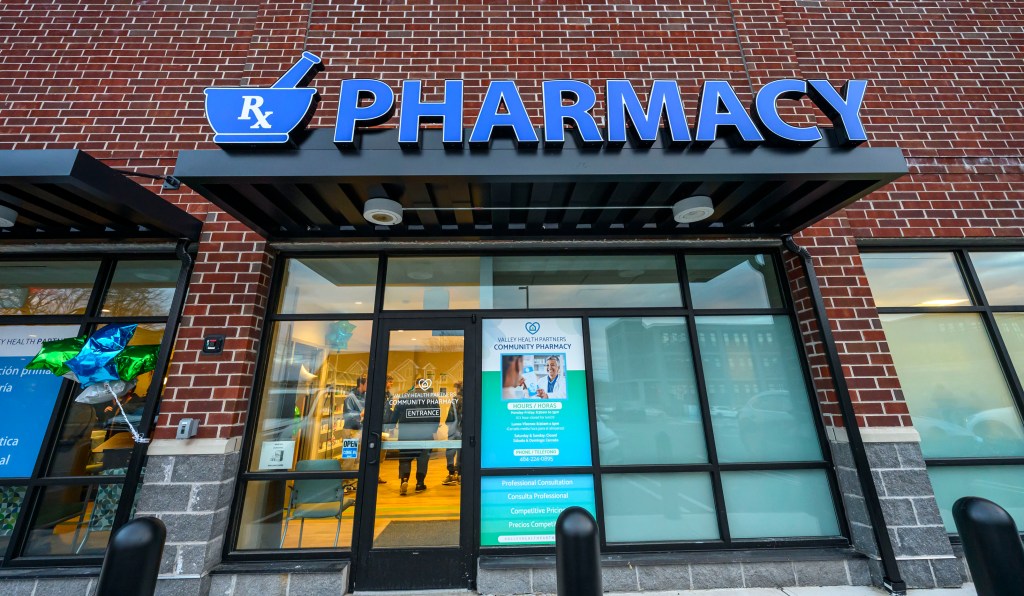
In March, the CVS at 620 Old Philadelphia Road, the only pharmacy in South Side Easton, closed.
After more than 10 months without a pharmacy serving the neighborhood, residents finally have one again. Nonprofit health care organization Valley Health Partners opened a new pharmacy at its health center at 440 W. Lincoln St. on Thursday afternoon.
The opening of this new pharmacy comes as pharmacies nationwide continue to close.
Across the U.S., both major chains and small local pharmacies are closing. From 2020 to November 2025, about 1,100 pharmacies in Pennsylvania went out of business, according to Spotlight PA. Nearly half of those were operated by former major pharmacy chain Rite Aid, which finished closing all its stores in November.
A major factor behindthis trend has been pharmacy benefits managers — third-party companies that act as middlemen in the health care industry — mediating prescription drug costs among drug manufacturers, wholesalers, pharmacies and health insurance providers.
Though Pennsylvania passed a law in 2024 meant to support pharmacies, some lawmakers have called on Gov. Josh Shapiro to do more to hold pharmacy benefits managers accountable as more pharmacies close.
Victoria Elliot said that a new pharmacy of any type opening in the state doesn’t happen often.
“We have an increasing number of pharmacy deserts, entire census tracts where there are not pharmacies present,” said Elliot, CEO of the Pennsylvania Pharmacists Association. “We lost a lot of pharmacies; we were second to California, I believe, for Rite Aid locations. When Rite Aid closed, not just rural, but also urban communities lost some of their only pharmacies. And some people who live in those communities may not have reliable transportation to get to those pharmacies or may struggle transferring their medications to another one.”
The Easton location isn’t the only pharmacy that Valley Health Partners has opened, according to Jennifer Cicconetti, chief of pharmacy for Valley Health Partners. Cicconetti said the organization also opened one at their center at 400 N. 17th St. in Allentown, though that is only for its patients.
Cicconetti said Valley Health Partners’ Easton health center was opened with a pharmacy in mind, but after the closure of the CVS, there was a realization it would need to be expanded beyond the original scope to serve the entire community.
“It takes a lot of legwork. There’s a lot of licensing and contracting with third-party payers for insurance and things like that; it’s very complicated,” Cicconetti said.
At the same time, Elliot said that pharmacies such as Valley Health Partners’ — operated by what are considered by the government as federally qualified health center look-alikes — have advantages. They receive Medicaid and Medicare reimbursements, as well as certain discounts through federal programs that for-profit pharmacies can’t access. She said this is why these centers are able to open and stay open while many pharmacies struggle to get paid fairly for the costs of medicines or the time it takes to prepare them.
These health centers and some nonprofit health systems are increasingly looking to fill the growing gaps in pharmacies by opening their pharmacy services to the public-facing side.
Cicconetti said that Valley Health Partners is passing many benefits on to patients. While anyone is welcome to use the pharmacy the health system offers its patients free home delivery and even has a subsidy plan that allows them to buy medications at a lower cost than they could have otherwise. Because of this, patients also pay lower costs and, in some cases, may pay nothing at all for medications.
Though this pharmacy is nowhere near the size of an average CVS or Walgreens, it does have a few shelves of over-the-counter medications and supplies that are now harder to find in the community. Cicconetti said more items could be added in the future based on community feedback.
Amanda Valerio, Valley Health Partners’ chief operating officer, said the pharmacy is core to their mission of providing all-encompassing care to patients. She said her organization is one of more than 1,500 health center look-alikes in the U.S., which serve 10% of Americans. She said they offer not just medical, behavioral health, dental, vision and chiropractic care, but also wrap-around services and support like care coordination, transportation assistance and help with navigating insurance.
“Here’s what I’ve learned,” Valerio said. “Every step we ask [of] our patients is a step where we risk losing them.”