
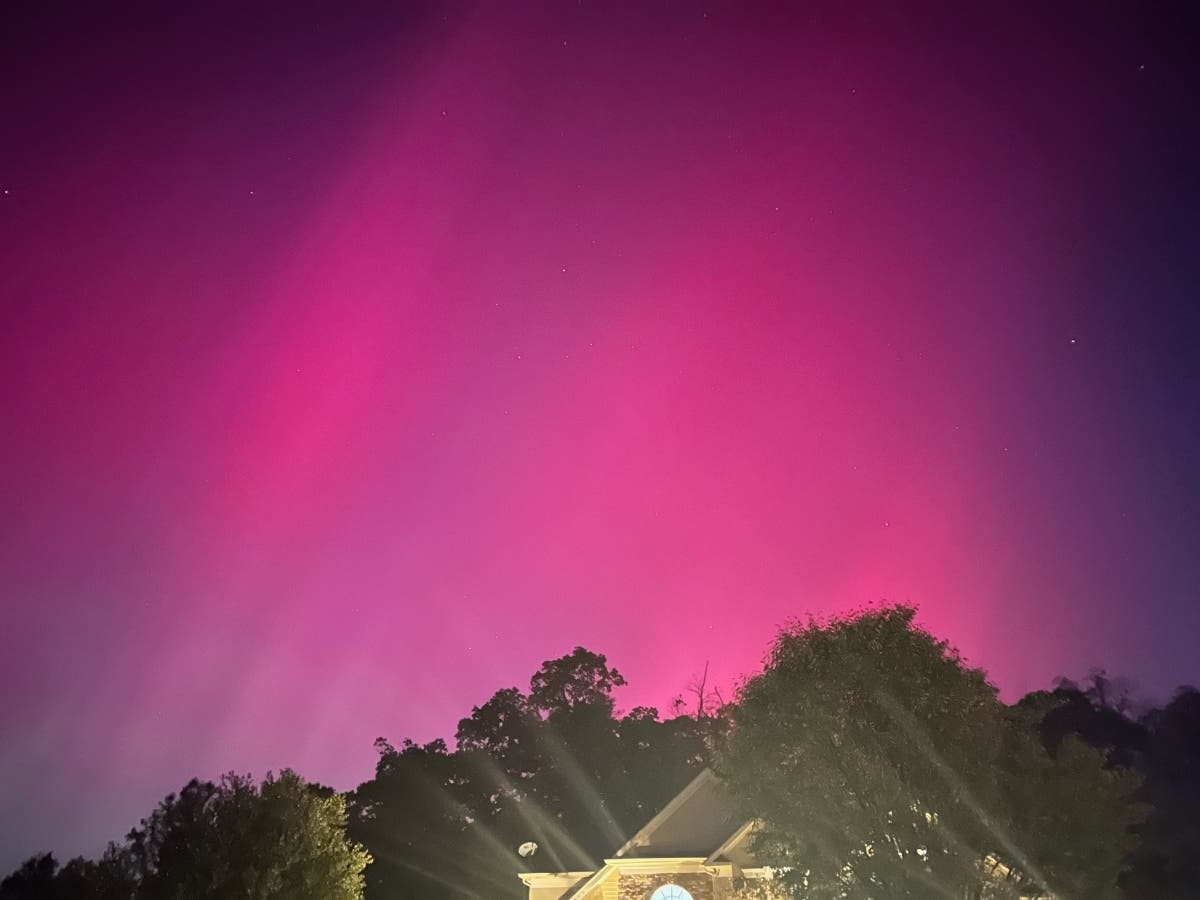
Residents across dozens of states, including Pennsylvania, may have an opportunity to view the Northern Lights Monday night due to a significant solar eruption that happened Sunday.
The sun released a powerful burst of charged particles, known as a coronal mass ejection. This cloud of particles is projected to reach Earth on Monday night or early Tuesday. When these particles interact with Earth’s magnetic field, they have the chance of creating vibrant aurora displays.
NOAA’s Space Weather Prediction Center has issued a “Severe” geomagnetic storm watch for Monday night. The event is anticipated to reach a level 4 out of 5 on NOAA’s space weather scale. Such a rating indicates a strong potential for widespread aurora visibility.
According to NOAA, areas as far south as Alabama and Northern California might be able to observe the aurora during the peak. In regions even further south, cameras may be capable of capturing faint colors, even if the lights are not easily discernible to the naked eye.
Forecasters say this represents one of the best opportunities in several months to witness the natural phenomenon.
While it will be very cold, skies in the Philadelphia region will be clear on Monday night into Tuesday morning, the National Weather Service predicts.
The chance to see auroras is likely to be a one-night event, although it could linger into Tuesday night in parts of Canada and the far northern U.S., AccuWeather said.