
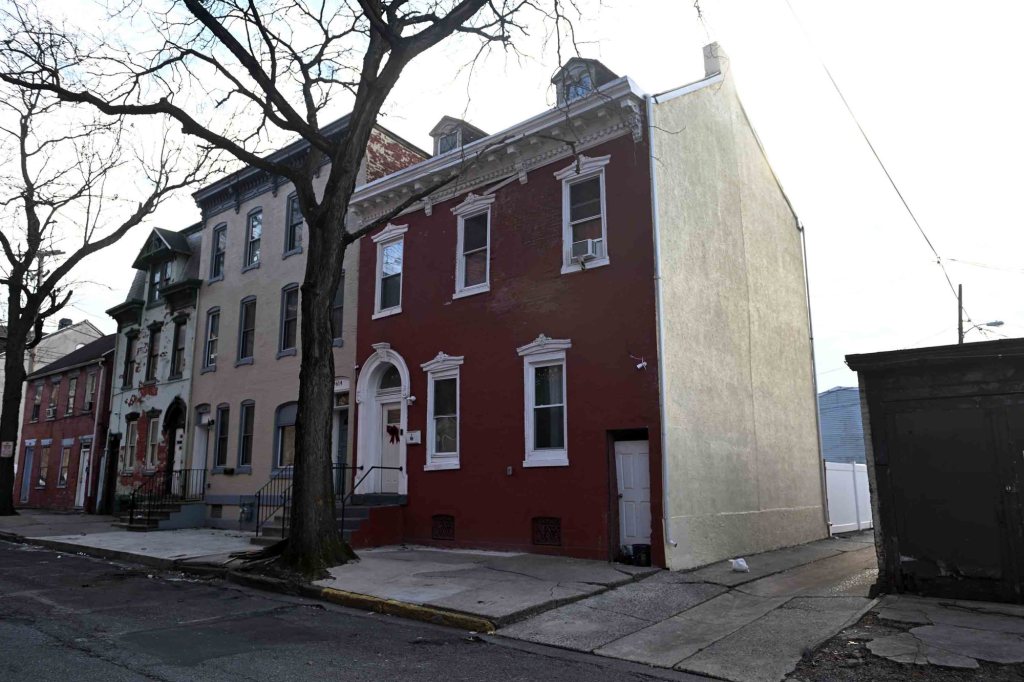
Reading’s director of community development says the city is making advances in its fight against blight, but it’s a fight the city cannot win alone.
Property owners, developers and neighborhoods all play critical roles in reducing blight, said David Barr, who was named director in June.
“It’s not entirely the city’s responsibility,” he said. “The owner is primarily responsible for fixing their properties.”
The good news, Barr said in a recent interview, is the growing number of properties coming off the blighted property list because owners are making repairs.
“We don’t talk enough about the properties removed from that status due to efforts by owners to renovate,” he said.
Barr said 11 properties were removed from the list in December after improvements were completed.
But there is work to be done.
As of mid-January, the city had 289 properties in its blight pipeline, he said. Of those, 46 are certified as blighted, a designation that allows the Reading Redevelopment Authority to pursue acquisition through eminent domain.
Under city code and state law, properties may be deemed blighted if they meet one of 12 criteria, including being unfit for human habitation, posing fire hazards, lacking utilities, code noncompliant or carrying excessive municipal liens.
Properties must also be vacant to be certified for potential acquisition by the redevelopment authority.
Barr outlined the city’s blight strategy, pointing to the steady progress made since City Council approved a comprehensive housing and blight strategy in 2019.
The city, he said, is focusing on education and tightening enforcement while also removing loopholes that allowed blighted properties to cycle through sales without meaningful improvement.
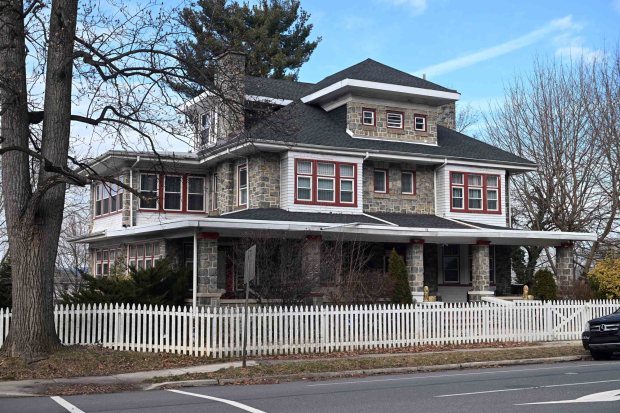 Reading officials say there are a growing number of properties, like this one at 1400 Hampden Blvd., that are coming off the blighted property list because owners are making repairs. (BILL UHRICH/READING EAGLE)
For example, council recently approved changes requiring blight declarations to be filed with the Berks County recorder of deeds, ensuring the status follows a property when it changes hands.
The city also has disqualified habitual offenders from bidding at county tax sales, reorganized its code enforcement staff into districts and resumed all-hands neighborhood sweeps in targeted areas, such as south Reading, Cotton Street, Perkiomen Avenue and Chestnut Street.
The goal, Barr said, is to change the stance of property owners from “I’m going to ignore you,” to “How much time do I have to get my property into compliance.”
In partnership with Alvernia University, the city also is exploring the emerging technologies, including using artificial intelligence-enabled cameras to spot code violations and quality-of-life issues, such as trash, abandoned vehicles and overgrown grass. Integrated software would produce a report that could be followed up by one of the city’s code enforcement officers.
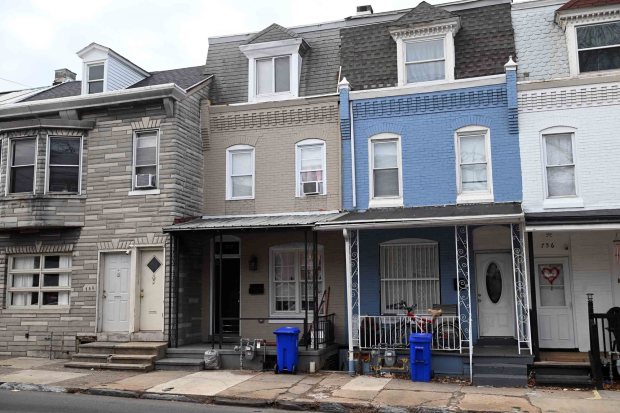 The home at 752 Schuylkill Ave. is one of the formerly blighted properties in Reading that has been rehabilitated, according to officials. (BILL UHRICH/READING EAGLE)
Beginning this year, the city reinstated presale code inspections for all properties, including owner-occupied homes, a practice Barr said will help prevent buyers from unknowingly inheriting serious code violations that can later lead to vacancy and blight.
A major shift also is underway with the Reading Redevelopment Authority board, which recently regained a quorum of members after several years of inactivity. The reorganized authority, he said, is motivated and prepared to move forward with redevelopment efforts, including condemnation of blighted properties.
“Now that the RRA has a quorum, it can proceed with the eminent domain process,” he said.
Barr and City Managing Director Jack Gombach said the authority’s work is intended to complement private investment rather than replace it.
Both rejected the idea that blight reduction depends on a large developer swooping into Reading and completing multiple adaptive reuse and development projects.
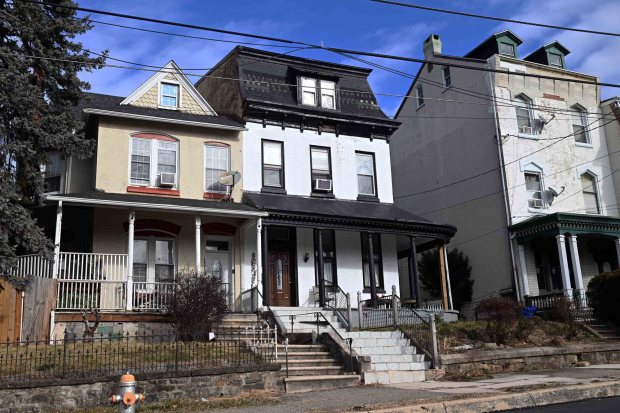 The home at 1321 Mineral Spring Road is one of the formerly blighted properties in Reading that has been rehabilitated, officials said. (BILL UHRICH/READING EAGLE)
“There’s this misconception, that there’s a lack of (local) developer talent,” Gombach said.
In reality, he said, revitalization in the city has been driven largely by local investors, small developers and homeowners reinvesting in their own properties and neighborhoods.
“It’s organic, it’s grassroots,” he said. “It’s local people investing in their own community,” he said.
Barr echoed that message, noting that many of the properties removed from the blight list were addressed by owners who did not wait for city intervention.
“We want to encourage that,” he said.
Property owners should budget 3% to 5% of a property’s value annually for maintenance, he noted, with older homes requiring even more attention.
Neighborhoods also have a role, Barr said, from encouraging basic upkeep to reinforcing shared standards.
Gombach said that long-term progress depends on community participation as much as policy.
Residents and property owners must become involved in fighting blight, fostering development and helping to advance the city economically, he said.
“They have to roll up their sleeves and get in with the city to make it happen,” he said.