
The new year in Pennsylvania brought with it a rarity in local government: the consolidation of two municipalities. This happened when DuBois and Sandy Township — both located in rural Clearfield County — completed a consolidation effort this month that was approved by voters in 2021.
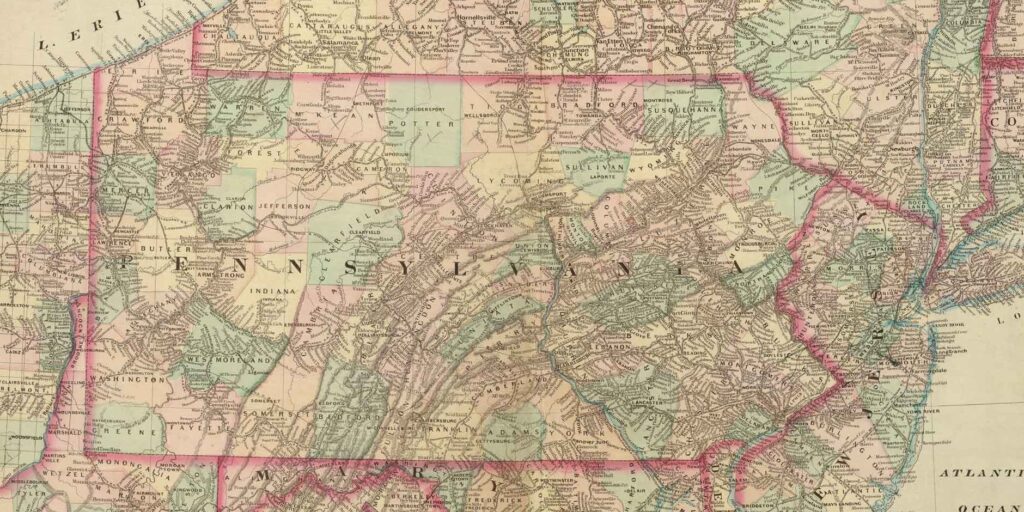
The case for municipal mergers and consolidations stems from the fact that Pennsylvania has one of the densest networks of local government in the country. To get a sense of this, Pennsylvania has 2,555 townships, boroughs, and cities. This is before you add on the dozens of counties, hundreds of school districts, and thousands of municipal authorities.
Many municipalities, particularly low population ones, lack the resources and people to effectively run a government. Pennsylvania’s current system requires tens of thousands of locally elected or appointed officials. These positions are frequently vacant.
To highlight this point, there are nearly 800 municipalities with populations fewer than 1,000 and nearly 60 percent of all municipalities in Pennsylvania have a population fewer than 2,500.
Low population municipalities are often clustered together. An online map demonstrates the extent of this. For instance, Potter County, located in the north-central part of Pennsylvania, has a collection of five townships in its southeast corner that have a combined total population of less than 1,000.
A possible retort is that these municipalities exist in name only, so what’s the harm? By that same logic, though, what’s the harm in consolidating them? After all, being a municipality comes with certain legal obligations that cannot be avoided without running afoul of the law. Having a municipality exist in name only is not a possibility, practically or legally.
There are other compelling reasons why Pennsylvania’s dense patchwork of small, resource-poor municipalities is a liability.
Economic development and infrastructure projects become more costly and time-consuming when they must coordinate across multiple jurisdictions, often with competing priorities and different rules and permitting processes. Many federal grants also require local matching funds, which small municipalities frequently lack. This means their residents are unable to access federal dollars that would otherwise flow to their communities. At the same time, clustered units of government often duplicate administrative functions and services across small geographic areas, driving up per-capita costs without delivering better outcomes.
The list goes on.
The only way to address the issue is for the Pennsylvania General Assembly to act. Before detailing the options available to Harrisburg, it is necessary to understand the current law. A consolidation combines two or more municipalities to create an entirely new municipality, while a merger is where one municipality absorbs another. Municipal consolidations and mergers may occur through two main legal mechanisms. Each reveals the flaws in the current system.
The first method allows the governing bodies of each municipality to enter into a joint agreement to begin the consolidation or merger. This agreement must contain the expected bureaucratic necessities, such as how assets should be managed and tax codes synchronized. It must also describe the structure of the government of the consolidated or merged municipalities. The law also recommends that a transition planning committee be formed to study and make recommendations to the existing governing bodies on how to proceed with the consolidation or merger. After these steps are taken, the residents of the municipalities vote via referendum to approve or reject the proposed consolidation or merger. A simple majority in each participating municipality is required to approve the referendum.
This first mechanism suffers from two shortcomings. First, it requires elected officials to vote for something that may destroy their positions. This disincentivizes elected officials from even entertaining the idea of municipal consolidations and mergers. Second, as discussed earlier, many low-population municipalities, which would benefit the most from consolidations and mergers, struggle to fill elected positions. This means these communities lack the ability to govern themselves, let alone undertake such a monumental task.
The second path to municipal consolidations and mergers is via resident petitions, which sidesteps local elected officials. This avoids the first problem outlined above. However, for a consolidation or merger petition to succeed, it must include signatures from at least five percent of those who voted for governor in the last general election in each municipality involved.
This theoretically is a low hurdle, but it runs into the second issue: many communities that would benefit from consolidations or mergers lack the residents to make this viable. To complicate matters, residents in rural communities are spread over large geographic areas, making the process of gathering signatures more difficult. Additionally, pursuing a municipal consolidation or merger via resident petition is a legalistic process, which will dissuade otherwise enterprising residents.
If municipal consolidations and mergers still don’t seem like that much of a hurdle, just look at recent history. An analysis by Spotlight PA in May 2024 found that since the current law took effect in 1994, seventeen mergers had been proposed, with eleven approved by voters, while only two of thirteen consolidation initiatives had been approved by voters. The completion of the DuBois–Sandy Township consolidation means that only three consolidations have succeeded in more than three decades.
What reforms could the Pennsylvania General Assembly undertake to make municipal consolidations and mergers easier? There are a few options.
One possibility could involve the state representatives and senators. These elected officials could propose consolidations and mergers for municipalities that fall within their districts. If all representatives and senators for the municipalities in question agree, that could trigger a referendum on the matter to be held in those municipalities. The main issue with this recommendation is that state representatives and senators may be unwilling to take on the political risks.
Another option is to simply make the process less daunting to municipal officials and residents. To do this, grants could be offered to municipalities interested in studying and implementing a consolidation or merger in their communities.
If two or more municipalities are interested in exploring the possibility of a consolidation or merger, the elected officials of the municipalities can apply for this grant, which would allow them to bring in a team of experts to study the idea and make proposals.
In essence, this simply moves the requirement to perform certain bureaucratic tasks, such as how to combine assets and standardize the tax codes, up in the process while offloading some of those responsibilities to a specialized team. That way some of the thorny issues inherent to municipal consolidations and mergers can be resolved before voting takes place. This fixes the issue of asking residents to approve of a municipal consolidation or merger before the details are known.
This isn’t a novel idea. The Pennsylvania Department of Community and Economic Development currently oversees the Strategic Management Planning Program, which “provides matching grant funds to assist municipalities experiencing fiscal difficulties to develop comprehensive multi-year financial plans and establish short- and long-term financial objectives.” Something similar could be created for municipal consolidations and mergers.
Other worthwhile ideas have been proposed, such as allowing municipalities to dissolve while transferring their responsibilities to county government. This plan is unlikely to succeed in most parts of Pennsylvania, because county government essentially functions as an extension of state government and the judicial system. Meanwhile, municipal government is responsible for many day-to-day services, such as infrastructure maintenance, police and fire protection, and parks and recreation.
The current proposal, though, would only allow municipal dissolution in Allegheny County, which has a unique system of county government that operates under a home rule charter. This idea should be extended to other home rule counties.
The consolidation of DuBois and Sandy Township is notable simply because it is so exceptional. Hopefully such local government innovations in Pennsylvania will become so common that they warrant little notice beyond the communities involved. While seemingly minor, this would help the state improve its competitiveness nationally. But to do this, Pennsylvanians and their representatives need to think creatively.
Seth Higgins is a native of Saint Marys, Pennsylvania. He currently resides in Philadelphia.