
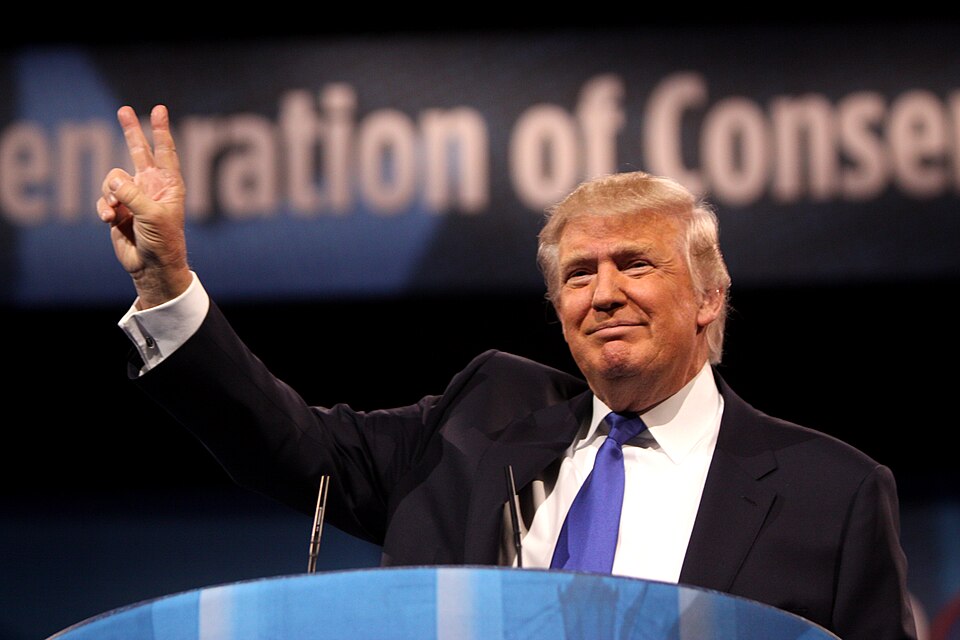
Tuesday, Jan. 20, 2026, will mark President Donald Trump’s first year in office for his second term.
Over the past year, Trump and his administration have made a string of highly controversial policy decisions. Compared to his first term, Trump has enacted harsher policies on immigration, tariffs and foreign affairs, drawing criticism.
Protests in the U.S. were up 133% in 2025 compared to 2017, the first year of Trump’s first presidency. In June 2025, the No Kings protests became one of the largest single-day protests in recent U.S. history. More recently, there have been nationwide anti-ICE protests in response to Trump’s immigration enforcement and ICE presence in major cities, including Portland and Minneapolis.
Paul Johnson, an associate professor in the Department of Communication, explained how Trump’s increasing ability to deport immigrants to foreign countries is because of shifts in immigration enforcement norms. Along with the change in enforcement, the Trump administration has restricted the distribution of new student visas and terminated existing visas, prohibiting access to the United States for some.
“For a long time, [there was] a kind of modus vivendi that [has] been established with regards to the charges that you could receive if you were a person here without a proper legal authorization — that right has been basically abolished.” Johnson said. “Even before that, [they] have been cracking down on all kinds of visas, so they’re just making it harder for people to come here through the legal channels too.”
Lou Glatt, a sophomore biology major, has experienced the Trump administration’s change in immigration policy. She said her neighborhood back home has been “ripped apart” by Immigration Customs Enforcement officers, leaving her feeling powerless.
“I’m from Minneapolis. My neighborhood and all neighboring neighborhoods are being ripped apart right now, families and everything,” Glatt said. “A lady I work with, she got deported by ICE at her other job, and it’s just scary to see all this happening. It feels helpless. Even though I know there are things that [the people who want to make a difference] can do to show support, we don’t have the power to change what we want to change.”
Glatt described President Trump’s first year back in office as “scary.”
“I say that because a lot of people from my community just aren’t safe,” Glatt said. “A lot of people are being ripped away from their home.”
Jalynn Braxton, a sophomore digital communications major, said the past year has been “exhausting.”
“I feel like we just hear so many new news stories every day, and it’s so hard to keep up with everything changing so fast with the government,” Bratt said. ”It’s just so hard to hear everything that’s happening. It’s very exhausting to hear.”
Johnson said, overall, the policies and decisions of the Trump administration are not very popular.
“The issue of the border crisis [in] 2024, both parties agreed, [was a] huge issue,” Johnson said. “Now that people see what they meant when they said ‘border crisis,’ which was abducting their friends and family members and hauling them off to some prison in a foreign country, they don’t actually like that very much.”
Similarly, most Americans disapprove of the Trump administration’s tariffs, amongst other policies.
“Approval for the tariffs is actually pretty low, because you’re starting to see inflation creep into lots of different things,” Johnson said. “It’s definitely not popular legitimacy, because what they’re doing is, by and large, very unpopular.”
Johnson offered insight into how the Trump administration has been able to change policies so drastically in such a short period of time, despite the administration’s lack of public support.
“I think [there are] two factors — one is spectacle,” Johnson said. “They’re very good at using social media to kind of produce an image of themselves as powerful. This is why ICE will pump out videos on social media, clips of people being detained and thrown into a plane and sent away. Fear is a big part of it, too. Fear and a combination of opportunity.”
Nolan Blaze, a sophomore nursing student, does not think Trump’s second term is going very well. He thinks the administration is focusing too heavily on what he sees as “non-major” issues, such as immigration.
“I’m not very happy with how it’s been going. I think there’s just been a lot of focus on non-issues that are very polarizing and just aren’t helpful to moving the country forward,” Blaze said. “A lot of them are ICE deportations, especially when it comes to the fact that the majority of the people that he’s deporting are not criminals, let alone violent criminals, or have convictions in any way.”
Blaze would prefer the administration to focus more on the economy and lowering costs.
“Housing is more expensive than ever, groceries are more expensive than ever, tuition is more expensive than ever,” Blaze said. “The wages that people are making aren’t keeping up with that.”
Jesse Milston, vice president of College Republicans at Pitt and junior political science major, said Trump’s first year back in office is off to a good start.
“The term is going very well,” Milston said. “He’s been acting on things he clearly promised he would during the campaign. More than half of what was promised in the campaign platform sheet was focused on in the [One Big Beautiful Bill Act] alone. He’s closed the border, reordered our trade, lowered taxes and has run a phenomenal foreign affairs plan.”
Gianni Davis, a first-year majoring in psychology, said while they aren’t a fan of the administration, they are not surprised by the actions Trump’s team has taken so far.
“I don’t think any of it’s going well — it’s going how I expected it to go,” Davis said. “The economy hasn’t improved, really at all, since Biden’s term. When [Trump] got into office and he passed those [tariffs], prices started going up in pretty much every capacity.”
Chilota Udeani, a first-year studying political science, said Trump and his second-term administration have motivated her to get more involved in politics and make her voice heard.
“I am getting more involved, especially since I have turned 18,” Udeani said. “Last year was the very first time I voted. Even though it was a small election, I did feel like my voice was getting heard. And I was at an ICE protest. [I’m] trying to get involved more, and trying to know [what] is happening, and do something about it.”
Olivia Pinocci-Wrightsman, president of College Democrats at Pitt and a senior studying political science, said they have also seen an increase in membership. However, she acknowledged that there are now more obstacles that may keep people from getting involved.
“We’ve definitely seen an increase in club membership, but I don’t think that’s representative necessarily of every student,” Pinocci-Wrightsman said. “I think some people see [current political events] and they become extraordinarily motivated to be involved in their communities. On the other hand, some people just feel so hopeless and they feel like their decisions don’t matter anymore. And in an even worse circumstance, they feel that it’s not safe for them to partake in the ways they used to.”
Gabrielle Oliver, a first-year studying law, criminal justice and society, said she is taking a step back from politics because of how “scary” headlines have been under Trump’s second administration.
“[I’m] moving away [from politics], which is sad to say because I would like to be more educated on politics,” Oliver said. “That’s something I’ve always felt deeply about, but now that he is in office [with] all of these 24/7 news articles — it’s scary to see all the time. So I’d say I’m keeping myself educated, but not reading it all the time, just to keep my peace.”