
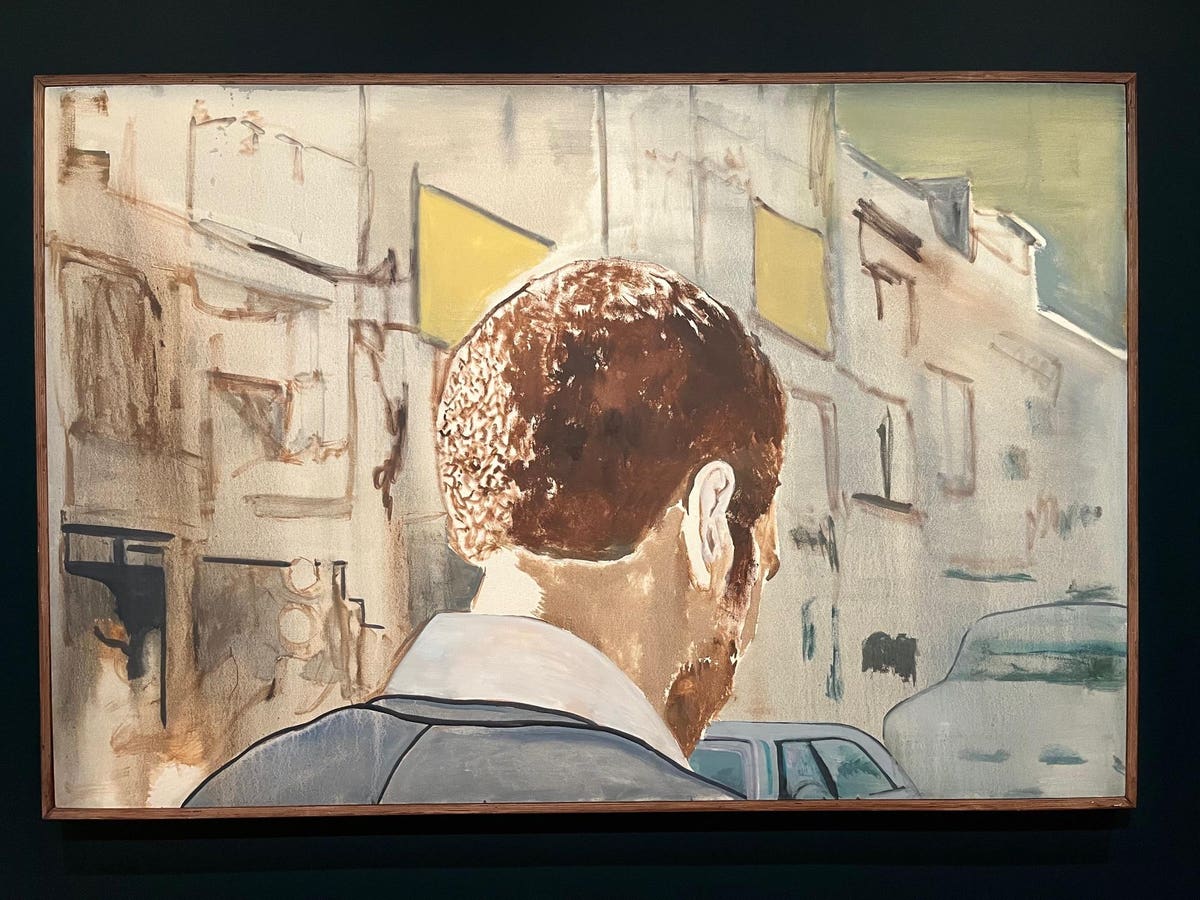
Noah Davis, ‘1975 (1), 2013. Oil on canvas. Private collections.
Chadd Scott
A warm sun shines on the man’s back. At least for now. Tomorrow, who knows? Life in America for young Black men is nothing if not uncertain, to put it kindly.
He walks with his head down, shoulders slightly slumped, as if carrying a weight–weight both real and unseen. A burden. The baseless blames for a nation’s problems. The scapegoat.
Noah Davis was 30 years old when he painted 1975 (1), one of a series of paintings based on photographs his mother took in college between 1977 and 1980. 1975 was when she first became interested in photography.
Davis had two more years to live. Cancer.
What about the protagonist of 1975 (1), who could have been Davis himself? How much longer did he have? Would he grow old and take grandkids to Dodgers’ games? Would a racist cop murder him later that afternoon in a traffic stop?
Noah Davis paintings look into Black life in America, not at it. Regular Black folks. Lots of young people. Like himself. Not rich, not poor, not hustling, not struggling. Just living.
Like the neighborhood kids playing at the community pool, also from his 1975 series, a stop-you-in-your-tracks, sincere, insightful, nostalgic slice of life from before kids were on their devices all day, kids turned loose by parents to have fun and make friends IRL.
Davis was also a committed student of art history from ancient Egypt to “Hood Rothko’s,” a hysterical expression of his own creation. His 1975 bathers now hang one floor above the most famous bathers in painting, Paul Cézanne’s; “Noah Davis” opens January 24 and remains on view through April 26, 2026, at the Philadelphia Art Museum, the last stop in a gorgeous, melancholy retrospective that traveled to Potsdam, Germany, London, England, and Los Angeles, California, where Davis passed.
Davis had no connection to Philadelphia other than his talent. His paintings—his bathers—belong here, under the same roof as Cézanne’s bathers and Van Gogh’s sunflowers and Diego Rivera’s frescos. They’re that good. As good as anything. And rare.
Because Davis died so young, he was unable to paint hundreds of artworks and see them distributed to museum collections around the world. Much of what’s on view in Philadelphia comes from private collections. See them now or see them never, perhaps.
See them now.
Noah Davis Paintings
Noah Davis, ‘1975 (8),’ 2013. Oil on canvas in artist’s frame. Private collection © The Estate of Noah Davis. Courtesy The Estate of Noah Davis and David Zwirner.
Photo: Kerry McFate; © David Zwirner
Where bathers are an art historical standard, 1990s daytime trash TV talk shows were not a topic picked up by master painters before Davis.
On view adjacent to his “1975” paintings is another series, calling out the daily mockery Black people faced on Maury, Ricki Lake, and The Jerry Springer Show. Black people as laughingstock, caricature. Paternity test reveals and stepfathers sexually attracted to stepdaughters. Black people cast and produced to look stupid and foolish as standard operating procedure. Bigotry for ratings.
Davis could paint with tenderness or bring the hammer.
He painted housing projects, not as places of violence and decay, but as places of potential. He painted his father, Keven Davis. Noah Davis had just become a father himself when dad was diagnosed with terminal cancer. He painted Black excellence, architect Paul Revere Williams, who built over 3,000 buildings in Los Angeles between the 1920s and 1970s when architects were almost exclusively white and the city was still racially segregated.
All appear in “Noah Davis,” a survey bringing together over 60 works across painting, sculpture, works on paper, and curating completed between 2007 and his death in 2015.
The Missing Link
Portrait of Noah Davis.
Patrick O’Brian Smith
Painting alone would never be enough to produce the change Davis sought. He wanted to author an alternate canon of art history, a canon recognizing historically overlooked artists, and make their artwork available to all.
In 2012, he and his wife, fellow artist Karon Davis, co-founded the Underground Museum with a small inheritance left to Noah by his father. The money was expressly intended for fostering community and joy. The couple used it to convert three storefronts in the historically Black and Latinx neighborhood of Arlington Heights, Los Angeles into a free cultural center.
Davis had been pondering an absence he felt, a hole, a missing link. Space for the people around him to feel recognized and gather. An exhibition titled “The Missing Link” opened in L.A. in February 2013. Paintings from that show and series appear in the survey.
Community, togetherness, society. Places of recreation and culture and music and joy and friendship. Places like community swimming pools and housing projects. Places like the Underground Museum.
Carrying on without Davis proved too much and the Museum closed in 2022. Some people, you can’t replace.
Philadelphia Art Openings And Closings
Noah Davis, ‘Untitled,’ 2015. Oil on canvas. The Museum of Modern Art, New York. Gift of Marie – Josée and Henry R. Kravis in honor of Jerry Speyer’s 80th birthday, 2020.
© David Zwirner
The art gods giveth and they taketh away. While Philadelphia welcomes the opening of “Noah Davis” and Susan Kleckner at Haverford College, previewed previously by Forbes.com, it prepares to say goodbye to a pair of landmark special exhibitions premiered in the fall.
Across a grand atrium from where Davis’ paintings are presented, PhAM displays “Dreamworld: Surrealism at 100,” a major exhibition celebrating the centenary of the Surrealist movement through February 16. The final stop in an ambitious tour organized with the Centre Pompidou in Paris—and the sole venue in the United States—the exhibition features important works from the movement’s key figures including Frida Kahlo and Salvador Dalí.
The Barnes Foundation, a half mile down Benjamin Franklin Parkway from PhAM, presents “Henri Rousseau: A Painter’s Secrets” through February 22. The landmark exhibition features paintings from the Barnes’ collection and museums around the world, including the Museum of Modern Art’s The Sleeping Gypsy (1897), one of the most famous paintings in art history and a crown jewel of MoMA’s collection rarely loaned. For the first time ever, three of Rousseau’s major works will appear in the same space: The Sleeping Gypsy, Unpleasant Surprise (1899–1901, the Barnes), and The Snake Charmer (1907, Musée d’Orsay, Paris). Not even the artist himself witnessed this grouping; by the time he made The Snake Charmer, The Sleeping Gypsy was no longer in his possession.
Fortunately, more time remains to see the spectacular display of Ruth E. Carter’s movie costume designs at Philly’s African American Museum. “Ruth E. Carter: Afrofuturism in Costume Design” stays on view through September 6th, 2026, with unforgettable wardrobes created by Carter for movies including “Do the Right Thing,” “Malcom X,” “Amistad,” “Selma,” “Black Panther,” and “Sinners.”
Philadelphia’s African American Museum, where history is shared, stands two blocks from Independence National Historical Park, where history has been erased by the Trump regime.
More From ForbesForbesPioneering Feminist Artist Susan Kleckner Receives First Comprehensive RetrospectiveBy Chadd ScottForbesPhilly Is The Champ This Fall For ArtsBy Chadd ScottForbesWhat Are Confederate Monuments Doing In Los Angeles?By Chadd Scott