
I don’t remember if or when the temperature where I live was ever minus 7 degrees, but that’s how cold it was one morning this past week. The rhododendron leaves were so curled up that they looked like pencils. And more bitter cold and snow were in the weekend’s forecast.
There were animal tracks all over the snow in the fields and yard. Most of them were from white-tailed deer. But there were also feral cat prints and ones from the dog family, almost certainly made by coyotes. A lot of them went right to the heated bird baths that we’ve had to refill most recent mornings.
With the frigid weather and snow there was an incredible amount of activity at the bird feeders and on the millet and cracked corn that we throw out on the ground during the winter. And I was paying extra attention to all of this because of the Winter Finch Forecast that came out last fall.
Every year around the end of September, an ornithologist from Canada evaluates cone and other food crops up there and connects them to the bird species that eat them during the winter. And the winter of 2025-26 was predicted to be a huge irruption year for northern species.
What’s an irruption? It’s a phenomenon where “widespread crop failures force birds to seek food elsewhere,” the National Audubon Society says.
Tyler Hoag, a Canadian biologist/ecologist, is who’s doing this forecast now. He said that due to low cone and mast crops on trees like white and black spruces, alders, cherries, mountain ashes, and others, birders should expect to see northern finches and other northern species around here this winter.
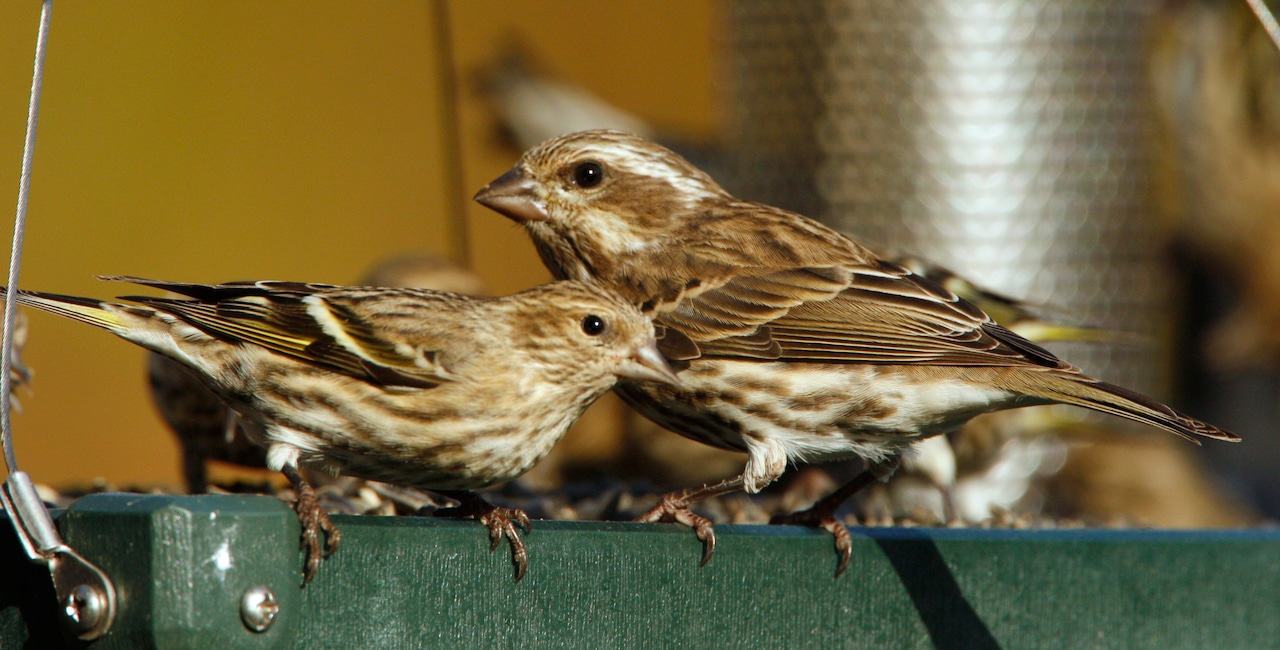
These species include, among others, pine siskins, redpolls, purple finches, evening and pine grosbeaks. So of course I’ve been looking for them since the cold weather arrived. But the only ones I‘ve seen until recently have been purple finches, although other people all over Pennsylvania and New Jersey have reported most of the other ones.
Thus, I got really excited one day around noon last week when David told me to quick come and look at a bird with yellow on it. I thought I’d finally see an evening grosbeak. But instead I found myself looking at an oriole.
At this time of the year, orioles are supposed to be in the extreme southern part of the country or in Central or South America, not around here. David first saw it at the peanut butter/lard mixture I put out on the deck posts in the back yard. But for the next several days it was in the front yard.
Normally in early April I put out an oriole feeder with oranges and grape jelly in it. But, because orioles start migrating south as early as late August, I bring it in at the end of September.
But because I got tired of just looking at the other feeders and this one’s bright orange, I put it back out in early December to remind me that someday spring will come again. Never in my wildest dreams did I think there’d be an oriole on it right now. But that’s where it mostly ate while it was here.
Seeing a Baltimore oriole eating suet and frozen grape jelly during a snowstorm was bizarre. So I was really relieved when it finally disappeared after four days.