
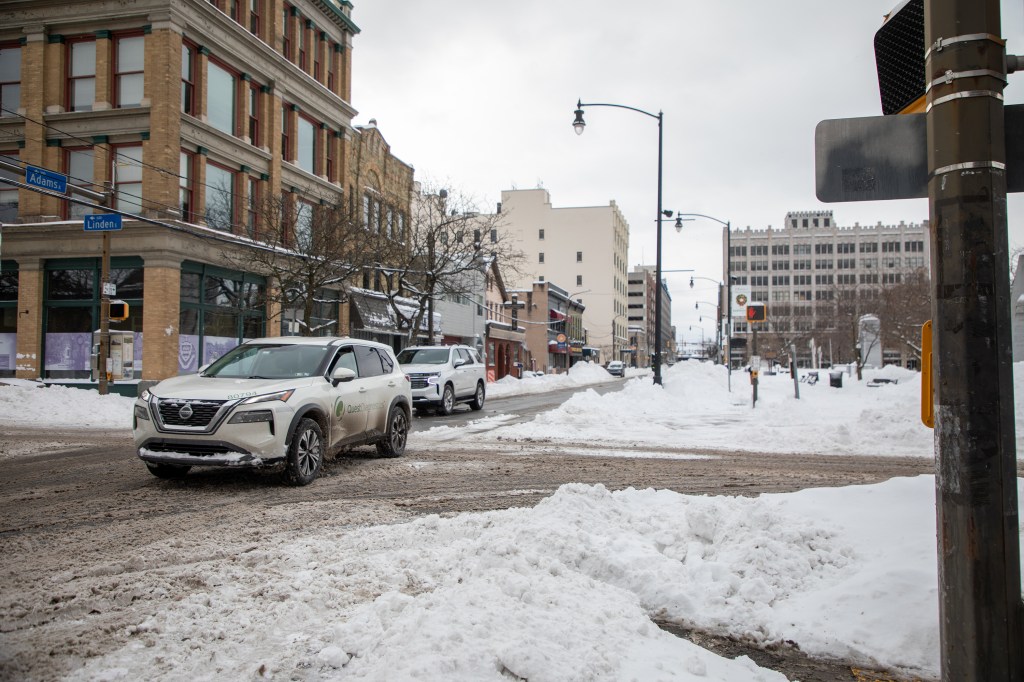
Residents across Northeastern Pennsylvania continued shoveling out Monday after a substantial winter storm Sunday dumped double-digit totals of deceptively dense snow on parts of the region, where accumulation ranged from almost a foot in some areas to local highs of about 20 inches in others.
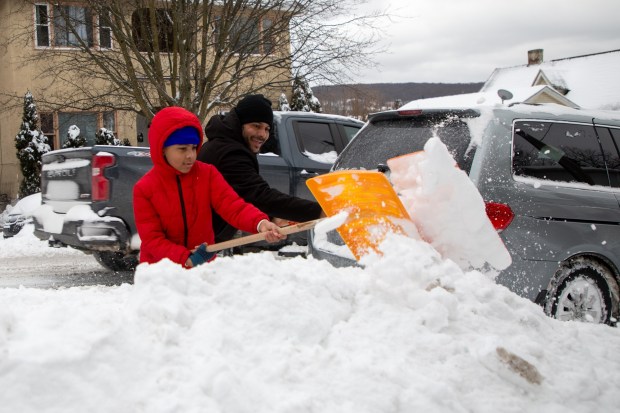 Francisco Tiburcio and his son Carlos Alberto shovel snow along Irving Ave. in Scranton on Monday, Jan. 26, 2026. (REBECCA PARTICKA/STAFF PHOTOGRAPHER)
Hawley in Wayne County and Rowland in Pike County both registered reported snow totals of 20 inches, while amounts elsewhere in the region generally ranged from about 12 to 17, Ben Lott, a meteorologist with the National Weather Service in Binghamton, New York, said Monday.
The most recent National Weather Service reports available for Lackawanna County as of Monday afternoon showed a slightly smaller range there, with about 14 inches of snow reported in the Vandling area as of Monday morning and about 12 and 10½ inches reported in Carbondale and about a mile south of Scranton, respectively, as of Sunday evening. Those amounts were reported at and slightly before 8 p.m., and may have increased somewhat thereafter. The Moosic area had seen about 8.9 inches as of 7:15 p.m. Sunday.
In Luzerne County, NWS reported highs of 17.3 inches of snow in Edwardsville and 17 inches in Freeland as of about midnight Sunday into Monday. High amounts in Wyoming and Susquehanna counties were reported in Factoryville,16.2 inches as of 4 p.m. Sunday, and New Milford, 16 inches as of 9:23 a.m. Monday.
The National Weather Service in State College reported 15 inches of snow in an area about 4 miles north-northeast of Shenandoah in Schuylkill County about 2:49 a.m. Monday. That was the highest amount it listed in the county as of Monday afternoon.
Generally speaking, Lott said the snow that blanketed the region seemed lighter as it fell than it actually was.
“From a lot of measurements that we’ve been getting from some of our reports, this was actually a fairly dense snow,” he said. “The flakes were quite small, so at the time when it was falling it seemed like a light snow, but now that once it settled it (is) kind of a heavy, dense snow. So our snow-to-liquid ratios were roughly like 10-to-1 from some of the reports that we’ve been getting.”
A snow-to-liquid ratio is essentially a measure of the moisture content of snow and can be used to gauge how light or heavy a particular snow event is, with a 10-to-1 ratio reflecting 10 inches of snow for every one inch of liquid water. A higher ratio means a lighter snow and vice versa.
“When I say 10-to-1, for every 10 inches of snow there would be roughly an inch of water equivalent to that, so if it was all rain it would just be an inch of rain,” Lott explained. “So when you have a lower ratio like that it’s typically a wetter snow, whereas if you have something like 20-to-1 or even 30-to-1 that’s usually your really drier, fluffier snow. But, like I mentioned, because the snow was smaller in flakes it had it seeming like it was a light snow when it really wasn’t.”
Heavier, denser snow makes for more difficult shoveling, with Lott and others advising those still digging out to hydrate well and take frequent breaks.
The American Heart Association urges caution when shoveling heavy snow, as doing so can increase one’s risk of a heart attack or sudden cardiac arrest, though that didn’t appear to be a pronounced problem locally as a result of Sunday’s storm.

Clay Ave. facing towards the University of Scranton in Scranton on Monday, Jan. 26, 2026. (REBECCA PARTICKA/STAFF PHOTOGRAPHER)

A plow truck pushes snow along Vine St. in Scranton on Monday, Jan. 26, 2026. (REBECCA PARTICKA/STAFF PHOTOGRAPHER)
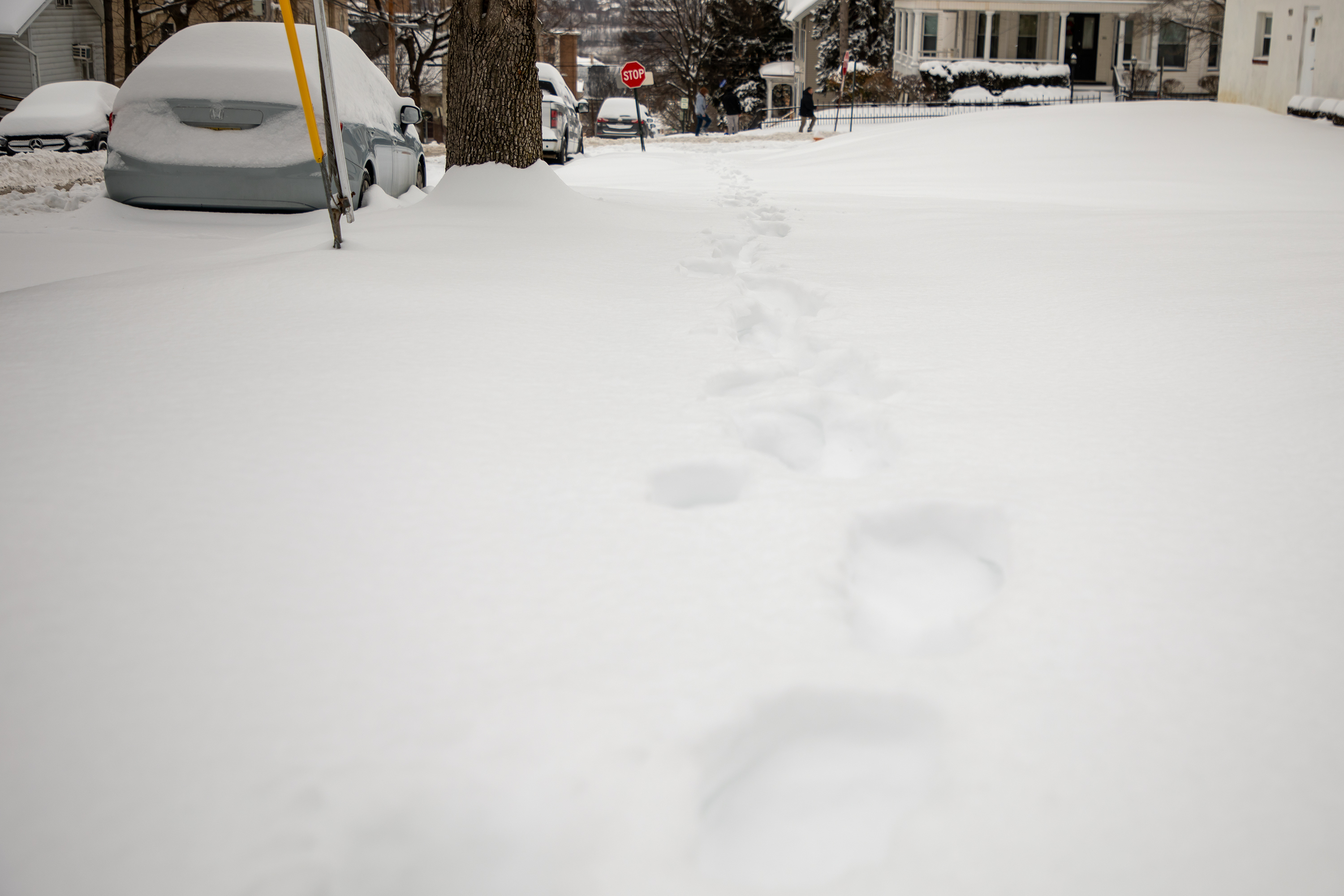
Footprints in a unplowed sidewalk near the corner of Vine St. and Madison Ave. in Scranton on Monday, Jan. 26, 2026. (REBECCA PARTICKA/STAFF PHOTOGRAPHER)
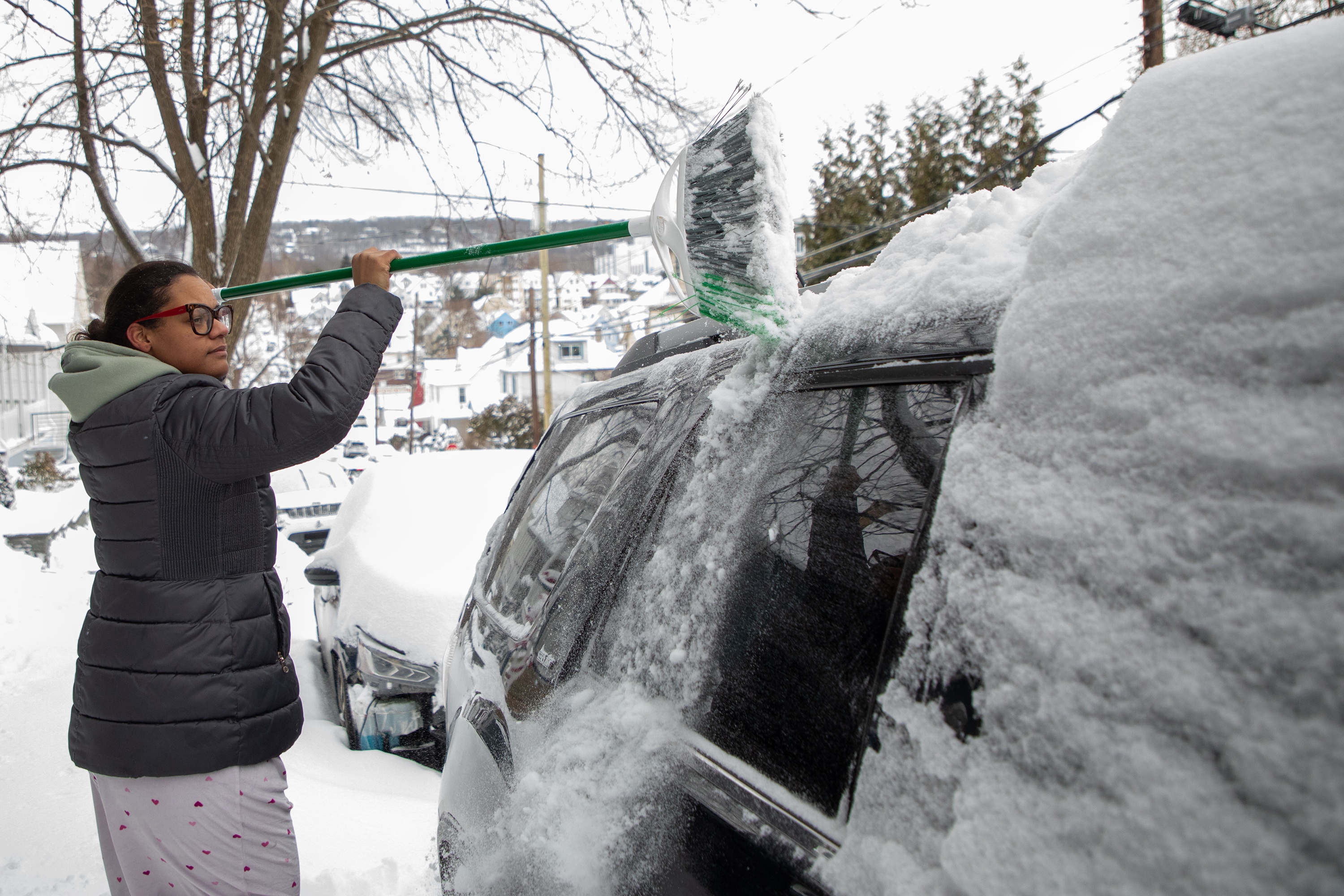
Freisi Colon cleans off her vehicle parked along Vine St. in Scranton on Monday, Jan. 26, 2026. (REBECCA PARTICKA/STAFF PHOTOGRAPHER)

Jerry Haley pushes a snowblower along the sidewalk of Irving Ave. in Scranton on Monday, Jan. 26, 2026. (REBECCA PARTICKA/STAFF PHOTOGRAPHER)
Show Caption
1 of 5
Clay Ave. facing towards the University of Scranton in Scranton on Monday, Jan. 26, 2026. (REBECCA PARTICKA/STAFF PHOTOGRAPHER)
Of the roughly 24 people that had presented at the emergency department of Geisinger Community Medical Center in Scranton with chest pain or cardiac-related issues since Friday, only one explicitly mentioned that they’d been shoveling snow, a Geisinger spokesman said Monday morning. Lehigh Valley Hospital in Dickson City did not experience anything of the sort, a spokeswoman said, and efforts to reach Commonwealth Health were unsuccessful.
Dr. Corey Goldberg, M.D., Geisinger’s regional medical director for emergency medicine in the northeast region who oversees Geisinger South Wilkes-Barre and Geisinger Wyoming Valley Medical Center in Plains Twp., said emergency department visits generally drop during winter storms.
“Whenever we see icy conditions or cold conditions we get those slip-and-fall injuries, also a little bit of frostbite,” he said. “During conditions like this the numbers of patients that come to the emergency department actually decrease significantly, so you still see those chest pain patients and you don’t know for sure if it’s from their activities of shoveling or not. Anecdotally, you do hear stories of patients coming in after shoveling and having chest pain, it’s kind of a classic story, but I can’t say that the numbers are more than what we normally see.”
But Goldberg did offer some broader advice, noting those with a history of heart problems or of being physically inactive should typically talk with their doctor before doing a physical activity like shoveling to make sure they can handle it.
“If you do, obviously you want to dress for the weather,” he said. “You should layer and not keep cotton directly against your body in case you sweat. That can get wet and cold. Keep your hands, keep your toes, keep your face covered since these can be prone to frostbite and pretty quickly. Certainly you’re going to want to stay hydrated, drink plenty of water prior and afterwards. You can even treat this as a workout, so you warm up beforehand — get loose, do some stretching.”
He also advised shoveling snow when it’s fresh, though it may be too late for that at this point, and to take frequent breaks.
Lott, the National Weather Service meteorologist, wasn’t immediately sure where the recent storm might rank among large snow events of the past.
“I don’t think this would equate to anything historical, however we haven’t seen anything quite this big or widespread in the last couple of years, especially not in Northeastern Pa.,” he said. “I wouldn’t say it’s anything unusual. We can certainly see storms like this during the winter season. Even though we haven’t seen anything like this in the last couple years, it is kind of a good reminder that these type of systems do occur.”