
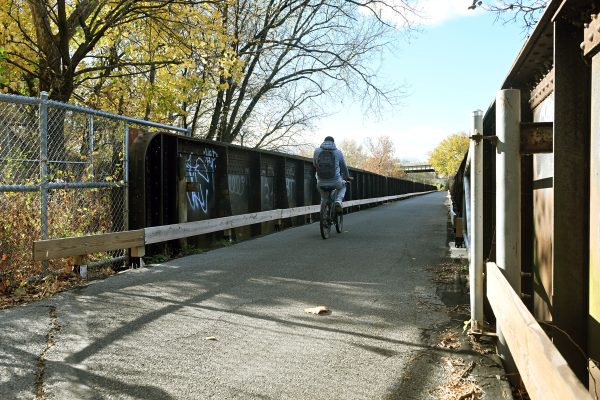
Schuylkill River Greenways Association is inviting the public to help reimagine the Reading Gateway Bridge.
The roughly 400-foot-long pedestrian span connects Riverfront Park to West Reading and is used by thousands of runners, cyclists and pedestrians each year.
Residents are invited to share general ideas about the bridge and learn more about future trail projects at a meeting Jan. 29 from 5:30 to 6:30 p.m. at the WCR Center for the Arts, 140 N. 5th St.
The bridge, owned by Berks County and used under a trail easement held by Greenways, is a critical link on the Schuylkill River Trail, which the nonprofit stewards.
The trail draws recreational users and commuters from Schuylkill, Berks, Chester, Montgomery and Philadelphia counties.
Though functional and well-maintained by the county, the bridge is lined with large, steel walls that make it feel more industrial than welcoming, said Elaine Schaefer, Greenways executive director.
To change that, the Greenways is partnering with community transformation organization Barrio Alegria to gather ideas from residents, she said.
Schaefer said the project’s focus on community input sets it apart from typical infrastructure projects.
“The transformation of the Reading Gateway Bridge is a truly unique project because it provides an opportunity to combine the utilitarian usefulness of a bike and pedestrian trail with the beauty and creativity of an extraordinary public art project,” Schaefer said. “It’s an opportunity for the community to envision the incorporation of large and impactful art into an important piece of transportation infrastructure, creating a destination site that elevates the gateway into the city.”
Anthony Orozco, Barrio’s director of operations, said the bridge redesign is part of a broader effort to enhance the riverfront.
“This redesign of the bridge is just a part of all the improvements that are coming to our riverfront and the trail,” Orozco said. “Our riverfront and Schuylkill River Trail have a natural appeal that draws droves of people without any promo or advertisements; the innate interest in this beautiful natural resource can no longer be ignored.”
Potential upgrades could include new lighting, murals by local artists and structural changes to alter the feel of the passageway, Orozco said, noting decisions will depend on public input.
“This is not a top-down approach,” he said. “This puts the people at the drafting desk; it puts the pen in their hands.”
Schaefer said additional improvements also are planned along the trail segment through the Reading Area Community College campus and a future extension along the city’s northern riverbank.
Planned Schuylkill River Trail upgrades include 3 sections in Reading
The outreach effort marks the first step in what could be a multiyear process.
“We want these assets to reflect the community and showcase its vibrancy,” Schaefer said. “We want the neighbors to feel like this is ‘their section’ of this amazing trail.”