
When the email dropped in my inbox, I knew it was bad news, but like the ocean exposing tide pools just before a tsunami, I assumed the Post-Gazette was on an upward trajectory.
It was 12:30 p.m. on Wednesday, Jan. 7, and I had just stepped into the shower when my phone dinged with a text from my coworker in a group chat. I drew back the curtain and opened my phone, pearls of water momentarily obscuring the screen.
There’s no way this is good news, right? A meeting with 45 minutes notice.
I checked my email. The subject line read: “1:15PM TODAY – MANDATORY MEETING FOR ALL PG EMPLOYEES.”
Squirting shampoo into my cupped hand, my mind began to race. What if they were shutting down the paper, like how they shut down the alt-weekly Pittsburgh City Paper a week prior with zero notice? I don’t have much money saved up. I should have been more responsible. I shouldn’t have dropped $70 on drinks last night.
There’s no way they’d shut us down, my friends reassured. We don’t have enough information to assume that. They’re probably restructuring or announcing a sale.
I wrung out my hair, slipped on sweats, opened my laptop and joined the Zoom call. It was silent, and we were greeted with a black screen, a cursor lazing around.
Two minutes passed. I texted, “Do you guys hear anything yet?”
“Blank screen with someone moving a pointer no sound,” my colleague responded.
The rest of our thread goes as follows:
A prerecorded video????
…is she well? She can’t be well
Wtf
Oh no
What on earth
WHAT
Holy s***
OH MY
GOD
Uh guys…
I might actually cry
Holy f***
We had just been told, via a prerecorded video of an unfamiliar woman in a gray suit, that the Post-Gazette would cease all operations May 3 due to mounting financial losses. We were encouraged to “respectfully consider the legacy of the Post-Gazette” and told that the paper’s owners wanted “to exit with grace and dignity.” Who was that woman? Jane-something? Was she AI?
It was 1:21 p.m. I shut my laptop and cried. It didn’t make sense. They just signed a 10-year lease on a new building, and we were set to move at the end of the month. Members of the editorial board were finalists for a Pulitzer the year prior. The investigations team and I had received a grant and a partnership, and we were putting the finishing touches on that project after months of reporting. The Post-Gazette had been awarded Pennsylvania News Organization of the Year for four years in a row.
Some people cried at their desks in the newsroom, according to my colleague. Managers shuffled into an office for an emergency meeting. People roamed aimlessly; others looked dazed. I began receiving texts as if someone had died.
I’m so sorry. Did you know? You’re in my thoughts.
I could talk about how crucial local journalism is to tight-knit and well-informed communities, how two newspapers fold each week in America, but we know all this. It’s why the paper had recurring meetings about how to boost online subscribers, strengthen our social presence and contemplate the paywall.
I’d rather tell you why I ended up here, and what it has felt like to realize that future may be disappearing.
For most of my life, I thought I would be a scientist. I pored over National Geographic magazine and Scientific American in grocery store checkout lines and at libraries. I watched PBS with my parents, scrunched against the foot of the couch, my mouth agape at the scientists and their fascinating discoveries. When I didn’t get into any neuroscience Ph.D. programs, and the COVID-19 pandemic hit, I pivoted to a science journalism program at Johns Hopkins. I found the work encompassing — we were reading Michael Pollan and Kathryn Schulz for homework. I idolized them and would have read these books for fun. I was ecstatic.
I started as the Post-Gazette’s only health reporter in 2022, after driving across the country and arriving the Friday prior to my first Monday on the job. On my first day, I marveled at the printing press on display when the elevator doors opened to the newsroom, the framed front pages of the paper’s Pulitzer-winning coverage of the synagogue shooting, the massacre site a five-minute drive from my new dwellings.
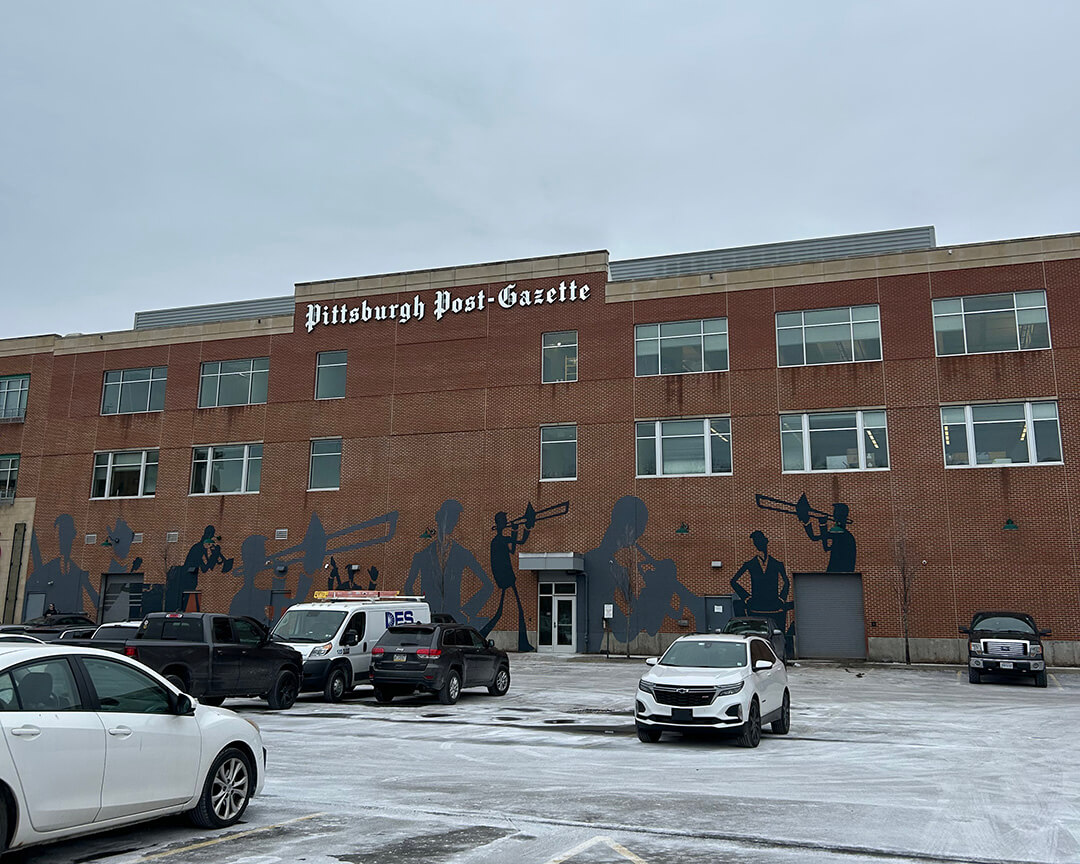
The Pittsburgh Post-Gazette newsroom building, where staff learned via a prerecorded video that the paper would cease operations this spring. (Courtesy: Hanna Webster)
I quickly learned that being a reporter in a new city means you learn about its culture and its idiosyncrasies as fast as you file a story. I visited a sprawling pop-up dental clinic at the convention center, where 1,500 teeth were pulled over the course of two days. I wrote about cases of a new virus called mpox rising in Allegheny County. I covered vindictive attacks on gender care at UPMC Children’s Hospital. I wrote about the results of a new air quality report, and I took self-portraits in my bathroom mirror for a personal essay on over-the-counter hearing aids (I wear one in my right ear). In photos of that time, I am grinning underneath the lit-up Pittsburgh Post-Gazette sign; I am bright-eyed, holding a stack of papers with my freshly printed bylines.
Pittsburgh may be a city of people who block parking spaces with deck chairs and who are content with fries on salad, but it’s also a city of loyalists who love where they come from. I lost count of the number of people I met who have spent their whole lives here, living in houses passed down through generations. I made friends quickly by talking to strangers at bars. I met my partner here. The Post-Gazette is part of this legacy, just as it’s a part of me.
I’ve spent the past three years developing my beats: the opioid crisis and other drug news (my editor calls me “Hannabis”), infectious disease, vaccines, trans rights and health equity. I’ve hung out in the rec rooms at drop-in harm reduction centers; walked headachy and with stinging nasal passages beside a rainbow-sheened creek in East Palestine, Ohio after a train derailed there and spilled contaminants; watched firefighters axe the side of a house as flames devoured it; sat on parents’ couches as they cried, grieving their children killed by fentanyl.
I did this because it gave me purpose. I did it because I saw an immediate impact when people had reliable information about vaccines or the closing of a clinic. I did it because it made me part of the community.
I still rage occasionally when I see a cruel comment below my story or in my inbox, still cry about the stress of throwing myself into work that I’m unsure will matter. But to the left of my desktop computer at the newsroom, I have tacked a small collection of handwritten cards and printed-out emails thanking me for my work. Even five days after the news of the paper’s impending closure, a source said they were glad they told me about how methadone changed their life. That they trust me. I hold these small admissions close, hoarding others’ gratitude like love letters in a shoebox, like I’m preparing for it all to disappear. And now it is.
My colleagues who have lived through layoffs in other newsrooms say it wasn’t supposed to happen this way. While we were lucky that the layoffs were not immediate, they said we should have gotten more notice about the owners’ intentions or been given the news by a human we knew. The Post-Gazette is the only newsroom I’ve worked in. I don’t have another reference. All I have is the persistent dread in the pit of my stomach, wishing I could focus on the work without the hot breath of disaster.
We’re living in a purgatory of our livelihoods, unsure if we should get other jobs or try to save this institution in some way. We’re still interviewing sources, filing stories, taking photos, all with the knowledge it could be gone in three months.
I keep returning to the scenario of a Pittsburgh without the Post-Gazette and how that may further fracture our community, but also my own engine at full-speed smashing into a wall I didn’t know was there. It took about three years to develop an authoritative handle on my beat and gain confidence in tackling more involved projects. I wanted to start a new investigation, look into slumlords and cancer clusters. I still had so much to learn, countless relationships to build. Why was I being asked to stop?
I still hope this desultory, paperless future is not the real future we’ll grow into but a vision that helps us correct our path. I hope one of Pittsburgh’s endowed foundations steps up, or that we can reshape what we know as the Post-Gazette into something new that still enriches the lives of the people living here and the more than 2 million in the broader metropolitan area.
The Post-Gazette has helped me find my voice and sharpen my moral compass. When I was 22, I remember whispering to my then-boyfriend one night that I wanted to change the world. At the time, I was picturing something grandiose, something naïve, like reversing climate change or curing cancer. But the Post-Gazette has taught me the value of zooming in.
I need only to focus on bettering the days of the people around me, on bolstering my community, on empowering people to tell their stories. These are not small acts. They’re actually all we have.