
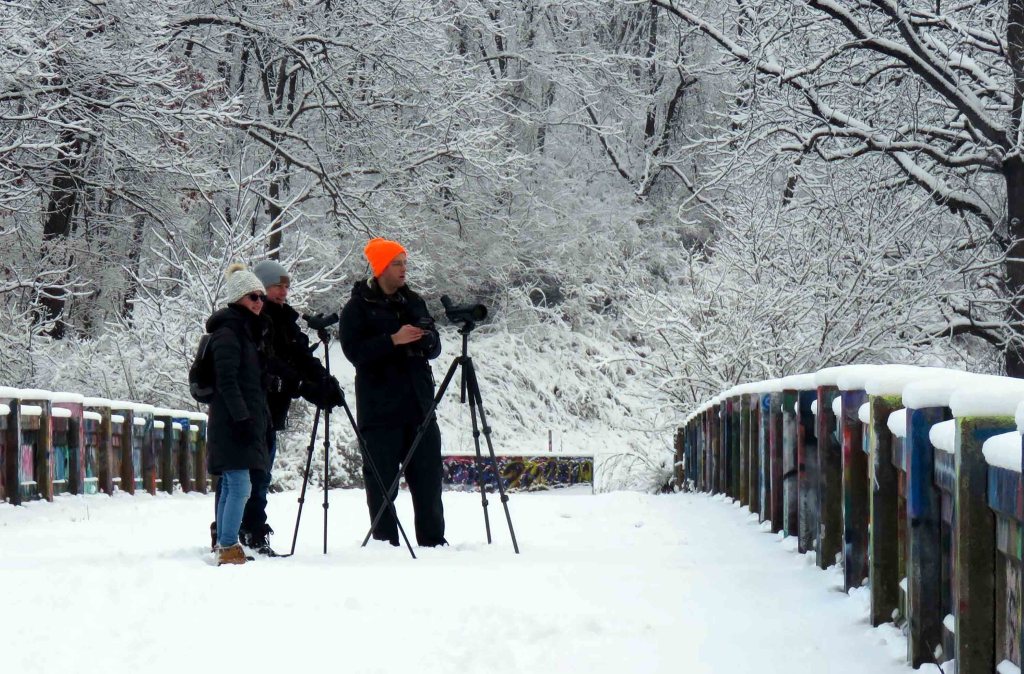
Participants in the recent Reading Christmas Bird Count awoke on the morning of Dec. 14 to a glistening winter wonderland of windswept misery.
“The most remarkable thing about the count is that it happened,” compiler Lucy Cairns of Wyomissing writes in her message to the counters. “In the seven years since I became compiler, the weather has been variably cold, windy, and rainy, but never so potentially dangerous that I considered cancelling the count — until this year.”
The overnight snowfall totaled as much as 5 inches in the area, and along with the falling temperatures and increasing wind during the day created a challenging count situation not found since the frigid winters in the 1970s and 1990s.
Road conditions were poor in the morning, resulting in less coverage throughout the count circle.
Yet, 44 participants found 19,804 birds of 75 species during the count, just a slight drop in the average, and several species had unusually high numbers, Cairns writes.
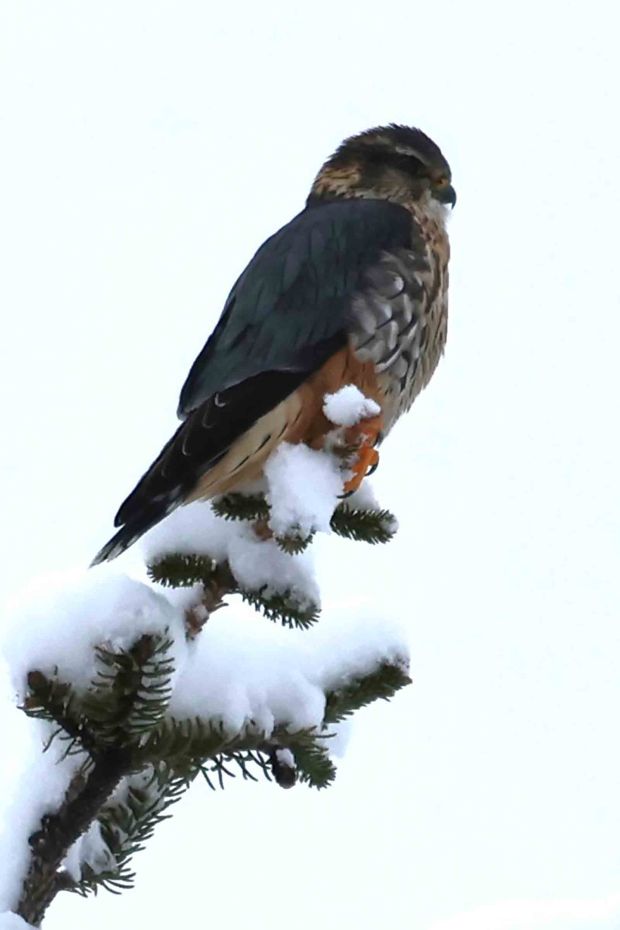 A merlin in Jim Dietrich Park in Muhlenberg Township surveys its territory during the Reading Christmas Bird Count on Dec. 14, 2025. (Courtesy of Todd Underwood)
The record high count went to the snow goose with 7,024 tallied. Eight red-breasted nuthatches represented a 10-year high, as did 1,200 horned larks found in the Fleetwood, Oley, and Lower Oley sectors, along with 1437 dark-eyed juncos.
Another surprising find was a catbird, only the second sighting in the last 10 years.
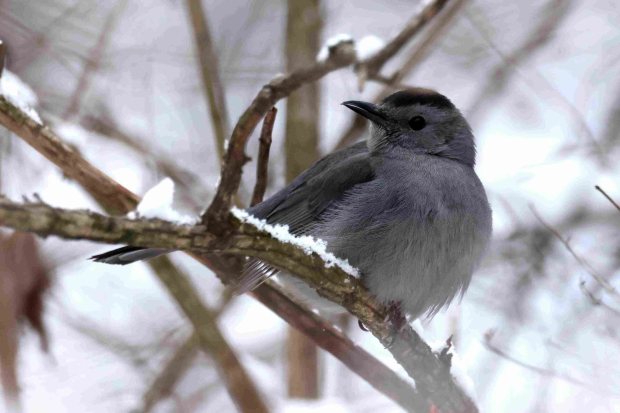 A gray catbird in Bern Township was an unusually late sighting for this bird that should have already migrated by the time of the Reading Christmas Bird Count on Dec. 14, 2025. (Courtesy of Todd Underwood)
Bald eagles for the first time since 2019 failed to break double digits with eight recorded. Only 70 American crows were sighted, the lowest number in the last 10 years.
However, for the second time in the 115-year history of the count and for the second year in a row, a pine warbler was found.
Other unusual birds for the count include five rusty blackbirds, five American pipits and a Lapland longspur in a flock of horned Larks feeding on weed seeds in a field.
Three peregrine falcons were recorded, two in Reading and one in the Oley Valley.
 A peregrine falcon pair perches on the Callowhill Center at Fifth and Penn streets during the Reading Christmas Bird Count on Dec. 14, 2025. (BILL UHRICH/READING EAGLE)
The 33 observers in the Hamburg Christmas Bird Count were also affected by the weather with cold and freezing drizzle encountered throughout the day on Dec. 28.
“The weather had some birds hunkered down and remaining less active than usual,” notes compiler Laurie Goodrich. “Afternoon drizzle also dampened both observer effort and bird activity. Counters commented there seemed to be ‘fewer birds’ than usual. Many ponds and lake areas were frozen with Leaser Lake 10% open, affecting water bird sightings.”
Still, participants were able to find 15,249 birds of 79 species, slightly lower than the recent 10-year average of 15,922, Goodrich said.
Despite the adverse weather, records were set for red-shouldered hawk, 10; Merlin, six; red-headed Woodpecker, nine; and common raven, 50. Rare sightings include a golden eagle subadult, Lincoln’s sparrow near Pine Creek, and a rusty blackbird at Leaser Lake.
The Hamburg count noted its 60th anniversary this year.
Reached at his home in Michigan, the founder of the count, Warren Faust, fondly recalled the 18 years he compiled the records before passing the duties to the late Jim Brett and Goodrich at Hawk Mountain.
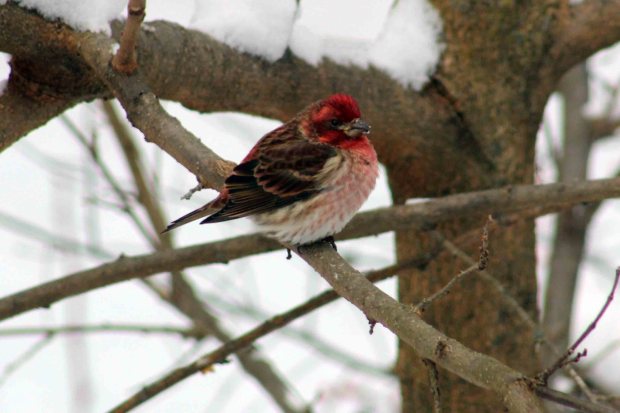 A purple finch, an increasingly rare sighting from the North, was found on the Reading Christmas Bird Count on Dec. 14, 2025. (Courtesy of Peter and Jane Wolfe)
The 87-year-old retired scientist with the Great Lakes Environmental Research Center along with the late Matt Spence, who was just beginning his 32-year tenure as the compiler for the Reading count, saw the need for an additional Berks County count.
“There were people involved in the Reading count,” he recalled, “they weren’t really sticking to the boundaries of the count circle. People sort of were, you know, going in their own favorite areas and the like.”
In an effort to uphold the integrity of the count and the count circles, Faust and Spence drew up a territory centered at the Pinnacle that would also reach down and just fit in the northern part of Lake Ontelaunee that was just outside of the Reading circle.
There was another reason for the count, too.
Faust had gotten wind of plans by the Army Corps of Engineers to create large dams, one on the Tulpehocken and another one farther north on the Maiden Creek, for flood control.
“The Maiden Creek dam never happened,” Faust said. “But at the time if there’s going to be a big change here, we could start a count and get some information before the changes occur.”
Faust and Spence enlisted the help of Maurice Broun, who was in his final years as curator at Hawk Mountain.
“He was supportive of it,” Faust said. “He liked the idea, but he didn’t want the Hawk Mountain name associated with the count. But he helped us get people lined up, and he was always participating.”
Faust has some vivid memories of those early days of the Hamburg count.
The Hamburg count set national highs for ring-necked pheasant in 1969, 1970 and 1973 with a maximum of 1,468 in the 1969 count.
Now, the pheasant population has been essentially extirpated throughout Berks with the Hamburg count’s 10-year average at two individuals.
Goodrich observes the changes in the landscape that have affected bird numbers.
“Hamburg bird count numbers since1965 reflect changes in the overall landscape for the northern Berks and southern Schuylkill area,” she said. “In the last six decades we have observed an increase in suburban development and a decrease in rural open farmland habitats.
“Additionally, farmland has shifted from mostly pasture-dominated farmland, with dairy or hay predominating, to today’s farms which show largely row crops of corn, soy, alfalfa, etc. Reduced grassland habitats and more efficient farming practices have also resulted in less food and cover for wildlife in winter and have reduced habitat for grassland — reliant birds such as pheasants, American kestrels, northern harrier and some songbirds.”
Faust moved to Michigan in 1970 to pursue graduate studies in zoology at the University of Michigan, where he worked on studies of the Kirtland’s warbler, an extremely rare species that nests only in scrubland habitat at one location in the state.
He kept compiling the Hamburg count, though, until 1983.
One of the more memorable moments of the counts Faust compiled occurred in 1968 when nearly every party in the Hamburg count found the pine grosbeak for a total of 88 of the extremely rare northern finch.
None has been observed in the last 10 years.
“It’s tempting to be discouraged when CBC counts are depressed by adverse conditions,” Cairns writes. “Participants in the Reading Christmas Bird Count went above and beyond, in difficult, risky conditions, to produce another in a very long string of successful counts.”
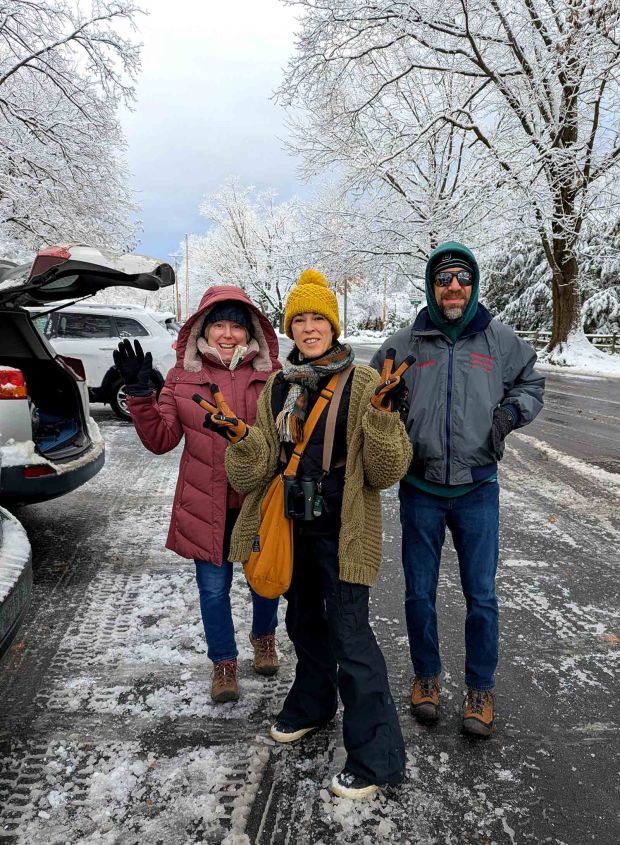 From left, Denise Muller, Holly Armbuster and Chris Ryan set out to count along the Wyomissing Creek on the Reading Christmas Bird Count on Dec. 14, 2025. (Courtesy of Lucy Cairns)