
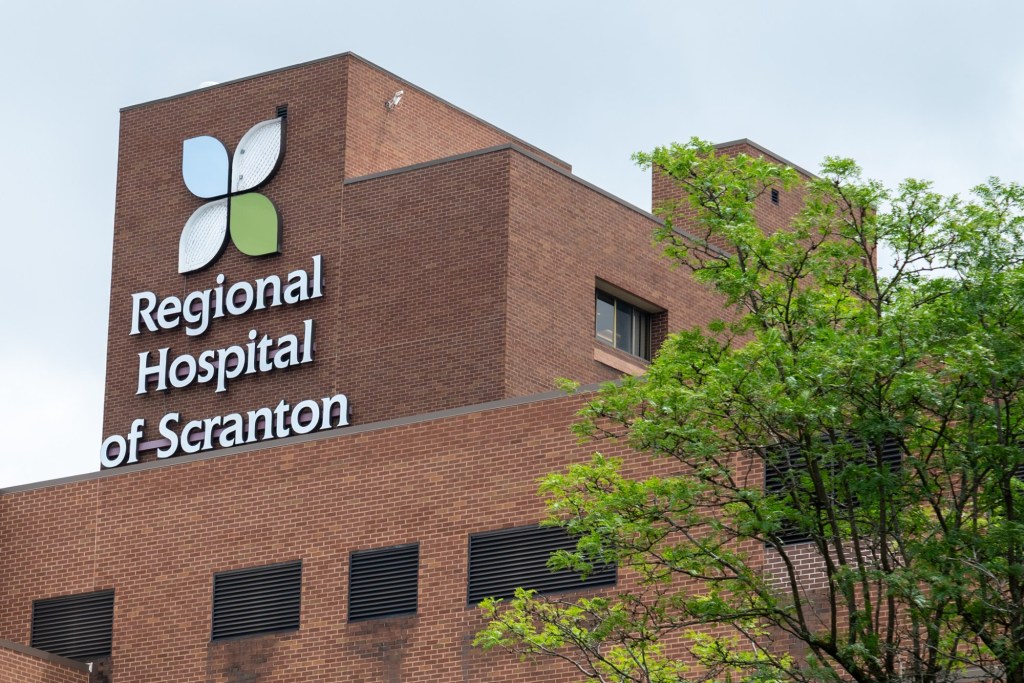
The nonprofit working to acquire Commonwealth Health’s hospitals in Scranton and Wilkes-Barre is “ready to conclude the transaction” as it awaits approval from the state Department of Health and anticipates a decision from the state in the coming days.
Officials with Tenor Health Foundation said as much this week in a statement issued amid the health department’s ongoing review of a proposed ownership change under which Tenor would acquire and operate Regional Hospital of Scranton, its nearby Moses Taylor Hospital campus in the city and Wilkes-Barre General Hospital in Luzerne County. It comes as hospital workers and other stakeholders grow increasingly anxious over the prospect of Regional and Moses Taylor closing should the state reject the ownership change.
Concern those two financially struggling hospitals could close absent acquisition by a new owner intensified last year after the would-be sale of all three Commonwealth Health hospitals to another nonprofit collapsed in late 2024. Tenor emerged in 2025 as that would-be owner amid a concerted, multifront push to save Regional and Moses Taylor, with Tenor signing in late October a definitive agreement to acquire Commonwealth Health in a pending transaction that includes the three hospitals and other assets.
While Tenor officials originally expected to complete the transaction in 2025, the calendar turned without a resolution.
“We stand ready to conclude the transaction and to successfully operate Moses Taylor and Scranton Regional and Wilkes Barre General hospitals, however we await Department of Health approval which we understand is moving in a positive manner and we anticipate receiving a decision in the coming days,” Tenor said in a statement Tuesday.
The state’s review process is “ongoing,” Department of Health Press Secretary Neil Ruhland confirmed in an emailed statement. That statement did not address questions about the anticipated timeline of the review or whether the department is aware of any imminent risk of Regional and Moses Taylor closing absent approval of Tenor’s change-in-ownership application.
For profit Community Health Systems Inc., Commonwealth Health’s Tennessee-based parent company, also didn’t address whether Regional and Moses Taylor are likely to close if the Tenor deal doesn’t get done soon.
“The Pennsylvania Department of Health continues to review the proposed ownership change and has indicated they have all of the information needed for that decision, but we have yet to receive a definitive answer from them,” CHS spokeswoman Tomi Galin said in a statement Monday. “We don’t have any additional information to share today.”
Workers and union leaders at Regional and Moses Taylor urged the state Department of Health in a recent letter to consider health care access and jobs during its ownership-change review. They called on the department and state officials “to do everything in your power to secure our future,” describing the hospitals as “essential access points for acute care, emergency services, and inpatient treatment for our region.”
“Any disruption, delay, or uncertainty surrounding ownership has real consequences for the patients, families, and communities who rely on our hospitals, and for those of us who provide care every day,” they wrote. “While we recognize the Department’s responsibility to ensure compliance, safety, and regulatory integrity, we respectfully urge that those considerations be balanced with the urgent need for stability, transparency, and continuity of care.”
Those who see the pending Tenor transition as a potential lifeline for Regional and Moses Taylor also worry about the void in the local health care landscape their closures would create — a void other health systems and providers would struggle to fill.
Geisinger officials said earlier this month that their hospitals in Lackawanna and Luzerne counties were operating above capacity at historic levels not seen even during the heights of the COVID-19 pandemic. They largely attributed the capacity constraints to surging respiratory virus activity, but said patients switching from Commonwealth Health to Geisinger was a contributing factor.