ALLENTOWN, Pa. — City officials will host a community meeting next month to gather public input on Allentown’s Urban Forestry Master Plan, an initiative aimed at expanding tree coverage in underserved neighborhoods.
The meeting is scheduled for 6-7:30 p.m. Feb. 2 in City Council chambers at City Hall, 35 Hamilton St., according to a city news release.
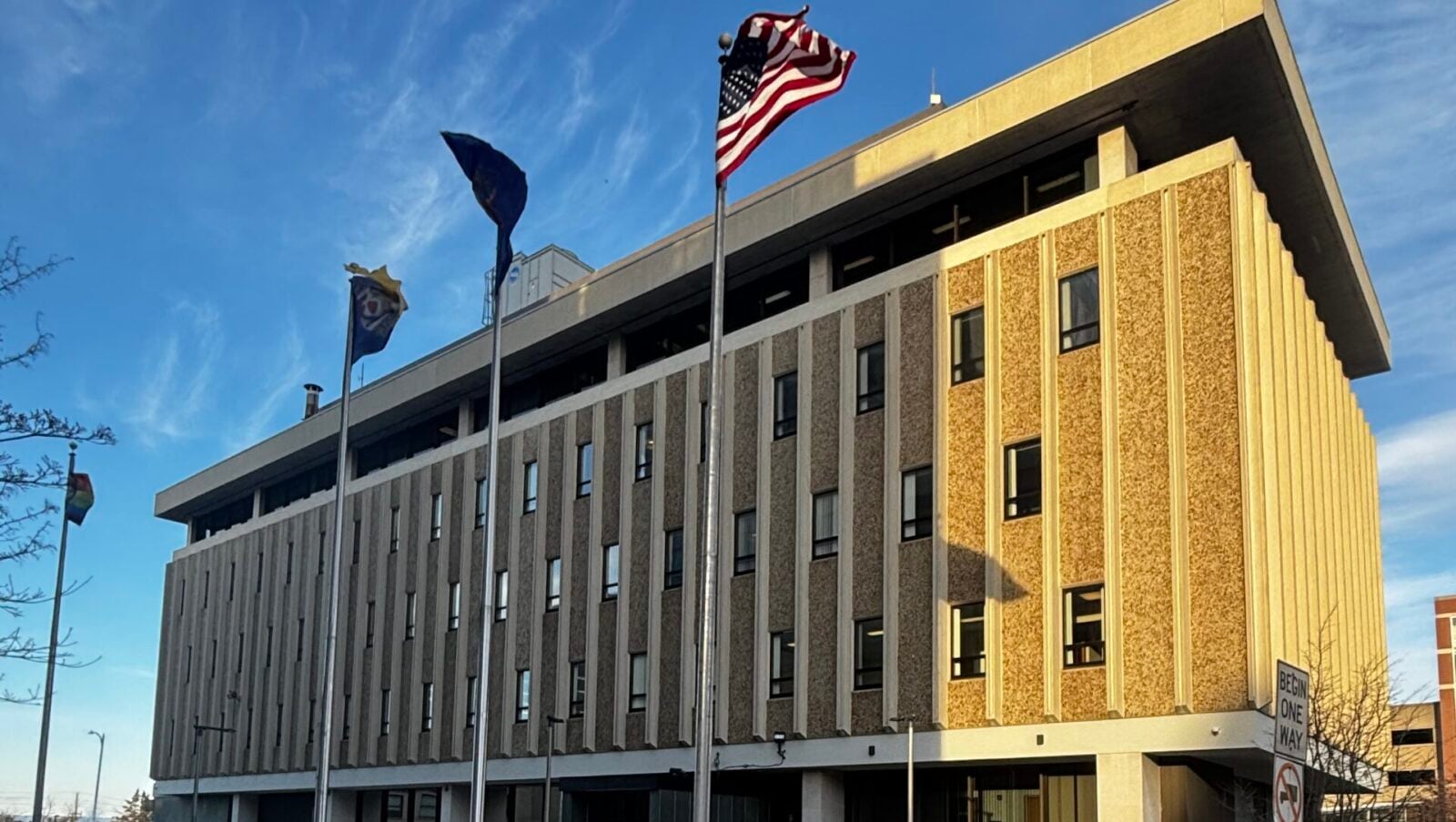 Allentown City Hall, where officials will host a community meeting on the Urban Forestry Master Plan on Feb. 2. Residents can provide feedback on the city’s tree-planting priorities. (Photo: Luzmarie Tavarez)
“I’m really excited that this will be our first community event related to this plan, so I’m excited to get some feedback from the community on what they want to see in this plan too,” said Veronika Vostinak, the city’s sustainability coordinator.
The plan will include a comprehensive inventory of city trees, a long-term vision for tree planting and care, and specific policies and programs to improve Allentown’s urban forest. A community survey is open through mid-February.
The initiative is supported by a $920,800 grant from American Forests, a funding partner for the U.S. Department of Agriculture’s Forest Service. The funding will support planting up to 800 street and park trees through 2027, according to a Penn State report prepared for the city. The city must spend the grant by mid-2028, Vostinak said.
Equity focus
“The process of the plan will be to look at the city overall with a special lens for traditionally underserved areas and areas with low tree canopy,” Vostinak said. The plan “will look at projects, policies, and programs that the city can take on to help to improve and make the tree canopy more beneficial for all of Allentown, but more equitable overall.”
 Graphic: Penn State Law, Policy, and Engineering
Initiative
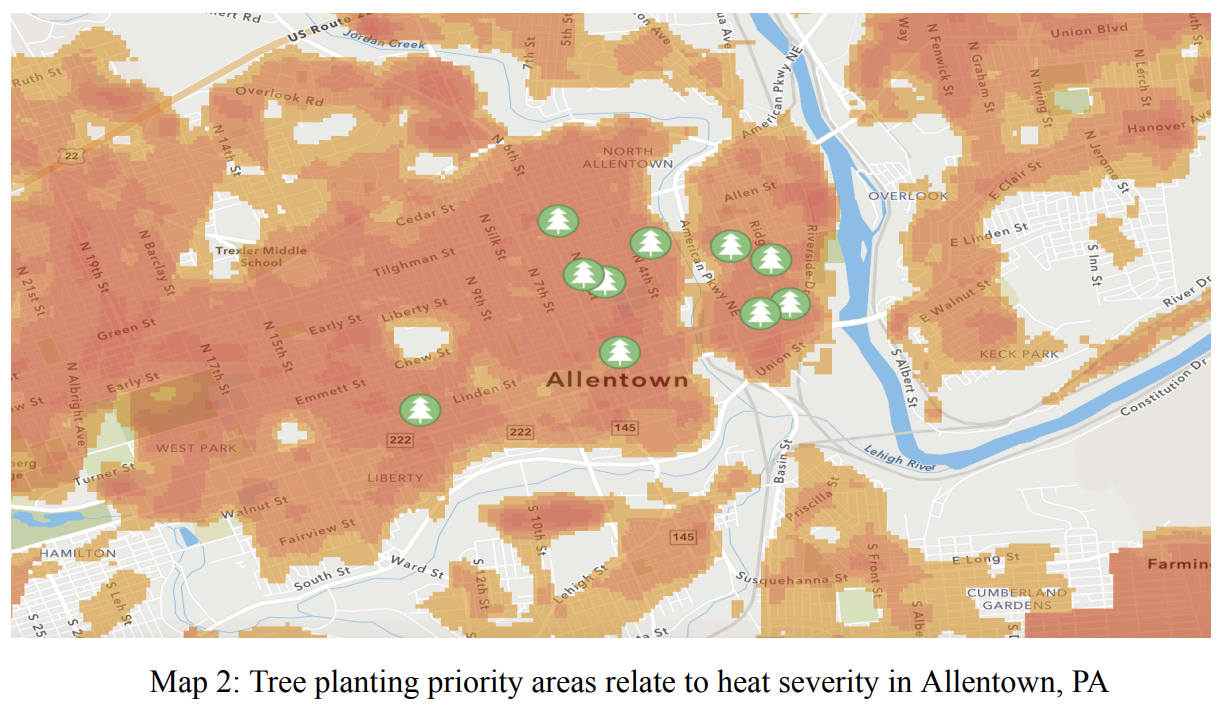
Allentown faces significant heat vulnerability, with some urban areas reaching summer surface temperatures exceeding 100 degrees Fahrenheit, according to climate resilience planning data. A May 2025 report from Penn State’s Law, Policy, and Engineering Initiative found “a lack of granular data in Allentown, especially within traditionally underserved areas of the city.”
The report identified the city’s hottest surfaces — east-side corridors, areas near the Lehigh River, and pockets of South Allentown — as having the fewest street trees and highest renter density, increasing both heat exposure and barriers to tree maintenance.
The city also ranks third in the nation among the most challenging places to live with asthma — and first for asthma-related emergency room visits — according to the Asthma and Allergy Foundation of America’s 2025 report. Officials say increased tree coverage could help address these public health challenges.
“This plan will guide how we grow and care for our trees to help cool our city, clean the air and support improved mental and physical health,” Vostinak said.
Tree inventory underway
City crews are currently conducting a street tree inventory to assess existing species, tree conditions and locations where new plantings are needed.
“We are learning a little bit more about what species are, the conditions, and where the empty wells are, where there’s no longer a tree, to inform us of the areas that need more tree plantings and resources,” Vostinak said.
The plan will also include a species-selection component to determine which trees are best suited to different areas, taking into account factors such as proximity to power lines and local growing conditions.
“There are shade trees which get bigger and provide more shade, but those may not be the most appropriate in areas where there are power lines overhead or in proximity to utility lines,” Vostinak said. “The species selection program will help both the city and property owners to determine what trees make the most sense in their particular spot, while also taking into account the biodiversity of the city in the area overall.”
The city is using tools, including the Tree Equity Score from American Forests, which identifies areas with low tree canopy and high concentrations of renters or lower-income residents.
“We have a couple of tools that we use,” Vostinak said. “There’s one tool available to us from American Forests that shows areas with high percentages of renters or lower-income residents. Some tools that show socioeconomic factors, the canopy overall, and provide some goals for where the canopy should be, versus where it is now.”
Language access
The Penn State report also flagged language barriers as a significant obstacle to community participation, noting that outreach materials and public meetings are frequently held only in English despite the city’s majority Latino population.
The report recommended the city publish tree-planting materials in both Spanish and English.
What’s next
A separate climate action plan is also in development.
“We should be starting our climate action plan in the next couple of months,” Vostinak said. “Our city council approved the technical consultants a couple of months ago, so we’ve just been going through the contracting process and should kick that project off soon.”
Residents can take the urban forestry survey online or attend the Feb. 2 meeting to provide feedback.
This is the part where we ask.
No billionaire owner. No paywall. Just you keeping local news free.
$5 keeps us going
100% funds local journalism.