
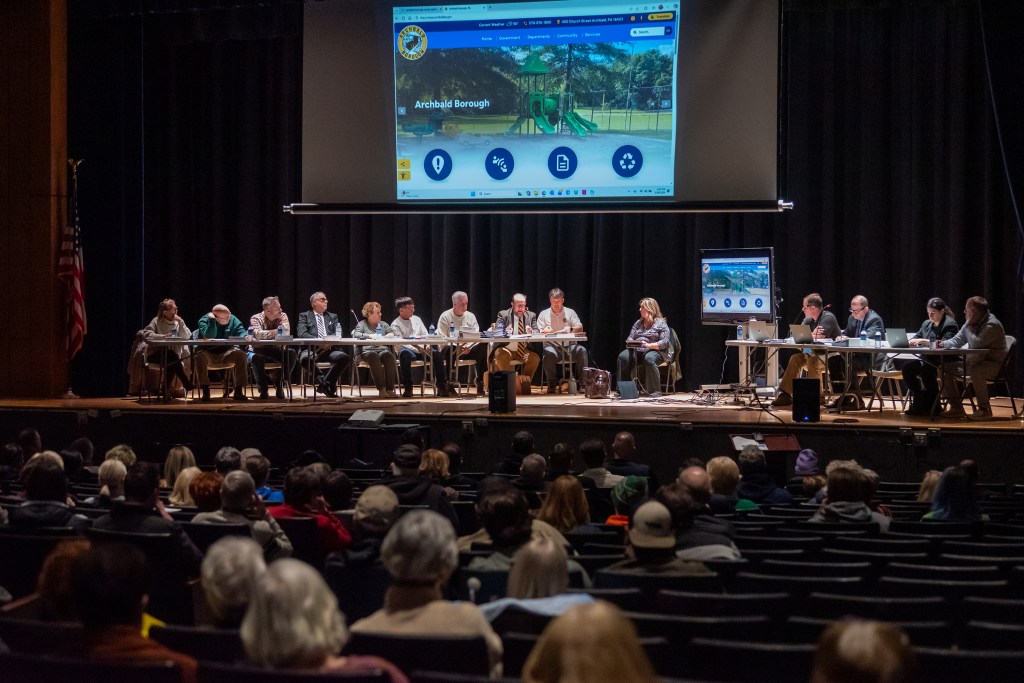
ARCHBALD — Lackawanna County Commissioner Bill Gaughan urged Archbald officials to consider the countywide impacts of data centers Wednesday night while state Rep. Kyle Mullins unequivocally opposed a proposal to build more than a dozen data centers above Business Route 6.
The local legislators joined more than 300 community members Wednesday in the Valley View High School auditorium for the first of what will likely be multiple public hearings on a conditional use application for the Wildcat Ridge Data Center Campus — a proposal from Brooklyn-based Cornell Realty Management LLC to build 5.66 million square feet of data centers above the borough’s Sturges and Eynon sections, requiring significant amounts of water and electricity to operate the facilities.
Testimony from the campus’s project manager and attorney revealed Wildcat Ridge would get its water from Lake Scranton, that it does not currently have an end user, that it would only be built if it has an end user, and that commercial space on the site could include “Trader Joe’s, or something like that.”
Wildcat Ridge became the first data center campus proposed in Lackawanna County when company representatives approached Archbald council during January 2025 work session, and one year later, representatives for the developer sat opposite borough officials on stage in Valley View’s high school auditorium to make their case as to why council should approve their project, in light of significant opposition from the community.

Lackawanna County Commissioner Bill Gaughan expresses his concerns about proposed data centers during the Archbald Borough Council’s public hearing at Valley View High School on Wednesday, Jan. 28, 2026. (REBECCA PARTICKA/STAFF PHOTOGRAPHER)

Lackawanna County controller and president of the Keyser Valley Neighborhood Association Gary DiBileo asks the crowd to raise their hand if they oppose data centers during the Archbald Borough Council’s public hearing regrading the proposed Wildcat Ridge campus at Valley View High School on Wednesday, Jan. 28, 2026. (REBECCA PARTICKA/STAFF PHOTOGRAPHER)
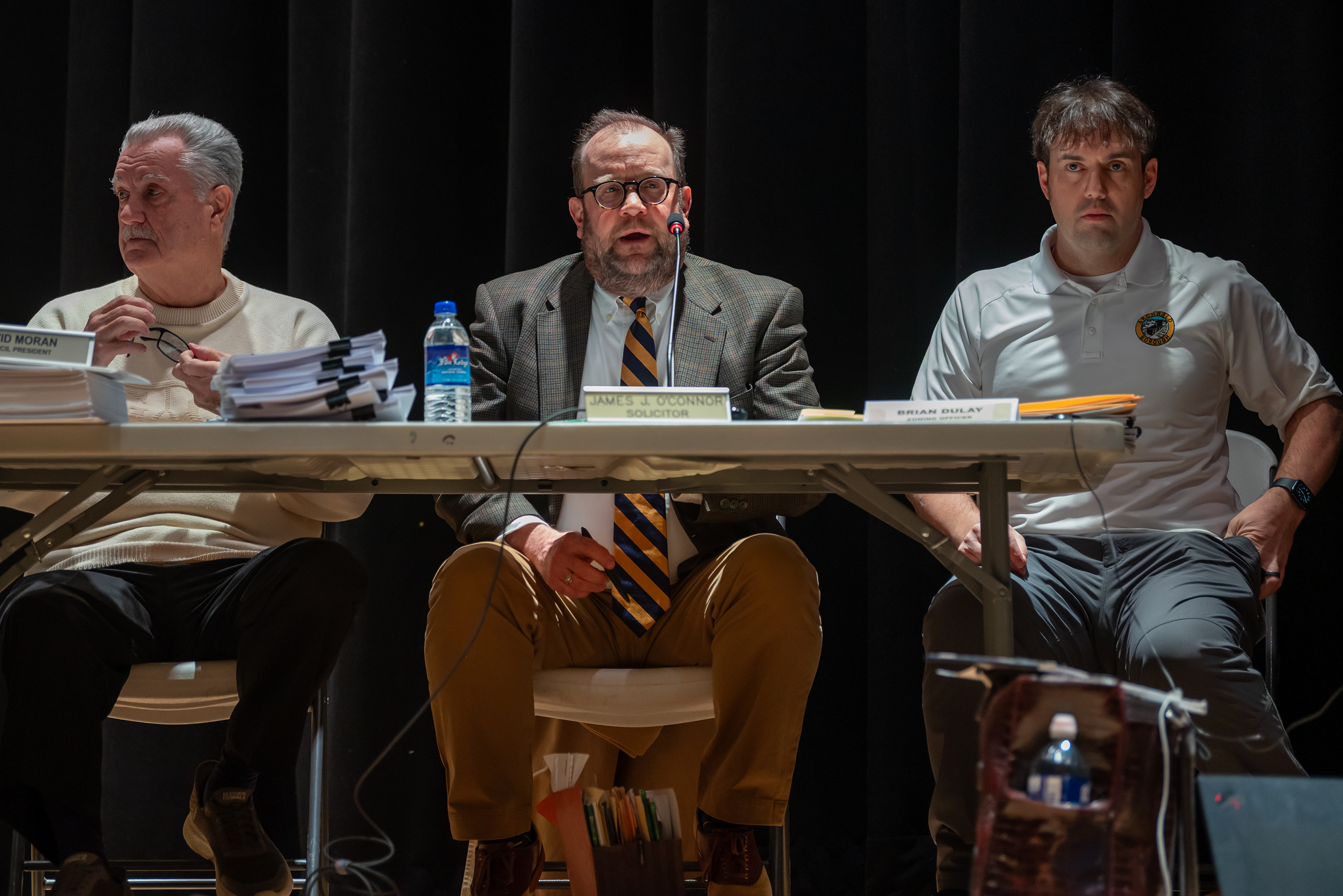
Solicitor James O’Connor speaks during the Archbald Borough Council’s public hearing regarding a conditional use application for the Wildcat Ridge Data Center campus at Valley View High School on Wednesday, Jan. 28, 2026. (REBECCA PARTICKA/STAFF PHOTOGRAPHER)
Show Caption
1 of 3
Lackawanna County Commissioner Bill Gaughan expresses his concerns about proposed data centers during the Archbald Borough Council’s public hearing at Valley View High School on Wednesday, Jan. 28, 2026. (REBECCA PARTICKA/STAFF PHOTOGRAPHER)
Despite proposals elsewhere in Lackawanna County, Archbald maintains the highest concentration of potential data centers, with 44 buildings planned across five campuses.
Wednesday’s meeting was Archbald’s first public hearing on an individual data center proposal, kicking off a series of hearings that will eventually culminate with borough council deciding whether to approve or deny Cornell Realty’s application to build 14 two-story data centers, each up to 80 feet tall with a 202,340-square-foot footprint, along 574.2 mountainside acres above Business Route 6 and continuing up Wildcat Road, or Route 247.
After about two hours Wednesday, borough officials and Cornell Realty Management’s attorney agreed to adjourn the hearing and reconvene it at a later date to provide more time for more testimony after the developer only presented one of five expert witnesses.
‘Not powerless’
Gaughan, who last week suggested the state should consider legislation explicitly authorizing counties to impose an impact fee on artificial intelligence data centers, and Mullins, whose 112th district has the highest concentration of data centers in the county, both addressed council at the start of Wednesday’s hearing, followed by Lackawanna County Controller Gary DiBileo, who was recently involved in opposing a now-rejected data center proposal in Ransom Twp. along Newton Road.
All three men were critical of data centers and their impacts, with Gaughan saying he worried the area was becoming a “sacrifice zone” where a community is told it’s the right place to absorb damage so someone else can reap the reward.
“I’m here because the impacts on water, power and infrastructure, housing and land use from data centers ripple outward across the entire county, and those are the people that I represent,” Gaughan said. “This is not just another hearing. This is not just another development proposal. This is a question, I think, about who we are, and who we are willing to become.”
The commissioner drew from the region’s coal mining heritage, calling Archbald a town “built by coal miners, by men who went underground before sunrise and came home after dark. By families who sacrificed their health, their bodies, and sometimes their lives so their children could have a future above ground.”
“For generations, this valley powered an industrial nation, and what did this region get in return? Black lung, collapsed mines, polluted water, abandoned land,” Gaughan said. “We know this story. We have lived this story. Outside industries came in, they took what they wanted, they left when they were done, and the people here paid the price.”
He questioned the benefits of data centers, pointing out they don’t build a workforce, a middle class, nor anchor a community. Instead, they provide a handful of permanent jobs while placing a “massive strain on infrastructure, noise, heat, water usage, power demands that Lackawanna County ratepayers will help subsidize, and most of the profit that will leave Archbald on a fiber-optic cable,” he said.
“I am opposed to a future where communities like Archbald are once again told, ‘Trust us, be patient. It will be worth it in the end.’ We have heard that before. Coal was supposed to be worth it, it wasn’t,” Gaughan said. “This time, we are not powerless, because the people in this room and throughout the county who are fighting this data center development, are not obstacles to progress. They are the guardians of this place.”
He called for a statewide moratorium on data centers to determine their potential harms.
“Real progress is not measured in megawatts,” Gaughan said. “It’s measured in quality of life and whether your children can afford to stay here, and whether their water is clean, whether they have water at all, and whether they can find housing that’s affordable, and whether their town still feels like home.”
He received a standing ovation from the crowd when he concluded his remarks.
Mullins, D-112, Blakely, acknowledged that data centers are “part of our new world,” but that there are appropriate, acceptable places for them. He said he opposes any data center that encroaches on neighborhoods or parks, harms the environment, negatively impacts water or power, or jeopardizes residents’ health, safety or quality of life.
“Let me be abundantly clear: This Wildcat Data Center proposal is inappropriate and unacceptable, from its sheer size to its proposed water and power usage, to the deforestation it would involve, to the unknown runoff of stormwater,” Mullins said. “This is why I oppose it and why people feel overwhelmed.”
Data centers should be confined to locations that have as minimal community impact as possible, Mullins said. As a result, he said he is working with other state representatives on a package of proposed laws to protect communities and put up guardrails on the industry.
DiBileo, who is the president of the Keyser Valley Neighborhood Association in Scranton, pointed to his community’s experience opposing a data center in Ransom Twp. He asked who was in support of data centers. No one raised a hand in the crowd.
“How many are against?” he asked.
Hands shot up throughout the crowd.
“I must admit that when data centers first chose to invade Lackawanna County here, I did not understand the issue and exactly what the people here were facing,” DiBileo said. “Data centers didn’t sound like something that could be a problem. I have since found out, and it doesn’t take long at all to learn of the harmful effects that giant computer cooling power plants can have on a community like they do in Loudoun County, Virginia.”
Loudoun County earned the nickname “Data Center Alley” due to its concentration of data centers, with about 200 existing facilities and 70 to 80 more proposed.
DiBileo pointed to Wildcat Ridge’s proposed water and energy consumption — up to 3.3 million gallons per day while requiring 1,600 megawatts of power, which is more than the entire Lackawanna Energy Center natural gas-fired power plant in Jessup can produce — while also raising concerns about air pollution, noise and what happens when the technology becomes obsolete.
“Please do whatever you can to keep them out, or at least as far away from people as possible, because research shows that the negatives far outweigh the positives,” he said. “And as you know, it’s never over until it’s over, and it’s never too late to do the right thing.”
‘Have an open mind’
Through testimony and cross-examination, Cornell Realty Management Attorney Edmund J. Campbell Jr. and project manager AJ Magnotta outlined how the proposal complies with Archbald’s November 2025 data center zoning ordinance, which designated where data centers can be built and established conditions they must adhere to in order to receive approval from council.
Magnotta, who is an associate vice president at LaBella Associates in Dunmore, was one of five witnesses Campbell planned to address.
“We understand and appreciate a lot of the concerns that were raised, and I would ask council to have an open mind, because I expect you will be surprised at much of what you hear,” said Campbell, of King of Prussia-based Campbell Rocco Law LLC. “Our application is detailed, thoughtful and responsive to your ordinance.”
The protections in the ordinance are designed to ensure data centers don’t impact the community like complaints in Loudoun County, Virginia, Campbell said.
Asked by Campbell about available water, Magnotta said they received a will-serve letter from Pennsylvania American Water for a maximum of 3.3 million gallons of water per day, though that would only be in the hottest months.
“But eight months out of the year, the facility uses about 53,000 gallons a day,” Magnotta said. “It’s just during those peak months where you get the high usage.”
He also referenced their plans to explore tapping into mine water below the site to use for cooling.
Other topics covered by the data center representatives included vegetative buffers, residential setbacks, reducing noise by facing each data center’s 41 backup generators — 574 total — up the mountain, access roads and working with first responders.
Councilman Tom Aniska asked Magnotta about required upgrades to PAW’s infrastructure to convey water to the site. Magnotta responded that the developer would pay for any PAW upgrades to maintain the same level of service to the community.
“That could include anything from upgrades at the Lake Scranton treatment plant to a larger water main feeding the area,” he said.
Resident Tamara Misewicz-Healey, who formed the “Stop Archbald Data Centers” Facebook group with her husband, later asked for confirmation the water would come from Lake Scranton. Magnotta said PAW stated it would come from their Lake Scranton District, which is fed by Lake Scranton. The Lake Scranton system serves the city of Scranton and all or parts of Archbald, Blakely, Dickson City, Dunmore, Jessup, Moosic, North Abington Twp., Old Forge, Olyphant, Scott Twp., South Abington Twp., Taylor and Throop, according to PAW.
Councilman Louis Rapoch asked where the data centers would get their water during a drought if Lake Scranton is “down to the bare minimum.”
PAW has to maintain a level of service to the public under the Pennsylvania Public Utility Commission, and if Lake Scranton were to run dry, they would shut off service to industrial users like the data centers, Magnotta replied.
Aniska also questioned the developer about a community host agreement, which Campbell said they are not opposed to negotiating, “So long as it’s legal and lawful.”
Council President Dave Moran asked about the maximum size of the campus; Magnotta said 14 data centers is the maximum they would build.
Misewicz-Healey inquired whether they would build the campus without an end user; Campbell said they would not because it is too expensive.
Councilman Richard Guman probed whether installing new water infrastructure would require digging up borough roads because the existing 12-inch water lines aren’t enough to carry 3.3 million gallons per day.
“So our road system is going to be torn up from here to high water?” Guman asked.
“Right, but…” Magnotta responded as the crowd drowned him out.
After agreeing to reconvene the meeting, Archbald Solicitor James “Jay” O’Connor reassured the crowd that anyone who signed up to speak will have the opportunity to address council.
The borough did not announce a new hearing date Wednesday night, though O’Connor said it would be announced on the borough’s website and via a public notice in The Times-Tribune.