
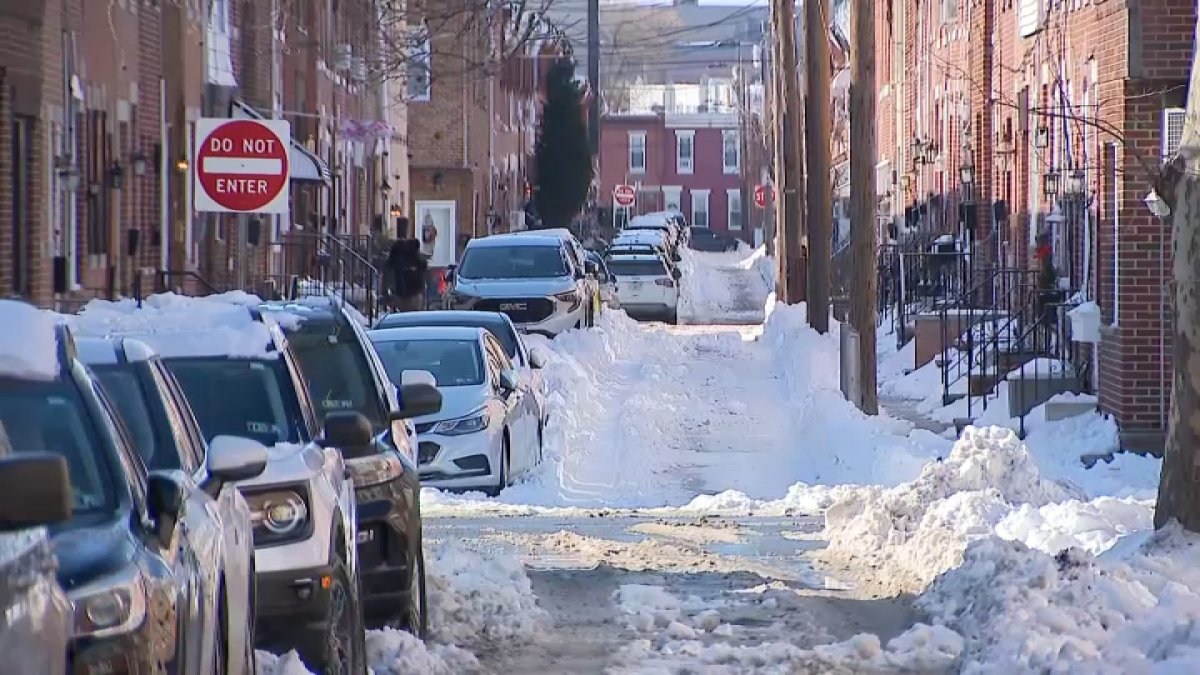
In the hours after the snow stopped falling in the Philadelphia region on Sunday, Streets and Sanitation workers went to work. It wound up being the biggest snowstorm in a decade. That, paired with days of below freezing temperatures, complicated the cleanup.
The snow state of emergency lasted days, Philadelphia schools and courts were closed, SEPTA operations ceased.
Removing the snow is a big task. The city has roughly 18,000 blocks.
City leaders said, at the peak of cleanup on Sunday and Monday, about 800 vehicles and pieces of equipment were on the roads. By Thursday afternoon, it had been halved. Well over a thousand city staff and contractors were involved in the efforts, according to the Streets Department.
“Staffing issues are contributing to it but the main issue is proper training,” said Charles Carrington, the president of Local 427, which represents the sanitation and streets workers.
During the cleanup efforts, the city deployed a map using GPS data showing where they had plowed and when. By Thursday morning, that had been disabled as the city said the snow event had ended.
But that wasn’t clear to all residents. In some neighborhoods, the snow has stayed in the streets, cars remain stuck and crosswalks, impassable.
More than 1200 calls for plowing have come into 311 between the end of the snow storm and Thursday morning.
Carlton Williams with the city’s Office of Clean and Green Initiatives said the 311 calls help them figure out where they need to plow, still.
“The best form of data we have is the 311 data,” Williams said. “We get those complaints, we put them on the map, put them on a map and address those complaints in the order in which they were received.”
Carlton Williams, the director of Philadelphia’s Clean and Green Initiatives, spoke with NBC10 about the city’s progress in removing snow and ice from roads following the biggest snowstorm in a decade.
The NBC10 investigators analyzed the 311 data. The most calls came from the 19148 zip code. Nearly 270 reports for plowing were made from people living in that part of East Passyunk. Other top locations include parts of Point Breeze, Queen Village and Port Richmond.
“There are some communities, like North Philadelphia and South Philadelphia when you have those tight streets where you have to use different processes that take much longer to treat,” Williams explained.
Williams said some of those neighborhoods require workers to remove the snow from streets, put it in a dump truck and go to a different location multiple times. He said other areas are easier to clear and those can be treated with a single pass of a plow during the day of the storm.
The two residential zip codes that didn’t have any complaints were Cedarbrook and Mt. Airy, which is Mayor Cherelle Parker’s zip code.
“We equally serve all neighborhoods simultaneously,” Williams said.