
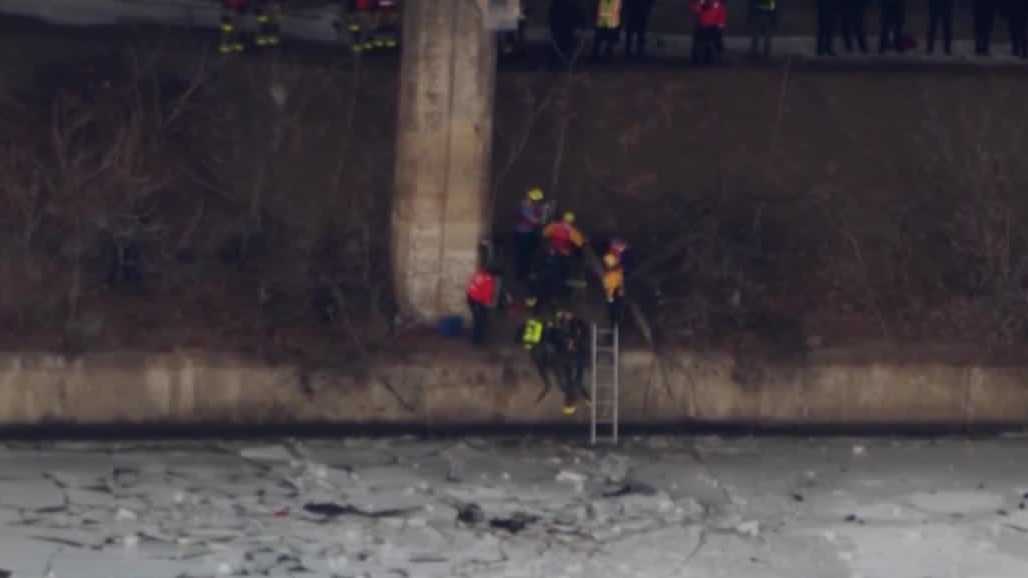
A river rescue operation in Pittsburgh faced significant challenges due to icy conditions, with divers contending with surface ice and low visibility in the water, said Jon Atkinson, president of the Fraternal Association of Professional Paramedics.”Diving, I think, in these rivers under normal conditions is arguably one of the most hazardous jobs that we do, and it’s made even more hazardous by the environmental conditions that they had to contend with today,” Atkinson said.Pennsylvania State Police said one person was pulled from the Monongahela River and taken to the hospital in critical condition after a vehicle went off I-376 and into the water early Thursday evening.Atkinson said that during such operations, divers must deal with surface ice and strong currents under the water, which complicates visibility.”In a dive operation like this, they have to contend with surface ice, the current under the water. The visibility in the rivers is not good,” he said.Atkinson also highlighted the impact of air and water temperatures on the divers’ ability to operate effectively.”The air temperature, the water temperature makes it difficult for these divers to operate in these conditions,” he said.The location of the rescue added to the difficulty, with steep hillsides and a wall drop-off at the river.”This was an especially difficult operation due to the location,” Atkinson said. “There was a pretty steep hillside, and then a wall drop-off there right at the river.”He noted the rapid freezing of the river, which could cover accessible areas with ice within minutes.”You end up in an environment where you’re underwater, and you come up to surface and you’re under ice,” Atkinson said.Despite the unusual conditions, Atkinson assured that the divers are trained for such situations.”We trained for these situations. We’re equipped for these situations. We do ice diving, we dive at night, we dive in all the conditions that we get here in Pittsburgh,” he said.Atkinson added that divers are typically underwater for about 20 minutes in icy conditions before the risk of hypothermia begins to set in.
PITTSBURGH —
A river rescue operation in Pittsburgh faced significant challenges due to icy conditions, with divers contending with surface ice and low visibility in the water, said Jon Atkinson, president of the Fraternal Association of Professional Paramedics.
“Diving, I think, in these rivers under normal conditions is arguably one of the most hazardous jobs that we do, and it’s made even more hazardous by the environmental conditions that they had to contend with today,” Atkinson said.
Pennsylvania State Police said one person was pulled from the Monongahela River and taken to the hospital in critical condition after a vehicle went off I-376 and into the water early Thursday evening.
Atkinson said that during such operations, divers must deal with surface ice and strong currents under the water, which complicates visibility.
“In a dive operation like this, they have to contend with surface ice, the current under the water. The visibility in the rivers is not good,” he said.
Atkinson also highlighted the impact of air and water temperatures on the divers’ ability to operate effectively.
“The air temperature, the water temperature makes it difficult for these divers to operate in these conditions,” he said.
The location of the rescue added to the difficulty, with steep hillsides and a wall drop-off at the river.
“This was an especially difficult operation due to the location,” Atkinson said. “There was a pretty steep hillside, and then a wall drop-off there right at the river.”
He noted the rapid freezing of the river, which could cover accessible areas with ice within minutes.
“You end up in an environment where you’re underwater, and you come up to surface and you’re under ice,” Atkinson said.
Despite the unusual conditions, Atkinson assured that the divers are trained for such situations.
“We trained for these situations. We’re equipped for these situations. We do ice diving, we dive at night, we dive in all the conditions that we get here in Pittsburgh,” he said.
Atkinson added that divers are typically underwater for about 20 minutes in icy conditions before the risk of hypothermia begins to set in.