
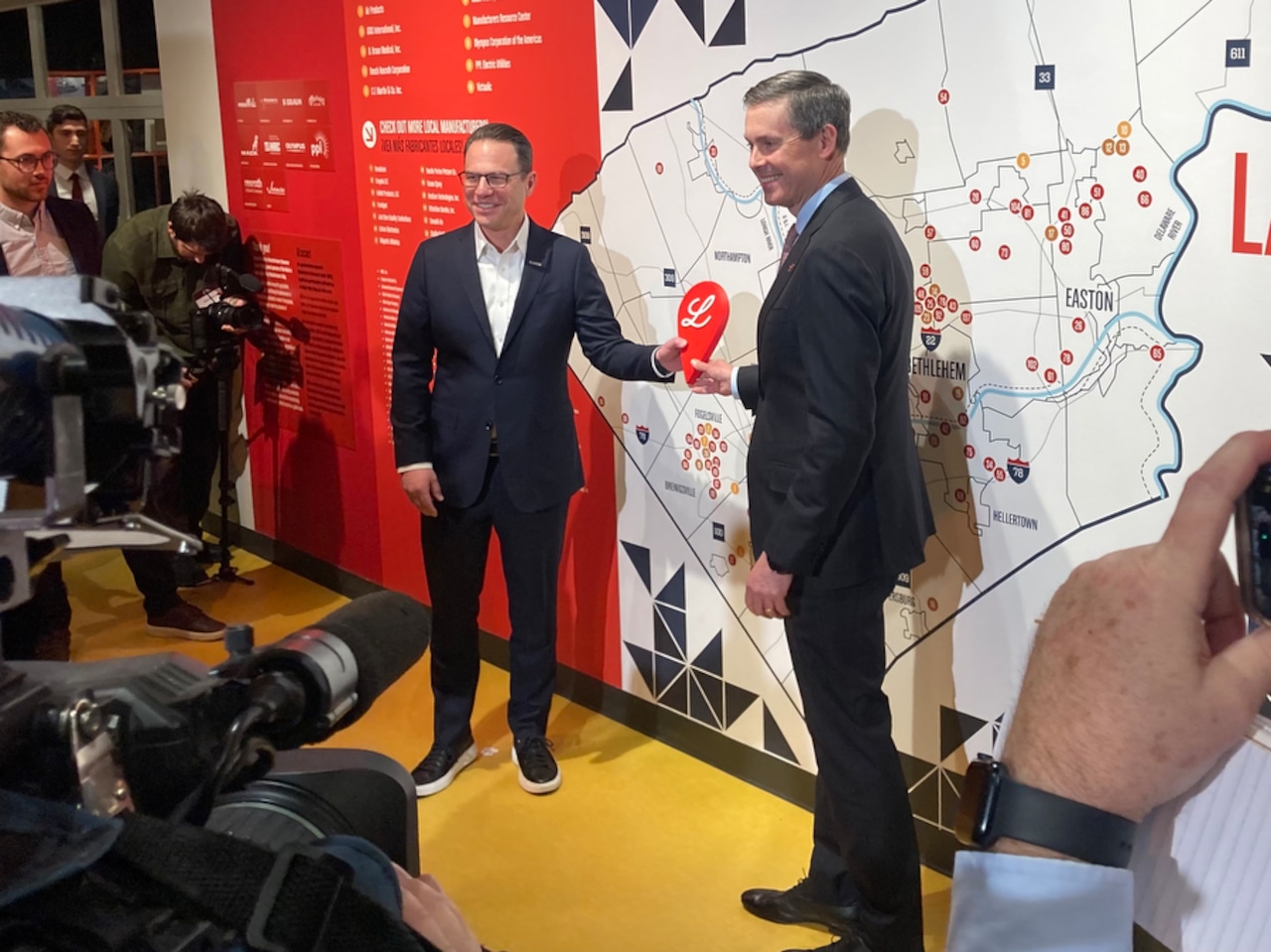
ALLENTOWN – In a big win for Pennsylvania and the Lehigh Valley, Eli Lilly & Co. has announced plans to build a $3.5 billion drug production plant in Lehigh County.
Gov. Josh Shapiro says Lilly’s commitment is the largest private-sector life sciences investment in Pennsylvania’s history.
When fully operational, the plant in the Fogelsville area of Upper Macungie Township is expected to create 850 permanent jobs. The site is about 10 miles west of Allentown.
“Our mission starts with patients and delivering the medicines they need,” David A. Ricks, Lilly chair and CEO, said in a news release as Gov. Josh Shapiro and local leaders gathered here to announce the plans.
“To meet increasing demand, we’re expanding our U.S. manufacturing network, with Lehigh Valley adding capacity for next-generation weight-loss medicines.”
The Pennsylvania plant is the last of four new North American manufacturing plants that Lilly said last year it planned to build. The company has since announced the other three plants will be built in Houston, Goochland County, Va. (near Richmond), and Huntsville, Ala., each representing an investment of between $5 billion and $6.5 billion.
Ricks said it received more than 300 proposals for sites for the four new plants.
“It was a highly-competitive process,” Ricks said.
“We’re creating high-quality jobs and collaborating across the region — with suppliers, educators, and workforce-development partners — to make critical medicines in the U.S.,” Ricks said, adding the average salary in a Lilly facility is about $100,000 a year.
“Those are high-value jobs that I can say with a lot of confidence, change the trajectory of families,” Ricks said.
The company said its target is to get the plant operating by 2031, though site work and construction – which itself can generate proect work for hundreds – will start several years before.
With Friday’s reveal, Lilly adds a major new flag to a Big Pharma roster in Pennsylvania that already includes firms like Merck, Johnson & Johnson, GSK and Sanofi Pasteur.
Shapiro, in his remarks, noted Pennsylvania was passed over for one of Lilly’s earlier plant announcements, but said his administration didn’t take no for an answer.
His team pursued Lilly’s leadership, learned more about what they needed and responded with an improved proposal for the next opportunity.
“They listened, and we are grateful for that. They believed in what we had to offer here in the Commonwealth, and we are grateful for that. And in the end, I would argue, we landed an even better deal for the Lehigh Valley,” Shapiro said.
Lilly is currently the world’s highest-valued drug maker, and it got there on the strength of its weight-loss products.
According to trade journal BioPharma Dive, Lilly’s injection-based drug Zepbound, and the version marketed separately for diabetes as Mounjaro, was the world’s top-selling pharmaceutical product through the first nine months of 2025.
Now, the company is trying to strengthen its grasp on the obesity drug market going forward.
Lilly hopes for U.S. Food and Drug Administration approval of its new obesity pill orforglipron this spring.
That would allow it to quickly follow rival Novo Nordisk to market with a pill version of what have been doses delivered by daily injections to this point; Novo Nordisk started selling a pill version of its Wegovy commercially earlier this month.
Lilly is also in clinical trials with a newer weight-loss drug, Retatrutide, a once-a-week injection designed for patients with obesity-related health complications that could benefit from deeper and more rapid weight loss.
Drug makers are excited about the ability of these new weight-loss pills to reach millions of more patients across the world.
“You’re getting glucose benefits, weight benefits, improvements in blood pressure, lipids, inflammatory markers — all that in a simple once-daily pill with no restrictions on food and water and of course which we can manufacture and distribute at scale,” Ken Custer, Lilly’s president for cardiometabolic health, told reporters at the company’s most recent quarterly earnings call.
The pills may also be an important solution in countries where it’s difficult to supply therapies that — like Zepbound and Wegovy — must be packaged, shipped and stored at cold temperatures, Ricks said.
“So we tend to think at a different magnitude about the opportunity here than historically what we’ve done with incretins,” Custer continued.
“In the United States there’s probably 8 or 8.5 million people on incretins (now) out of maybe 170 million who might benefit. And globally that’s a much bigger number, probably measured in the high hundreds of millions or even billions,” Custer said.
That’s where the new manufacturing capacity comes in.
Ricks said Friday the proposed Lehigh Valley plant will produce both Zepbound and, assuming it eventually wins approval for commercial use, Retatritude.
The Lehigh Valley plant will be supported by $100 million in state grants and tax credits.
The state has also committed to providing a Redevelopment Assistance Capital Program (RACP) award of up to $5 million to a local community college and/or technical school to help create a tailored workforce development program for Lilly’s needs.
Shapiro, at Ricks’ side for Friday’s announcement, hailed it as a great addition to Pennsylvania’s pharmaceutical and life sciences sectors.
“Lilly’s commitment to the Lehigh Valley and to Pennsylvania will bring billions of dollars of investment and hundreds of good-paying jobs, solidifying our position as a leader in the growing life sciences industry.”
And leveraging the incumbent’s edge in a re-election year, the governor took some credit for himself.
Citing his administration’s work over the last three years to cut red tape, invest in site development, and expand the workforce, Shapiro said “the bottom line is, after not even being on the field for years Pennsylvania is not only back on the playing field, we are winning big deals as we compete with the other states in our country.”
Founded in 1876 by Col. Eli Lilly, who started making drugs in Indiana after serving in the Civil War and becoming shocked by the quality of care provided to soldiers in that conflict, the company was an early mass producer of insulin and the polio vaccine.
Today, Lilly develops and makes prescription drugs across various therapeutic areas including diabetes, oncology, immunology and neuroscience.
Its products are sold in approximately 95 countries.