
As Pennsylvania’s capital, the City of Harrisburg is home to more than 50,000 residents and serves as a symbol of the commonwealth’s rich and storied history. However, like so many other cities across the state and nation, Harrisburg – particularly its downtown area – has grappled with economic challenges exacerbated by the COVID-19 pandemic. Popular eateries like Zeroday Brewing Co.’s Taproom, the Federal Taphouse and Home 231 have permanently closed over the last couple years, while other businesses, ranging from coffee shops to retailers, fear that the city’s economic woes could have wide-ranging ripple effects.
City & State spoke with state and local leaders – including Mayor Wanda Williams, state Sen. Patty Kim and Harrisburg Regional Chamber and CREDC President and CEO Ryan Unger – about Harrisburg’s economic challenges, the development of a downtown revitalization plan and coordinated efforts to draw new investments into the capital city.
These conversations have been edited for clarity and length.
There have been several business closures in downtown Harrisburg in recent years. What are some of the factors driving this?
Wanda Williams: The city of Harrisburg extended financial resources to some business owners after the COVID pandemic. Several times, we extended the funding to them – a majority of them paid all their debt off and left. So they used that money to pay any outstanding bills or debts, and they started moving. We did not know they were going to do that … We were trying to help them. We extended that service to them, knowing they would also maintain their business’s status here. Impact Harrisburg also assisted them, but they still moved … So the economic impact on Harrisburg is really bad, because we do not have individuals coming into Harrisburg who would like to purchase or even occupy rental space.
Many people are talking about how parking rates have increased. But over the years, we have never increased parking rates here in the City of Harrisburg … We had to sell our parking assets during Act 47 and the debt restructuring. Standard Parking has raised rates to $30, which is a really bad thing for the City of Harrisburg.
Patty Kim: My frame of reference is that I came into this area in 2000 – and downtown was considered “Restaurant Row.” And it was a source of pride, because it had just been growing by leaps and bounds. That’s how I see downtown, and I know that people who have been here longer remember… What I’m seeing now is just really sad. Something that was a source of pride becomes a kick in the gut whenever somebody leaves.
We have people, from residents to stakeholders or investors who are like, “We want to see downtown the way it used to be, or even better.” We are having conversations about what we can do, and they are going very well.
Ryan Unger: I think what downtown Harrisburg is facing, frankly, is no different than what we see in other downtown areas that have, predominantly throughout their history, relied on office workers for foot traffic. You can look at the architecture downtown, the physical infrastructure like wide-lane roads, big, tall buildings for offices – it was intended to be a downtown office park, not necessarily a place where your community gathers, but where office workers come to work – and many of them leave. We’ve got data. They show that pre-pandemic, we had a little north of 30,000 people downtown every day. The city’s population is 50,000. It was built to hold office workers and was office-worker-centric. I think consequently, post-COVID, the advent and acceptance of remote and hybrid work – people are commuting differently, they’re working differently, and we’ve got to adapt now in downtown Harrisburg. Restaurants and other services depended upon that, and now we’ve got to find a way to help bring back that foot traffic.
How big of an impact do you think post-COVID remote and hybrid work trends have had on Harrisburg’s downtown? How are other factors like parking and housing playing into these economic struggles?
WW: State employees – we have about 80,000 state employees – probably about 65-70% of them were working from home, so they’re no longer parking in the garages or parking spaces.
PK: It’s a combination of lifestyle patterns and has really hurt downtown. People have changed their habits after COVID. Whether it be coming downtown three days a week versus five – people are eating differently, too. Uber Eats is so popular that fewer people are eating in restaurants and more are just eating at home.
We need to diversify. We’re not looking at our assets the way we really should. We see the Capitol and we’re thinking, “Oh, great, we have out-of-towners coming in after session days.” It has to be more than that in order to survive and thrive. The city just agreed to a deal for an outdoor concert series along the riverfront … By adding more retail, keeping the restaurants there, and capitalizing on the riverfront, we can do a lot more. It’s unfortunate that we’re in this situation, but wow, what an opportunity for us to see ourselves differently than just restaurants for lobbyists after session days. We’re more than that.
RU: It begins with foot traffic, period. If you’ve got amenities and attractions that outweigh whatever the potential parking charges are, you can manage that. I think I heard a planner once say to me, “No one comes downtown to park.” You come downtown to visit a restaurant, go to a museum, go to a show, and that’s why you go downtown. Parking is a vehicle by which to do that. When you think about the way we’ve changed in terms of the way we live our lives, we DoorDash, we use food delivery. The Journal had a story a week or so ago about the death of workplace happy hours – we’re drinking less. The ground’s shifting underneath some of these businesses and offices that are downtown. So now we’ve got to try to figure out where that puck is going to, skate to it, and take it from there.
What work is currently being done to help revitalize Harrisburg’s downtown area and the local economy?
PK: The role I am playing is that of a convener or facilitator. These conversations have already been happening … Getting support from the governor – he’s been very responsive – speaking with the mayor and making a commitment that we’re going to work together.
Then, looking at state resources, I’ve advocated for $350,000 to go into a city revitalization plan – that’s in the works. I can’t say that it is a done deal, but it looks good. That will be our first major step in paying for a plan. Once we have a plan in place by professionals, we will talk to our stakeholders, our investors and businesses, and the state, and do something very similar to what Pittsburgh has done. I believe the state is very proud of the investments it’s made in Pittsburgh. We are not Pittsburgh, but we would customize that plan, a plan like that, to Harrisburg and move forward. It’s pretty universal that we need to do something. That’s the good thing right now. There’s nobody who will be like, “Downtown is fine.” I think once we get that plan in place, things will move pretty quickly.
WW: I’m really excited about everyone wanting to partner with us to revitalize downtown. But also, I’m concerned about the City of Harrisburg in general. We have seven districts, so why not be concerned about the other districts in the city of Harrisburg? … There are great efforts. There was a really good conversation around that table with the governor, and there are individuals who are committed to doing certain things. That really made me happy, because now everybody’s coming to the table.
RU: I think what makes us a little different is that we also recognize we need to show real progress, real quick. That’s one of the things that you’ve seen reported following our meeting with the governor. We want to seek financial support from the commonwealth, federal government, state and local governments, and private individuals to immediately fund projects and also to demonstrate that we have momentum going forward. At the same time, we’re really implementing a well-thought-out strategy, a parallel track of using what we’re learning from that process to identify early implementation projects.
Some of these things just take longer, like bringing in engineers to understand the costs of office-to-residential conversions and what street changes we need to make, since we’re not accommodating 30,000 people anymore. Do we do traffic calming? Do we shift one-ways to two-ways? That’s going to take some time. But that doesn’t mean we can’t make investments in office-to-residential conversions, green space, arts, entertainment and culture, focus on public safety. There’s things that we know that are just foundational …We can begin doing those things almost immediately if funds are available. It’s incumbent upon us to go to the governor, our state legislature, and other folks, working with the mayor and the business community, to say, “This is what we need funds for.”
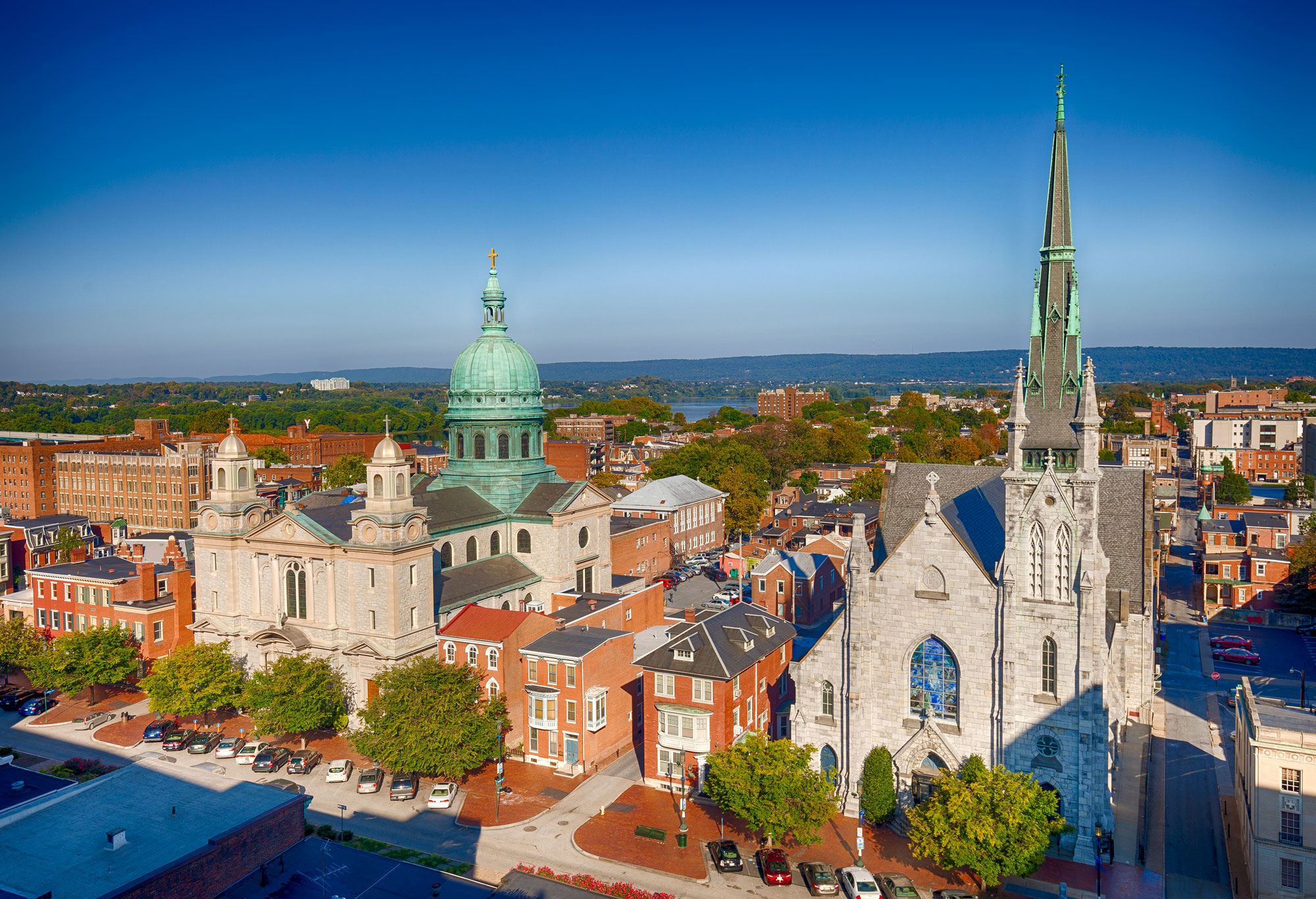
Numerous businesses in downtown Harrisburg have closed their doors since the COVID-19 pandemic. Photo credit: traveler1116/Getty Images
What specific sectors and types of businesses should the city look to attract downtown?
PK: We need more traffic downtown, and so we are working with Harristown Development Corporation to convert some of these buildings into residential. Right now, people are thinking, “Do I want to live downtown?” The answer’s probably “No” right now. But once we build a population downtown, we will need places for them to shop. We also have Harrisburg University there – students there are looking for things to do, and they also need to eat and recreate. We need to have people downtown first, and then we’re going to definitely be creative … make it a fun place for residents, students and visitors.
RU: We’ve seen downtown foot traffic drop from over 30,000 to closer to 20,000. Depending upon the day, it can be significantly lower. We know where those anchors and hubs and spokes are, and we need to invest in those assets …Certainly, we need to replace some things and build new amenities, but that doesn’t mean we don’t focus on the assets we do have and adopt an asset-based development philosophy to identify what we can do.
What are some of the city’s biggest strengths that can be leveraged as we talk about this downtown revitalization?
WW: When they talk about Harrisburg not being safe – every city has this drama. But in the last year, we’ve cut down on shootings. We had 13 homicides – we have all but one solved. The strength that we have is our police, our public safety. Our fire department is one of the major institutions here. We assist many communities in and around the city … Our public works department does a tremendous job keeping our streets clean and maintaining our vehicles. We have now entered into a memorandum of understanding with three townships – we now pick up their recycling and trash. We were just approached three months ago by two other communities that would like for us to assist them in doing their recycling and their trash.
PK: We are the state capital, we are by the beautiful Susquehanna River, we’re a small college town, we have our hospitals here – I think we have all the things that we need to be successful. We just have to get on the same page. I’m really excited about some good things happening soon. These projects take years, but with the amount of excitement, effort, and cooperation, things can move quickly. I am hyper-focused, as the state senator for the City of Harrisburg, to push the boulder up the hill. Things will start happening, moving, but we need that first push up the hill. This is one of my top priorities.
RU: Harrisburg has an arts and cultural district, a strong attraction scene featuring live music and concerts, theater, and a downtown museum and science center. And certainly, we need to build up office-to-residential conversions … but that’s a slower process. So if there are some things we can do immediately to drive foot traffic and help our restaurants and other downtown businesses, I think it’s incumbent upon us to identify and do them. When you look at downtown Harrisburg, it does not have the density you would see in other communities, even in South-Central Pennsylvania. I think you want to make it a more people-centric place, and then you need to try to attract and build the amenities that people want in their communities. They want places to shop. They want places to buy groceries. They want green space and parks. We’ve got many of the building blocks we need, but it’s going to require some coordination and, certainly, more investment.
What gives you hope and optimism about the City of Harrisburg and its future?
PK: I’m in the General Assembly, but we also have two state reps who are also on board. Politics is very divisive, but it is almost universal that we all want to see downtown do better. Unfortunately, we had to get to this point … but people are ready to roll up their sleeves and go. Downtown is like the front porch, the doorstep, the entrance of Harrisburg. When it’s not looking great, it’s a reflection. We can be so much better, and I think people are ready to see a difference and be a part of it.
RU: One of our core values as an organization is that we are unrelentingly and unapologetically positive. I think it’s incumbent upon us, as the regional chamber and economic development organization, to really channel that into how we talk about this city. I think it’s important to know that we don’t think this means burying our heads in the sand and ignoring the real issues and challenges we face. But I think we can do it in how we talk and how we view and how we put forth the next steps. In terms of specificity, I think we’ve got real interest and engagement from a broad array of stakeholders. We’ve seen some exceptional leadership from our legislators; some of whom have said, ‘ This is our priority.’ And that’s not always the case … we’ve got real acknowledgement and recognition that this is critically important, and now it’s incumbent upon us to start coming up with solutions.