
I’ve become notorious for looking ahead and thinking, once we power through this busy period, things will ease up and we can stop sprinting so hard. Then the calendar doubles over laughing at me and I realize that’s never happening. That largely describes 2025 turning to 2026.
Last year was a hyperactive year in which the LVPC and our sister organization, the Lehigh Valley Transportation Study, completed a four-county, two-state climate resiliency plan, reclassified all 8,235 Lehigh Valley roads, worked to develop a housing attainment strategy, developed an industrial land use guide communities can use to prepare for uses like data centers, created an electric vehicle charging prioritization plan, performed nearly 1,000 development-related reviews, gave planning and transportation training to nearly 400 people and created an employment and population forecast that will serve as a planning basis for virtually all aspects of life in the Lehigh Valley — just to list a few projects.
The “things will be easing up soon” thought came a lot, but I think it’s time to embrace the idea that we’re a growing region in which our community partners have a lot of needs as we evolve. That’s certainly better than the alternative, where two-thirds of Pennsylvania counties are shrinking or have flatlined.
As I come to terms with the reality that this is the new normal, here’s a list of upcoming projects we’ll be tackling in 2026, including several that were started last year:
• Passenger rail: The Lehigh Valley Passenger Rail assessment began to chug forward in 2025 as state Sen. Nick Miller and former Lehigh County Executive Phillips Armstrong announced that $300,000 in state money would be added to $100,000 in county money to fund a Phase 2 study that is part a 14-step, 10-12-year process of trying to re-establish passenger rail service in the Lehigh Valley. In 2026 and 2027 we’ll oversee the study that will identify an operator, determine the route — Northern New Jersey, Philadelphia or Reading — and begin to set goals, objectives and evaluation criteria for the system. The phase will take 12-16 months to complete.
• Housing strategy: The LVPC, Urban Land Institute and Lehigh County will complete and release The Lehigh Valley Housing Supply and Attainability Strategy in the spring. Northampton County, a planning partner, is rounding out the effort, along with all 62 local governments, school districts, nonprofit and private sector leaders charting a clear, multi-prong path forward to erase a 9,000-unit regionwide housing shortage. Everyone needs a home and the Housing Strategy will provide achievable ways of increasing housing for all income levels, and in locations that support the needs of everyone.
• E-plan: The Electronic Submission Portal is an essential resource for modernizing planning communication across the region. Plan review applicants will for the first time be able to submit projects online, and the portal will also be used for data requests, information sharing, grant consistency letters, and municipal ordinance and plan submissions. This helps the local governments, LANTA, state agency partners, sewer and water authorities, applicants and the Commission coordinate quickly and increase transparency and access to development, ordinances and plans.
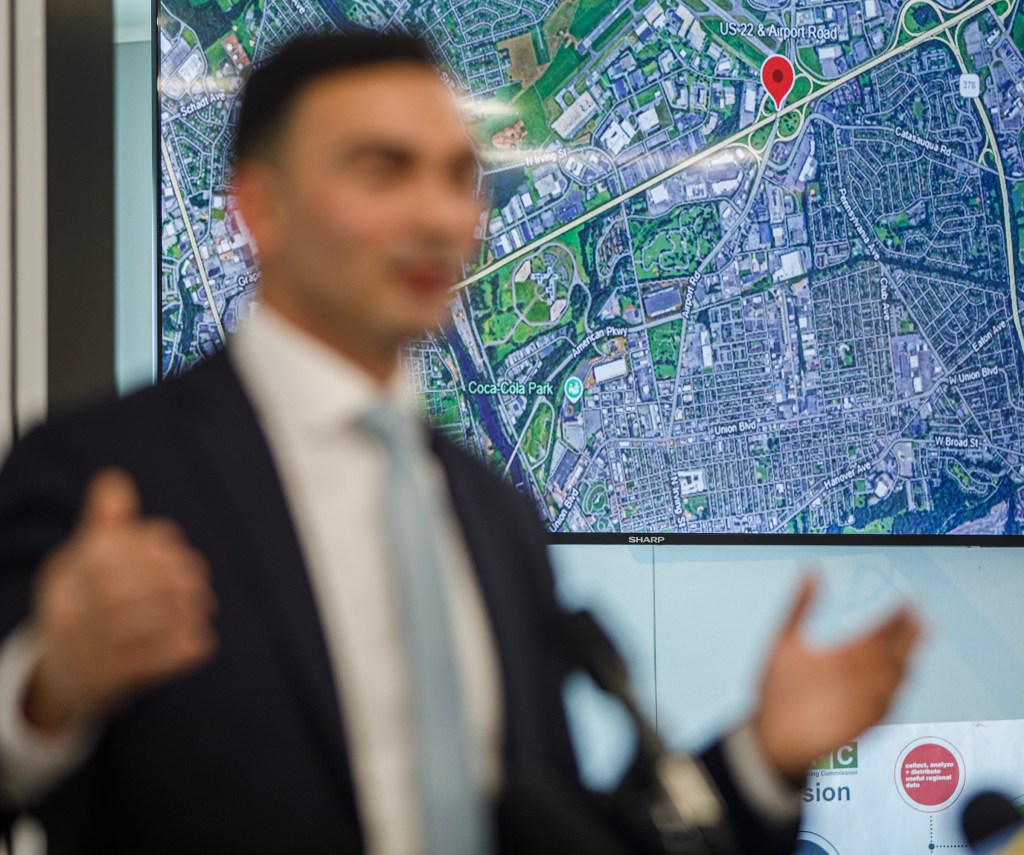
• Route 22: Thanks to $1 million in funding arranged by Senator Miller and PennDOT Secretary Michael Carroll, in 2026 we’ll be developing a Route 22 plan that will include identification and prioritization of needed improvements that prepare the region’s most critical corridor for better congestion management, safety and mobility, while improving environmental quality and economic mobility. The Route 22: Mobility, Safety and Congestion Management Plan, also known as the “What to Do With 22 Plan,” is due in December.
• Transportation Improvement Program (TIP): A four-year, $543 million investment portfolio for the next four federal fiscal years is being prepared. This TIP includes more than 100 road, bridge, trail and community projects in every corner of the Lehigh Valley. Congressionally directed funding to the region is the budget for projects like the Tilghman at Route 309 interchange, rehabilitation of the Hill-to-Hill bridge and supports LANTA capital investments. The plan takes effect Oct. 1.
• Congestion Management Plan: The LVPC is evaluating more than 300 road corridors, and applying a complex scoring system, to determine where investments should be made to reduce congestion across the regional transportation network. The analysis will help prioritize projects in the Lehigh Valley’s 25-year, $4.4 billion Metropolitan Transportation Plan and four-year TIP.
• Safe Streets 4 All: With help from an $800,000 U.S. Department of Transportation grant, planning will focus on all 62 Lehigh Valley municipalities to identify projects for investment to address pedestrian, bicycle and vehicle safety. The program is designed to prevent injuries and fatalities, while promoting all modes of transportation.
• Focused Water Planning: The LVPC will continue the multi-year project of updating the Lehigh Valley’s Act 167 Stormwater Management Plan for the 15 watersheds in Northampton and Lehigh counties. The project is the first time in the region and the largest initiative in the commonwealth to create a single, global plan that covers all watersheds, protecting water quality, while preventing flooding and property damage.
• FutureLV: The Regional Plan: In what will be an all-hands-on-deck approach, the LVPC will be building on the data and analysis work of 2025 to update FutureLV, the bi-county comprehensive plan and metropolitan transportation plan, designed to set the land use, environmental, community services, economic and transportation direction to carry the Lehigh Valley to 2050 and beyond. In addition, to beginning the single, common strategy for the region, it lays out the next 20 years of transportation investments. The plan will be released in 2027.
So no, things aren’t slowing down. People, businesses, jobs, refined infrastructure management systems, preparation for new and emerging land use, and much more underpin why planning is more important than ever.
In the 250th year of this nation, it’s important to reflect on what our own Benjamin Franklin embedded as a keystone of our national values: planning. Franklin famously observed, “By failing to prepare, you are preparing to fail.” We certainly are preparing and will be prepared and our work ahead reflects a region that’s growing, investing in itself to ensure long-term success. Sprinting may be the new normal, but at least we’re running with purpose and in the right direction.
This is a contributed opinion column. Becky Bradley is executive director of the Lehigh Valley Planning Commission. She can be reached at planning@lvpc.org.