
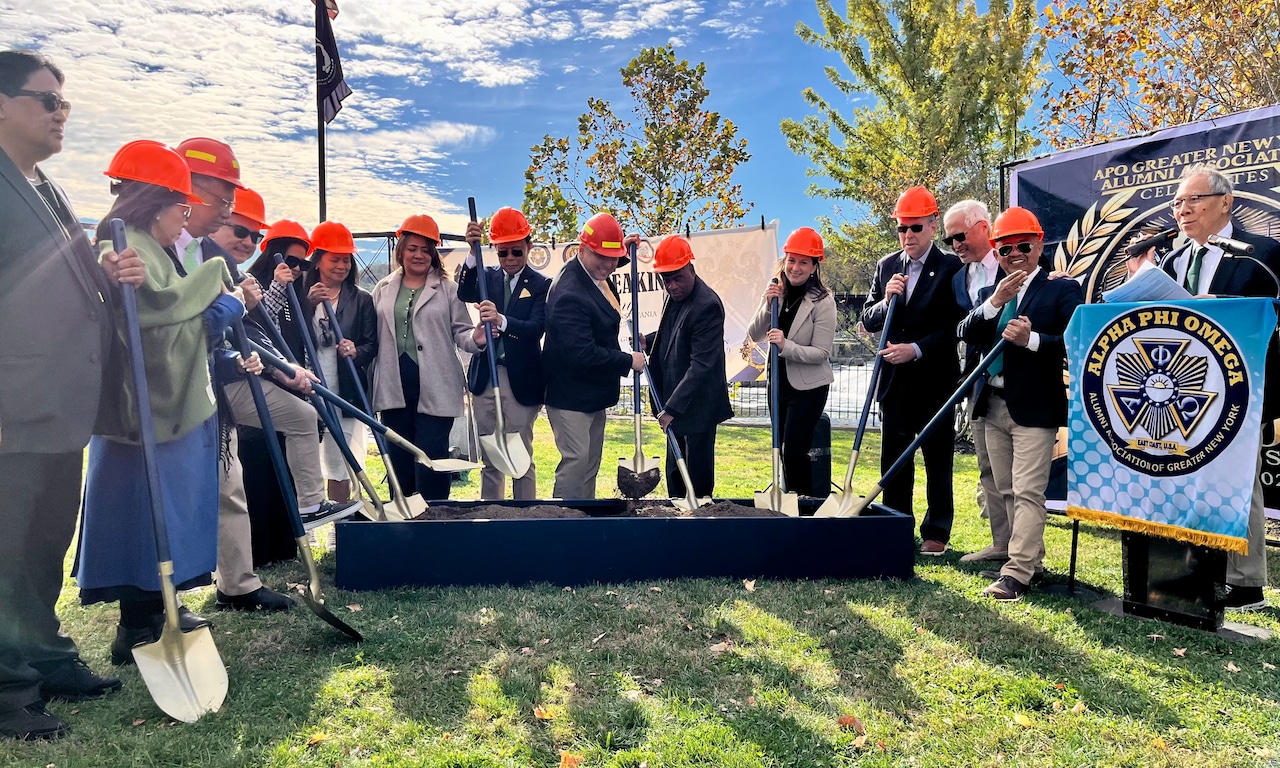
A fraternity founded 100 years ago at Lafayette College was set to be recognized at Easton’s Scott Park with a 15-foot obelisk.
But after a vote by city council, Scott Park will not be the obelisk’s home.
Easton City Council voted at a recent meeting to deny a certificate of appropriateness for the proposed obelisk honoring the Alpha Phi Omega fraternity.
Last year, City Council voted to approve the obelisk. The Alpha Phi Omega Alumni Association of Greater New York held a groundbreaking ceremony for the monument, attracting nearly 100 attendees to mark the anniversary and the fraternity’s founding at Lafayette.
Many came from around the U.S. and the world, including the Philippines.
Easton’s Historic District Commission recommended denying the COA, and council’s recent vote upheld that recommendation.
The decision concerned whether the specific design and placement were appropriate for Scott Park, not whether the city would continue to own the monument. It has already been accepted as a gift, according to the city solicitor, so the city will decide its new placement.
Council members’ concerns included the scale and massing of the obelisk, which some felt would be too large and visually dominant in the park setting.
Councilwoman Julie Zando-Dennis also raised concerns about the material and character of the monument. She argued that polished black marble is not consistent with materials typically found in the historic district, and the structure reads more as a monument than as integrated public art.
“It does concern me that this would set a precedent for other organizations to also put a monument in the parks,” Zando-Dennis said. “I agree with the historic district commission. I don’t think it’s appropriate no matter what.”
Mayor Sal Panto Jr. supported the monument’s historical significance, noting that Alpha Phi Omega is an international service fraternity founded in Easton. He compared the proposal to other commemorative features in the city, including the peace pole in Centre Square given to the Easton Rotary Club and the Lenni Lenape monument at Hugh Moore Park.
“But the fact of the matter is, this council voted 7-0 to put it in Scott Park. How does the historic district commission come back and say, ‘no,’ they don’t approve it?” Panto argued.
Panto and some council members favored tabling the matter to allow time to explore other locations or design changes. Zando-Dennis argued that council should vote on the certificate so it would be clear that the current design and materials were not appropriate for Scott Park.
A motion to table the item did not pass, and council proceeded to vote on the certificate. The denial was approved by a 6-1 vote, with Panto voting against it.
Resident and local architect Brett Webber approached the podium to thank city council for denying the COA. He said there is a difference between art and monuments; art is open and inclusive, while monuments from private organizations can be exclusive and shouldn’t be allowed to predominate public spaces.
He said the city needs a comprehensive plan and common vision for parks and public space before allowing monuments.
“The city should have every right and strength of conviction to say ‘we want to enforce the public way,’” he said. “Because this is my space, we all pay for this. This is part of the public realm.”