
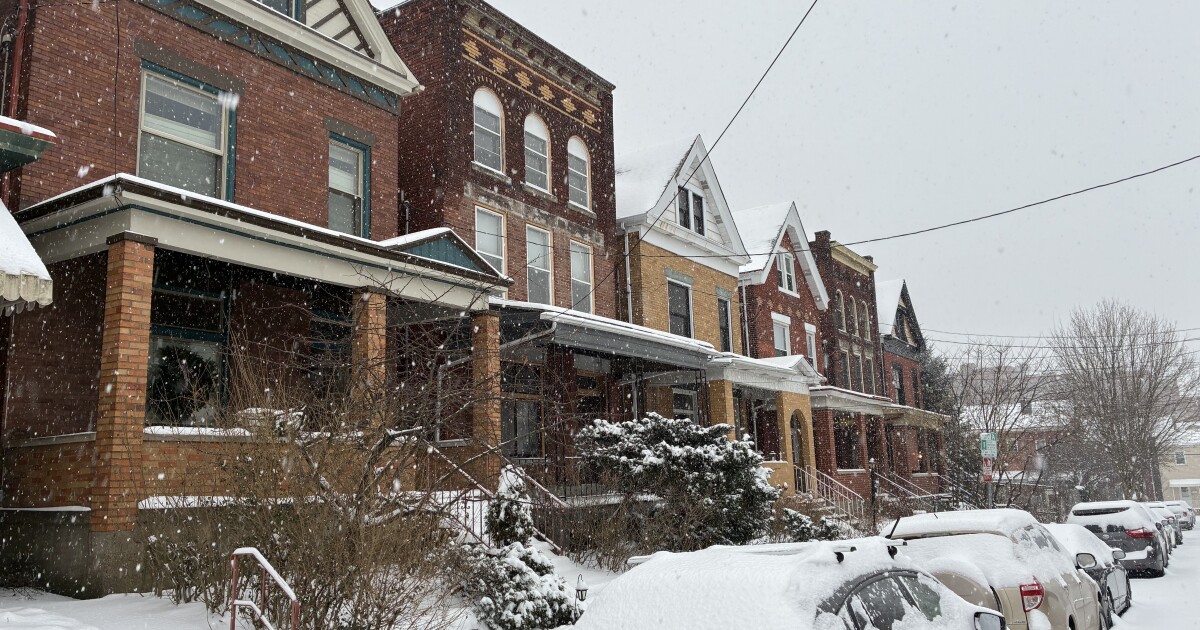
It’s been more than a decade since Allegheny County last did a property tax reassessment, and it’s not clear when the next one might happen. But County Council is already preparing.
At a meeting Tuesday, council voted 14-1 to approve legislation meant to protect longtime homeowners in gentrifying neighborhoods from future property reassessments. Democrat Dan Grzybek, the bill’s primary sponsor, described it as necessary groundwork for a countywide reassessment that is “certainly rapidly approaching.
“It’s definitely a question of when, not if,” he said.
Grzybek introduced the exemptions for longtime owner-occupants, a program also known as a LOOP, last month. The bill aims to ease the tax burden on residents who bought homes years ago in neighborhoods that have since seen skyrocketing property values.
“LOOP really helps protect those who are potentially most disadvantaged by countywide reassessment,” Grzybek said. “Those folks who are older, who are on fixed incomes who have lived in their home forever” in sought-after neighborhoods like Lawrenceville.
The next time Allegheny County reassesses, the LOOP would limit the new assessed value to a 35% increase in one year for any homeowner whose income does not exceed 125% of the area median income for the size of their household. The next year, the assessed value would increase another 7%, slowly bringing it to the market value.
The discount only applies to county taxes, and it cannot be combined with other tax cut programs, like the homestead exemption. Households could use the LOOP for up to 10 years, after which they would need to reapply for the program.
A LOOP doesn’t eliminate the possibility of a tax increase; Experts estimate that after assessment, one-third of property owners will likely see a lower tax bill, another third’s taxes will stay roughly the same, and the final third’s taxes will go up. Grzybek said the anti-gentrification measure could assuage lawmakers who would otherwise be scared to update property values.
“We wanna make sure that we [reduce] the worst potential impacts of a countywide reassessment, that we mitigate those to the extent possible,” he said. “But also I want to create the environment in which it is more politically feasible to pass the countywide reassessment that I think we desperately need.”
County Executive Sara Innamorato indicated her support for the program in a statement to WESA, calling policies that protect long-term owners a “critical part” of addressing local housing costs. But county spokesperson Abigail Gardner declined to comment on when a reassessment might occur, citing pending litigation. She said Innamorato feels any reassessment should be statewide and ordered by the legislature.
Democrat DeWitt Walton was the lone “no” vote at Tuesday’s meeting, saying that although he agreed with “the spirit of the legislation, the devil’s in the detail.” He argued that the income limits eligible for the program should be higher, allowing more people to qualify.
The measure drew little debate Tuesday, but the meeting did feature dozens of speakers who made their feelings known on another pending piece of legislation: a bill introduced last month that would bar county officials and employees from cooperating with federal immigration-enforcement efforts.
Lives of ‘constant fear’
The bill was not on Tuesday’s agenda: It is currently sitting in council’s committee on public safety. But speakers said they wanted council to see how much support it had, as polls suggest broad concern about the tactics being used by federal immigration officers.
Khara Timsina, who came to the United States in the 1990s and serves as the executive director of the Bhutanese Community Association of Pittsburgh, said he felt obliged to carry his passport everywhere, for fear he will be challenged by immigration agents.
“The same country that gave us a second chance to live a life in dignity,” he said, “has now filled our lives with constant fear.”
Those fears would have broader consequences, warned Jay Aronson, a professor at Carnegie Mellon University. Cooperating with immigration authorities can destroy immigrant communities’ trust in local government.
“This means that they’re less likely to seek help and less likely to cooperate and share information about public safety issues with law enforcement,” he said. “Local police forces know they can’t keep the public safe when the public doesn’t trust them.”