
In 1992, Pittsburgh Police and River Rescue recovered a man’s body from the Allegheny River between the 6th and 7th Street bridges. They responded to the scene after a witness called 911 to report an assault. Officers were able to find, arrest and charge the suspect. But despite decades of chasing leads, they were never able to identify the man they pulled from the river.
Until now.
Allegheny County officials announced Wednesday that thanks to modern forensics, investigators have identified this John Doe as Allan Keener. Keener was born Feb. 5, 1940, and had ties to Ohio and Kentucky.
Investigators were able to close Keener’s case thanks to forensic genetic genealogy experts at Othram, a lab based north of Houston, Texas. Scientists used a DNA sample and forensic-grade genome sequencing to build a comprehensive DNA profile and genealogy report to narrow down possible relatives of Keener.
Keener’s unidentified victim case is older than the careers of every investigator that spoke to WESA for this story.
“It’s one of those things that made me want to do this job to begin with,” said Stephanie Dittmar, an autopsy and histology technician in the medical examiner’s office. “It’s really really cool to see … something come of all the work that we’ve put into this.”
Othram built Keener’s profile and found a potential relative. Investigators in the medical examiner’s office contacted the relative who agreed to submit their own sample and confirmed that their John Doe was Keener. When investigators contacted the family to let them know, there was a mix of relief and sadness, according to Adelee Conner, a forensic biology and mobile crime unit scientist at the medical examiner’s forensic laboratory division.
“They didn’t have a lot of information surrounding the death of their loved one,” Conner said. “It was really rewarding to be able to hear the relief from her that [Keener] isn’t just missing, they’ve been found.”
According to police, Keener’s relative was unaware that he died, and some family members thought he abandoned the family. Now, 34 years later, some of their questions are answered. Allegheny County and Pittsburgh officials would not disclose the names of Keener’s relatives and said the family has requested privacy.
Kiley Koscinski
/
90.5 WESA
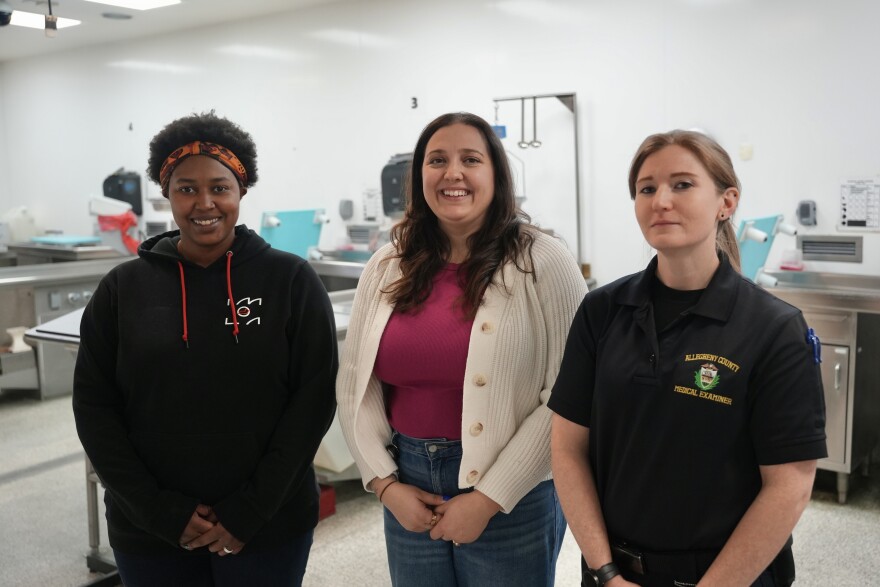
Stephanie Dittmar, Adelee Conner and Hannah George in the autopsy suite at the Allegheny County Medical Examiner’s Office.
Cracking cold cases with cutting-edge science
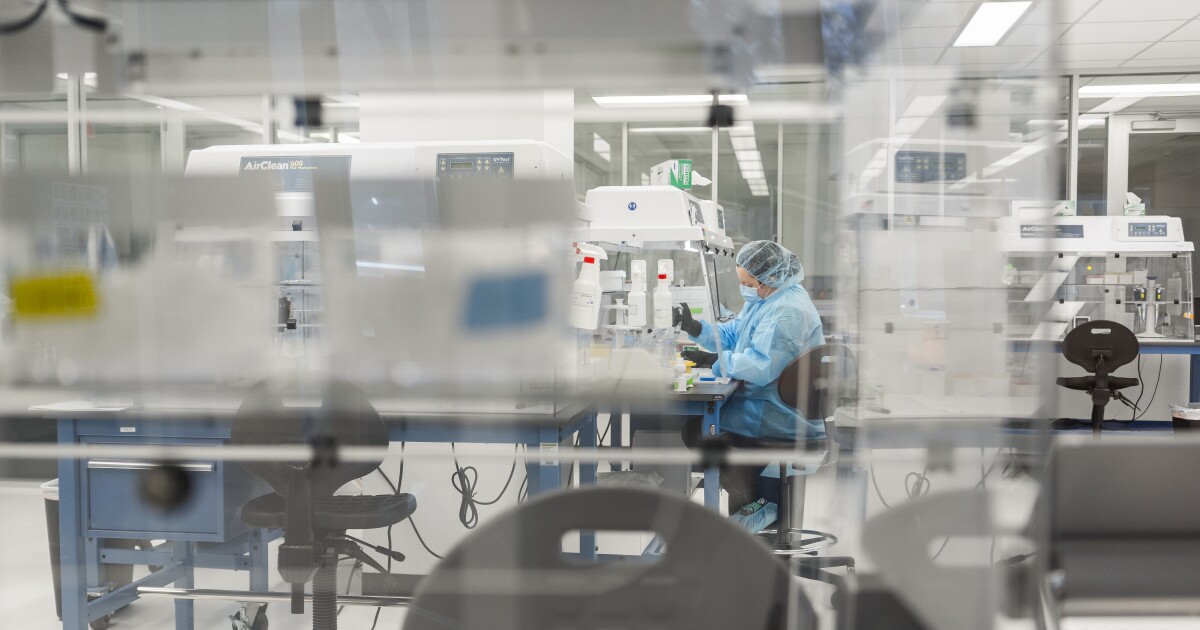
The medical examiner tapped the expertise of Othram thanks to a $100,000 state grant awarded in 2024. Keener’s case is one of several cold cases the county is hoping to resolve with Othram’s forensic-grade genome sequencing. The company’s proprietary technology can access genetic information from forensic evidence unsuitable for testing by other lab methods.
“Forensic-grade genome sequencing allows us to work with difficult evidence types,” said Colby Lasyone, Othram chief of staff. “This could be a situation where you have multiple contributors in a sample, a sample that’s been exposed to the elements or maybe it’s very old.”
Othram’s technology builds DNA profiles composed of hundreds of thousands of data points, which is far greater than the 20 data points built by law enforcement systems including those used by the Federal Bureau of Investigation. That additional data is what helped narrow down the search for Keener, according to Conner.
“Our [system] is more comparison based… to compare other forensic evidence that we find at scenes or that are obtained from suspects or victims,” Conner said. “None of our DNA that we use here is able to build a face or a body or anything like that.”
But Othram was able to take a blood sample from Keener and build a family tree based on his DNA.
“We’re not necessarily looking to match to an exact identity,” Lasyone said. “We’re looking to match to a relative so that we can build a puzzle… [and] in the middle there’s the unidentified person.”
Othram relies on a database of samples submitted to genealogy companies like Ancestry and GEDmatch. Most major genealogy companies require an opt-in consent during registration for users’ genetic data to be shared with researchers or law enforcement. Some, including 23andMe, partner with researchers but decline to work with law enforcement.
The company is helping more law enforcement agencies resolve cases that have gone cold. Their expertise is most useful for identifying people tied to a crime or who have died before the emergence of social media, according to Hannah George, a forensic investigator in the medical examiner’s office.
“If you have identifying scares or marks, tattoos and things like that… we can use social media and then try to reach out to family,” George said.
Keener’s case began long before George joined the medical examiner’s office. But closing the case is full circle for her: the initial report was filed by an investigator that was later a mentor to George.
Since Othram began partnering with law enforcement agencies in 2019, the company has been able to help solve more than 600 cases that have been made public, according to Lasyone. The company has also played a role in investigating other cases that remain in court or have otherwise not been publicized.
“Any case that has DNA where a profile can be built, it is our belief and our experience that the case can be solved,” Lasyone said.
Genealogy databases have emerged as an effective tool for crime investigators in recent years, more often to identify a suspect rather than the victim. Detectives in California used GEDmatch to identify the Golden State Killer in 2018. Joseph DeAngelo killed 13 people and raped 50 women across the state between 1976 and 1986.
Daniel Adaclog
/
Courtesy of Othram
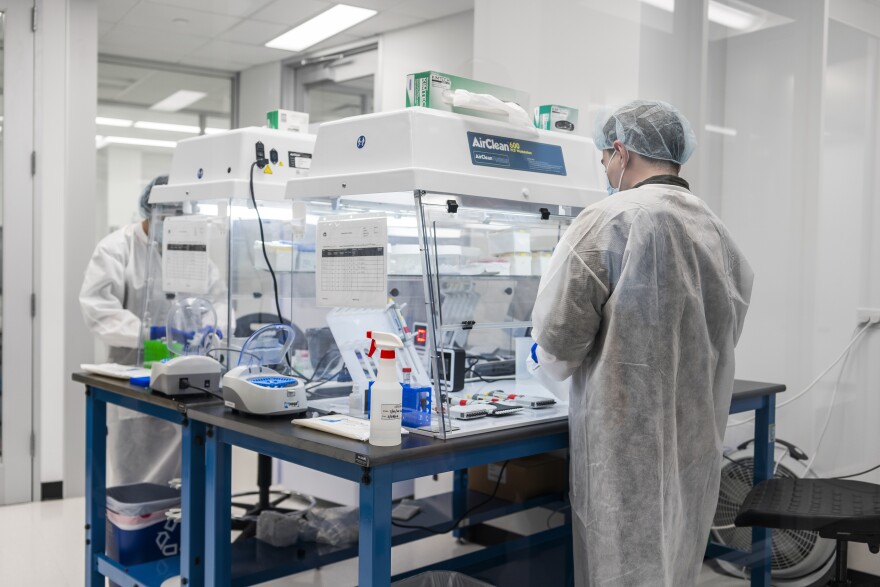
Scientists use DNA samples to build a family tree for an unidentified victim or suspect at Othram’s lab.
An unconventional investigation
With genealogy popping up in the investigations of many high-profile cold cases, investigators are typically looking for the suspect, not the victim.
“It’s really a twist on the way things normally go,” Lasyone said.
According to police, a witness saw part of the incident on a dock before calling 911 from a payphone. That same witness knew the suspect, who was later identified as Arthur Wiley. Police caught and arrested Wiley near the 6th Street Bridge shortly after they pulled Keener from the river.
Police tapped 20th Century early-stage DNA testing to match blood on Wiley’s hands and shoes with Keener’s blood. Investigators said Wiley confessed to the murder during an interrogation.
George Satler, a homicide detective in the Pittsburgh Bureau of Police, started his career with the bureau two years after Keener’s death. The case also predates the existence of the Allegheny County Medical Examiner’s office. At the time, police were working with the coroner’s office to identify Keener.
“It’s obviously our job to investigate the homicide,” Satler said. “But back then it was the coroner office’s job to ID the victim.”
Still, police worked up fingerprints and ran them through their own database, the FBI’s database and even military records. Their John Doe was not a match for any of them. Satler said police distributed a photo of Keener through the media in Pittsburgh and Kentucky with hopes of Keener’s family coming forward. They never did.
While Keener had ties to Ohio and Kentucky, he had no known address at the time of his murder and was known to be living under the 9th Street Bridge.
“Since he didn’t live in the area, he wasn’t staying anywhere, didn’t have any ID on him and his fingerprints [didn’t match the database], it was like the perfect storm that occurred and this guy wasn’t identified,” Satler said.
He added that Keener’s family never reported him missing, which was another rare circumstance that complicated the investigation.
The medical examiner’s office preserved a sample of Keener’s remains along with other cold cases for more than 30 years. Meanwhile, Arthur Wiley was convicted of third-degree homicide in 1993 and sentenced to prison.
Keener’s case was the oldest case of unknown remains at the Allegheny County Office of the Medical Examiner. But investigators plan to work with Othram to close a number of other cold cases, according to Mandy Tinkey, the medical examiner’s lab director.
“We have more than a dozen cold cases we are still looking to identify,” said. “We hope this partnership can bring forward other identifications that bring dignity and closure to our unknown remains.”
Lasyone stressed that Othram’s technology is available to any law enforcement agency seeking to close old cases with DNA technology.
“This technology is available and it’s helping to bring answers,” Lasyone said. “This is hope for others who are waiting for their answer.”