
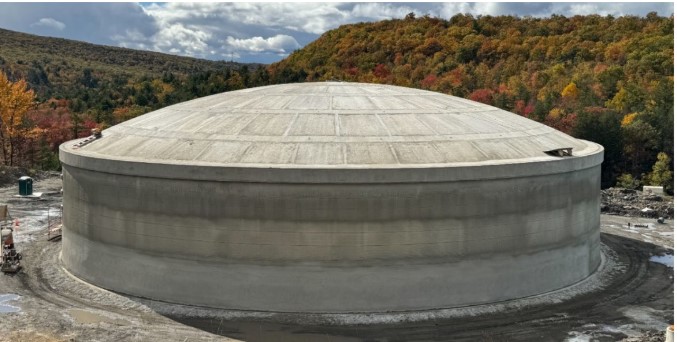
Data centers in Lackawanna County that would tap Lake Scranton, the city’s source of drinking water, for cooling would have to pay for the infrastructure needed to pump and pipe water out of that reservoir, a Pennsylvania American Water official told Scranton City Council.
The water company, which owns and operates Lake Scranton, also would ensure the reservoir had the capacity to handle any data center requests for water service, said Jeremy Eden, PAW’s senior director of operations in Northeast Pennsylvania, according to an Electric City Television simulcast and video of the council meeting posted on YouTube.
Council had water company representatives attend an informal council caucus meeting Tuesday night to provide updates and information on various water and wastewater services, projects and issues.
Council President Tom Schuster noted a data center proposal in Archbald plans to use water from Lake Scranton.
“Some information came out about how many gallons would be used from Lake Scranton, if in fact there was a data center to be built in Archbald. Can you just give us a rundown on what kind of water do you have on hand if this thing is to be built? What does it look like for Lake Scranton and the city of Scranton’s water supply?” Schuster asked.
Eden replied the company is in early stages of discussions with data centers.
“Our stance is ‘do no harm to existing customers,’” Eden said. “We’ve been very clear that currently our stance is any improvements to the infrastructure that would be needed to supply these data centers would be at the cost of those developers.”
Last month, The Times-Tribune reported Project Gravity wants to draw water from Lake Scranton to cool nearly 2 million square feet of data centers in Archbald. Representatives from Archbald 25 Developer LLC gave a presentation Jan. 6 at Valley View High School about their plans to build seven data centers across 180-plus acres between Eynon Jermyn Road and Business Route 6 in Archbald. The developers said they requested and received a will-serve letter from Pennsylvania American Water for approximately 360,000 gallons per day from Lake Scranton to cool the computer hardware that would fill their data centers. If drawing its maximum volume of water daily, Project Gravity would use enough water to fill a 660,000-gallon Olympic-sized pool about every other day.
“I know that a lot of the numbers are quite extreme that are out there,” Eden told Scranton City Council. “Those are usually just short periods of time, very hot days in the summer where they would use a lot of that water. The majority of a lot of times of year, especially cold winter times like now, it’s basically nothing, zero or not much. Just what you would see in an office building.”
The water company reviews requests for water service based on three parameters — a water source’s supply availability, treatment capacity and distribution capacity — and would review and evaluate whatever upgrades or infrastructure would be needed to provide the water service, such as pump stations, tanks and treatment, Eden said.
“After those designs get looked at and permitted by our engineering folks, they (developers) would then get that package of (costs of) ‘this is what you need to invest for us to serve it,’ ” Eden said.
Councilman Patrick Flynn asked if there are other PAW reservoirs currently being tapped for data center cooling. Eden said he was not sure statewide, but a proposal in Salem Twp. near Berwick would use water from PAW’s Berwick system, which is not in the water company’s northeast operational area.
Calling the advent of data centers a “hot-button issue” in Lackawanna County, Flynn said concerns involve potential droughts or other issues that could impact water levels, such as water-main breaks.
“Are there any guardrails that American Water would put in place to make sure that the small businesses and ratepayers are coming before a data center, in regards to water intake?” Flynn asked.
Eden replied, “Absolutely. As I said, there would be no harm to existing customers. And we understand those concerns and a very hard look would be taken from a source’s supply position to ensure that all modeling has been done prior to committing any sort of capacity to data centers.”
Flynn continued, “Would American Water be open, before any sort of deal is made with any of these data centers, to having public input from residents, of Lackawanna County or Scranton municipal officials, to have a seat at the table? Or is this just private business and if it happens, it happens?”
Eden said, “Just like we are having conversations tonight, that’s our intention and we want our communities to be informed of ongoing relationships.”
On Wednesday, water company spokeswoman Alana Roberts said PAW has had many preliminary/informal requests for water service for data centers, “but no formal applications or agreements are in place.”
Other topics of discussion during the hourlong council caucus Tuesday involved: how the company implements water and sewer line construction projects and coordinates with other utilities on excavations and paving of streets; the amounts of PAW investments made in recent years in the city; fire hydrants and water pressure; financial assistance programs available to ratepayers; and maintenance of stormwater catch basins.
Councilman Sean McAndrew asked how often the water company cleans out storm drains. PAW Superintendent of Operations Nick Wartella said there are over 14,000 catch basins in the city and the water company is required under a federal “consent decree” mandate to clean out 2,000 of them per year. Most of the 14,000 basins are owed by PAW and the rest are owned by the city, Wartella said. But nearly a decade after PAW acquired in December 2016 the Scranton Sewer Authority’s sewer system serving Scranton and Dunmore, it’s still not clear which entity — PAW or the city — owns which basins.
Councilman Mark McAndrew asked if the basins are mapped, saying it appears many are neglected because “it’s never clear who is responsible for what drains.” Wartella said, “I don’t know if there’s truly an actual list” of catch basins, but he would try to find out.
Councilwoman Jessica Rothchild said, “Those maps should be created.” Wartella said, “A good majority (of the catch basins) are ours. To know which is ours and yours would be good.”