
Electric bills across the country have been rising faster than the rate of inflation over the past few years, according to the U.S. Energy Information Administration.
In Pittsburgh last year, residential Duquesne Light customers saw default rates increase 15% in June and more than 10% in December.
The sudden increase has some throwing blame onto the relatively obscure organizations tasked with overseeing the reliable flow of electricity from power plants to homes and businesses.
Gov. Josh Shapiro has frequently called out PJM Interconnection for raising electricity prices and hurting consumers. He even touted his fights with the company during his recent budget address.
But electric bills are a little more complicated than that.
Here’s what you need to know to understand the electric grid and your bills.
Useful definitions:
Utility/electric distribution company: This is the company that sends you your electric bill, such as Duquesne Light or West Penn Power. Those companies determine how much electricity is needed to serve their customers and maintain the electric infrastructure in their service area to make sure power is delivered reliably.
Generator: A power plant. Examples include renewable sources such as solar fields and wind farms as well as thermal generators that use nuclear reactors or burn natural gas or coal to make electricity.
Customer/consumer: You, the person using the electricity and paying the bills.
Regional transmission operator: Companies that oversee the generation and flow of power throughout a region. These entities are regulated by the federal government.
Grid: All of the infrastructure needed to generate and deliver electricity.
Supply: The electricity itself.
Demand: The amount of electricity needed to keep the lights on.
Is there just one electric grid?
The electric grid is made up of many smaller grids. Each electric utility has its own power infrastructure that connects to other regional utilities. This patchwork is stitched together so that nearly the entire United States is connected by electric lines.
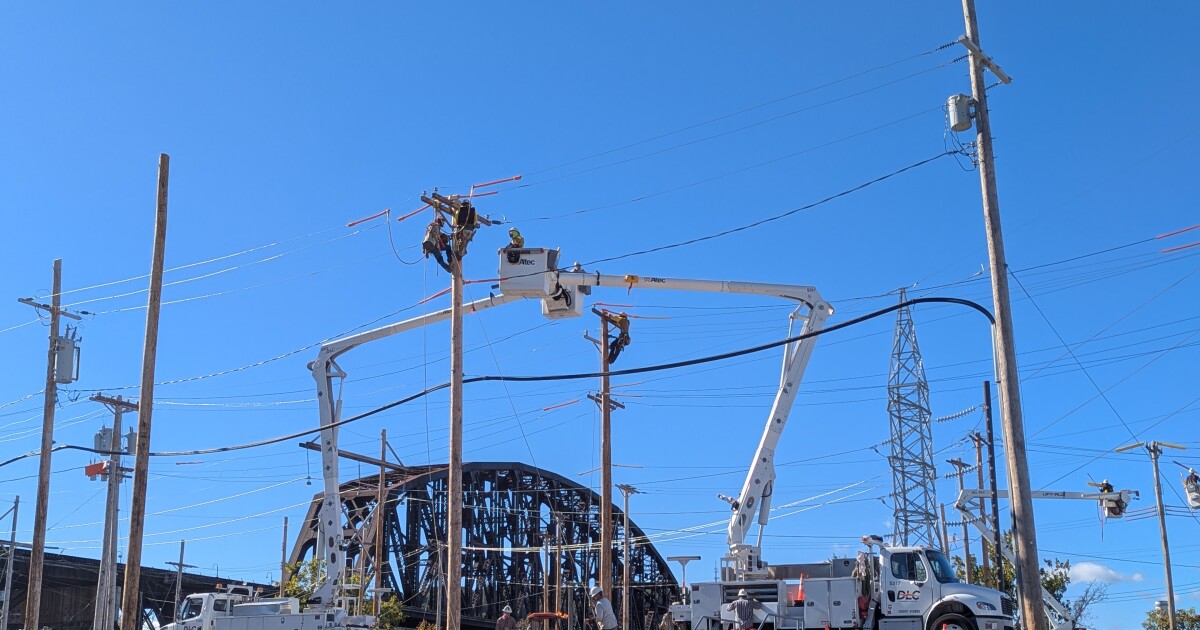
Jason Keller, director of grid infrastructure and engineering for Duquesne Light, said the grid has several parts: power plants, transmission wires, substations, transformers, and the “telephone” poles that run through neighborhoods. He said the electricity starts out at a very high voltage, then it’s brought down to a safe level for home use through that system of wires and transformers.
What am I paying for with my electric bill?
Supply (the actual electricity you use) and distribution (how it gets to you).
Your utility needs to maintain all the wires, substations, and transformers in its service areas. Sometimes utilities need to build more of these things, or conduct extensive repairs, like after damaging storms. The cost to maintain this infrastructure is what’s known as the distribution portion of your electric bill.
The other part of your bill is supply, the actual electrons you’re using. Electrons are generated by power plants, which in Pennsylvania cannot be owned by electric distribution companies. This part of your bill also includes the “capacity” that should be there when you need it in the future. Supply makes up 40-60% of the average bill.
Supply charges are more volatile than distribution charges, Keller said. Utilities have to buy the amount of electricity needed to serve customers from generators, such as nuclear power plants, gas-fired plants, or wind farms.
Who controls the price?
The two parts of your bill are determined in different ways.
Utilities must go before a regulator to raise their distribution rates. In Pennsylvania, that’s the Public Utility Commission.
Supply rates are driven by the market forces of supply and demand. These rates change daily, but this part of the bill is usually updated twice per year.
Keller said Duquesne Light can control how it maintains and invests in its distribution system — the physical wires and equipment that transports electricity. The company can’t control the price of supply.
“Whatever we’re paying for, that passes directly to you, no markup or anything like that,” Keller said.
Customers have the option to shop for better supply rates through PAPowerSwitch.com. Distribution rates are determined by which utility serves the area in which you live.
Where does PJM come into play?
“ You can think of PJM as that entity that’s quarterbacking all of those utilities that are interconnected in our region to make sure that we’re operating reliably on the distribution side,” Keller said. “ Most of what they do is trying to keep our customers from losing power.”
PJM is an independent nonprofit company that serves as the regional transmission operator for Mid-Atlantic states. It employs more than 1,000 people and is headquartered near Valley Forge, Pa.
PJM was formed in 1927 as a way for utilities in Pennsylvania and New Jersey to share power. Two Maryland utilities joined in 1956, creating the Pennsylvania-New Jersey-Maryland Interconnection, or PJM. It has since grown to include all or parts of 13 states and the District of Columbia.
As a grid operator, PJM makes sure there is enough electricity being generated to meet demand in the region. It also communicates with utilities and ensures transmission lines are able to get that power across different service areas to meet customers.
PJM uses two auctions or markets to ensure a reliable supply of power. The daily energy market handles real-time supply and demand.
Capacity auctions have been getting more attention lately. This auction serves as insurance for demand years down the road.
In the capacity market, power plants promise to be available later, for a fee. Utilities, and ultimately customers, pay that cost.
Recent capacity auctions have seen prices skyrocket, causing Gov. Shapiro to sue and even threaten to withdraw Pennsylvania from PJM.
PJM has said the most recent increase in capacity costs could lead to a bill increase between 1.5 and 5%.
Are the higher prices PJM’s fault?
PJM doesn’t set any prices. It operates on membership fees and it doesn’t get a cut of auction revenue.
Stephen Bennett, a government liaison for PJM, said the energy and capacity markets operate on principles of supply and demand.
“Our mission is really about reliability,” Bennett said. “That’s why we’ve designed and developed the markets the way we have. We work with economists inside and outside of PJM…and together we all work to make sure that the market structure is designed in a way to make the cost of that reliability as inexpensive as possible.”
Power demand has spiked recently, after years of being flat, which has driven prices up.
“If the market has a high-cost result, it’s not really because PJM is jacking the price up or we’re setting a price,” Bennett said. “It’s simply that the interaction of supply and demand has created a situation where prices are higher than they’ve been over the last several years.”
The prices should act as a market signal to companies that build power plants that building new generation to serve the PJM region is a good investment. But demand is rising faster than new generation can be built.
What’s driving higher demand?
For the most part, data centers.
PJM’s last capacity auction secured commitments to supply power in delivery year 2027-28. Peak demand for that year is forecast to be about 5,250 megawatts higher than the previous delivery year.
“Nearly 5,100 MW of that increase is attributable to data center demand,” PJM said.
The auction failed to secure the desired 20% reserve margin — basically, a cushion to protect against outages during peak demand.
Overall supply is tightening. A 2023 report from PJM said more than 42 gigawatts of generation in the 13-state region shut down between 2012 and 2022. Most of those plants burned coal.
Critics of PJM have blamed it for being slow to greenlight new generation projects. The operator revised its policy in 2023 in an attempt to speed up interconnection.
A new study from Carnegie Mellon University found the color of roofs and paved surfaces can make a big difference in quality of life in Pittsburgh.
It’s unclear if the forecasted demand from data center growth will materialize. The independent watchdog for PJM, Monitoring Analytics, said it is misleading to claim that recent capacity price spikes are “just a reflection of supply and demand,” adding there is “extreme uncertainty” in data center load forecasts.
“The current conditions are not the result of organic load growth,” the monitor said. “The growth in data center load and the expected future growth in data center load are unique and unprecedented and uncertain and require a different approach than simply asserting that it is just supply and demand.”
The Federal Energy Regulatory Commission in December ordered PJM to come up with new rules governing how large load users such as data centers connect to the electric grid, as a way to protect consumers. PJM outlined a new plan to connect large loads in January.
Shapiro is calling for data centers to bring their own power supply when building in Pennsylvania, as a way to keep costs down for other consumers.