
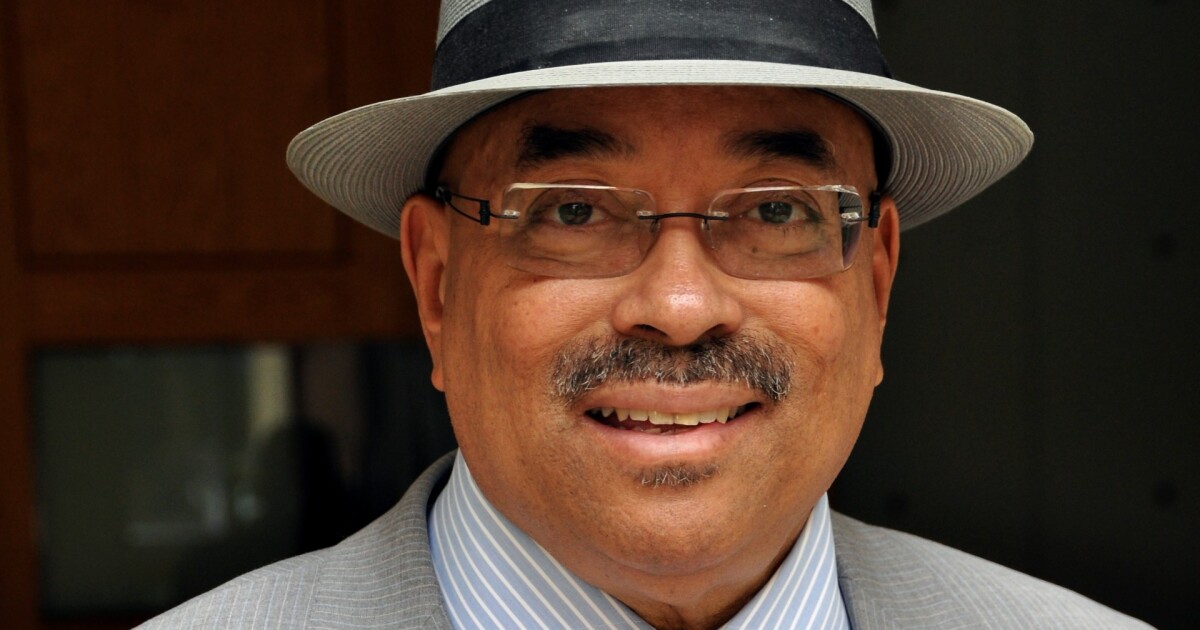
Chris Moore is one of Pittsburgh’s most beloved media figures. He’s also something of a cut-up.
The native of Little Rock, Ark., came to Pittsburgh in 1980. Ask him how he found his way here, and he’ll answer: “Greyhound.”
In fact, that was the year Moore took his first media job in Pittsburgh, as producer and host of the WQED TV public-affairs program “Black Horizons.” He’d go on to win multiple regional Emmy Awards, help set a standard for coverage of issues affecting Pittsburgh’s Black community, and leave a legacy of mentoring young Black journalists.
This Sunday, Moore will wrap his final media job here, retiring after 32 years as host of his KDKA radio talk show, “The Moore of Pittsburgh.”
‘He will always be respectful’
On Sunday, Feb. 8, his penultimate four-hour installment — the first since announcing his retirement — was filled with calls from listeners wishing him happy trails, as well as holding forth on such things as the polar vortex, alleged embezzlement at a crypto company and the plight of homeless veterans.
Moore fielded the calls with his trademark aplomb. As Minette Seate, his longtime producer at WQED, put it, Moore can “talk to anybody about anything.”
“He always tries to give people the chance to say what they want to say,” said veteran civil rights activist Tim Stevens, a frequent guest on Moore’s shows through the years. “He will always be respectful, but he will always engender a good dialogue.”
Moore, one of the handful of liberal voices on talk radio, said he enjoyed getting into it with callers who didn’t see eye to eye with him. But he said he feels there’s a right way to do it.
“That’s the important thing about radio talk, that you need to listen to people who disagree with you, and then if you have something to say to that, say something about it,” Moore said. “And sometimes they’ll change their mind, and sometimes they won’t. I think that’s the important thing about radio talk, and not enough people do that. They hang up on people, you know. They get angry and yell at ’em, and I try not to do that.”
From Wylie Avenue to Vietnam
A graduate of Grambling University, Moore served in Vietnam before beginning his career as a TV cameraperson in Little Rock. He also worked in TV and radio in St. Louis, Mo., before relocating to Pittsburgh with his wife, Joyce Meggerson-Moore.
“Black Horizons,” which WQED launched in 1968, was the nation’s longest-running minority-affairs program, and Moore was its host and producer for about 30 of its 42 years. (It went off the air in 2010; Moore left WQED in 2014.)
Moore said the program was meant to shine a light on the Black community, “and show that there were other things going on besides crime and punishment and those kinds of things, that there were good things that were happening” — things such as youth music programs.
“We wanted to show the positive side of the Black community, which no one else was doing at the time,” he said.
“Black Horizons” is a big part of Moore’s legacy. “He’s been one of the most dependable African American media people that we’ve had over the decades,” said Stevens, a frequent guest on Moore-hosted programs.
Also for WQED, Moore — frequently working with Seate — produced numerous acclaimed documentaries. “Wylie Avenue Days” (1991), about the Hill District’s heyday as a nationally known hub of Black life and culture, earned producer and narrator Moore his first regional Emmy. For “In Country: A Vietnam Story” (2006), he and two fellow vets returned to Vietnam for the first time since the war.
Other documentaries explore the Tuskegee Airmen of Western Pennsylvania, hip-hop in Pittsburgh, barber-shop culture, and Westinghouse High School.
Moore also worked for a decade as a host for WPXI-TV.
“Every part of his public life was some form of advocacy,” said Seate.
In 2018, he was inducted in Philadelphia into the Silver Circle Society of the Mid-Atlantic National Academy of Television Arts & Sciences, a lifetime achievement award.
‘The best that you can be’
Moore’s educational work included co-founding the Frank Bolden Urban Multimedia Workshop of the Pittsburgh Black Media Federation, which held journalism workshops for area high school students. (Moore also is a co-founder of the PBMF.)
But colleagues say education was just what Moore did.
“My entire time of working with him was one of mentorship,” said Seate. “I can’t imagine that I would be the person/producer/journalist I am without his guidance and mentorship.”
Ervin Dyer is senior editor at Pitt Magazine and PBMF treasurer. He met Moore in the ’90s while teaching at the Bolden Urban Journalism Workshop. At the time, he was a copy editor at the Pittsburgh Post-Gazette who wanted to break into reporting, and he said talking with Moore — and overhearing him talk to workshop students — gave him the confidence to make the transition.
In a time of vanishing daily newspapers and technological change in the industry, Moore is among those concerned about the future of journalism. But he said he hopes young people continue to pursue it.
“It’s a difficult profession, and it’s getting more difficult all the time, and that’s the reason you have to be the best that you can be,” he said.
He’s retiring, he said, because health issues and limited mobility have made it tougher to make it to the KDKA radio studios in Greentree. (The big recent snowstorm didn’t help.)
But he’s keeping a sense of humor about things. Asked what he’s going to do with his retirement, he quipped, “Spend less time with my family.”
His wife, who had accompanied him to his interview at WESA, nodded vigorously and smiled.