
According to new research from Penn State University’s Social Science Research Institute, an increase in online gambling is coinciding with increases in problem gambling in Pennsylvania.
The 2025 Pennsylvania Interactive Gaming Assessment: Online Gambling Report was contracted by the Pennsylvania Department of Drug and Alcohol Programs (DDAP). It is the fifth year of the assessment, which explores topics like gambling prevalence, demographics of gamblers, and gambling motivations and attitudes.
This was the first year the scope of the research included the prevalence of problem gambling in Pennsylvania. The results found that between 2.5% and 6.4% of Pennsylvania adults can be classified as problem gamblers, while 25.4% to 29.9% can be classified as at-risk gamblers.
“This year we expanded our survey to include the prevalence of compulsive and problem gambling among Pennsylvania residents,” lead researcher Glenn Sterner said in a statement about the findings. “This expansion of the assessment will help us to monitor this important public health indicator so that we can work with partners at the state to local level on addressing issues associated with the growing popularity of online gambling.”
Pennsylvania is leading the country in online casino revenue after setting a record with $3.46 billion in gross gaming revenue from online casinos in 2025. This coincides with the research finding that up to 30% of Pennsylvania adults engaged in some form of online gambling in 2025. That is a 50% increase from the 2024 report that found a 20% prevalence of online gambling.
This research could lead to increased investments in problem gambling support services alongside the continued growth of Pennsylvania online casinos and online sportsbooks.
Pennsylvania iGaming survey: Problem gambling services surged in 2025
Since 2025 was the first year that the Pennsylvania Interactive Gaming Assessment focused on problem gambling, there is no multi-year data to show how the prevalence of problem gambling in 2025 changed from previous years. However, the research does include several data points showing that Pennsylvanians used responsible gambling resources at record levels in 2025.
According to the report, Pennsylvanians called the National Problem Gambling Helpline 2,447 times in 2025. This was a 3.2% increase from 2024 and the second-highest annual call volume (behind 2,834 calls in 2023).
Perhaps more significantly, 2025 was the first year when more than 50% of calls to the National Problem Gambling Helpline mentioned online gambling as the primary concern. There were 1,230 helpline calls specifically mentioning online gambling in 2025. That was a 5% increase from online gambling-focused calls in 2024 and 50.2% of the total helpline calls in 2025.
Note that this research focused on calls to 1-800-GAMBLER, but the National Problem Gambling Helpline recently changed to 1-800-MY-RESET.
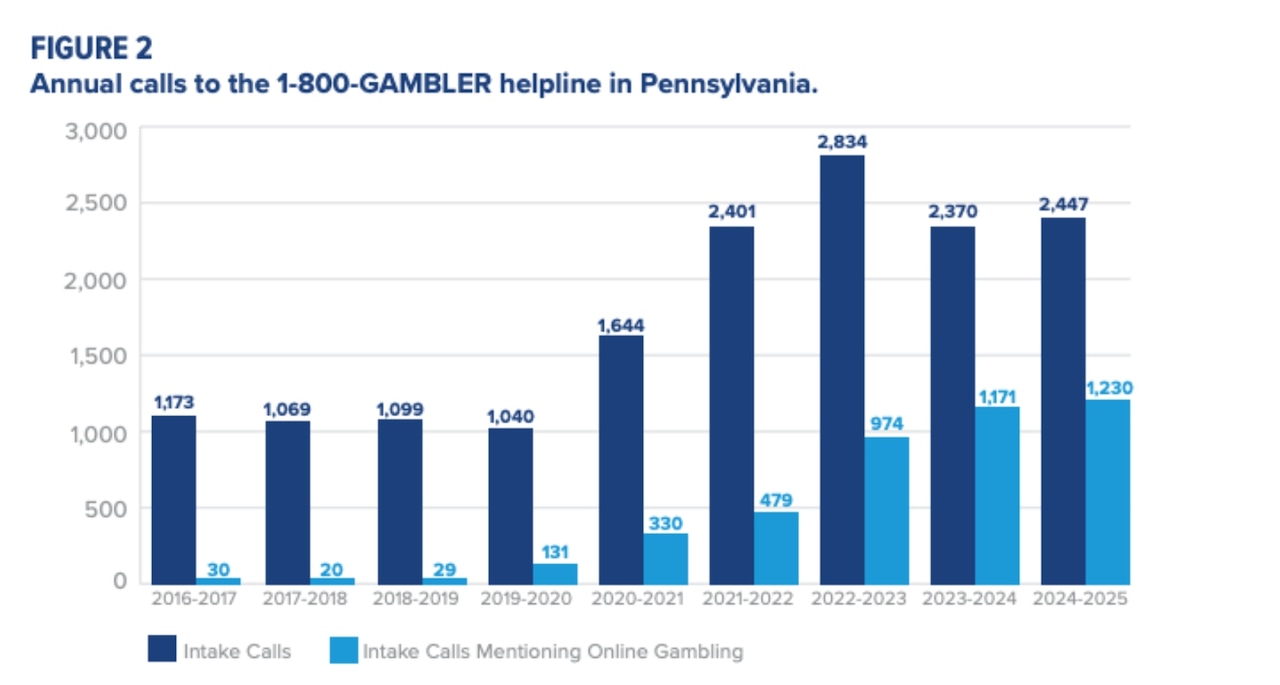 A screenshot from the 2025 Pennsylvania Interactive Gaming Assessment showing that calls to the National Problem Gambling Helpline increased 3.2% in 2025, and more than 50% of calls focused on online gambling.Penn State UniversitySelf-exclusion enrollments increase 65%
Another way to evaluate the increase of problem gambling prevalence is enrollment in PA self-exclusion programs.
According to the report, there were 4,403 new enrollments in self-exclusion programs in 2025. That was a 65% increase in total enrollments, which now sit at 11,195.
Pennsylvania plans expanded responsible gambling services
DDAP Secretary Latika Davis-Jones said that this research will help her agency expand the services it provides to support Pennsylvanians who may be struggling with a gambling problem.
In particular, she noted that support services will begin to include case management for the first time. That means people can receive support for other parts of their life that are impacted by problem gambling, such as financial counseling, childcare and healthcare.
“Knowing what the current online gambling trends are in Pennsylvania will assist DDAP in our work to assess and address how gambling behaviors impact compulsive and problem gambling within the Commonwealth,” Davis-Jones said in a statement.
“It will also help to guide our work as we expand DDAP’s gambling services to include case management support for the very first time. This will mean any individual in Pennsylvania who struggles with problem gambling behaviors can call 1-800 GAMBLER and receive case management and outpatient treatment services, like help with financial counseling, childcare, medical assistance, employment or other non-treatment needs.”
If you purchase a product or register for an account through a link on our site, we may receive compensation. By using this site, you consent to our User Agreement and agree that your clicks, interactions, and personal information may be collected, recorded, and/or stored by us and social media and other third-party partners in accordance with our Privacy Policy.