
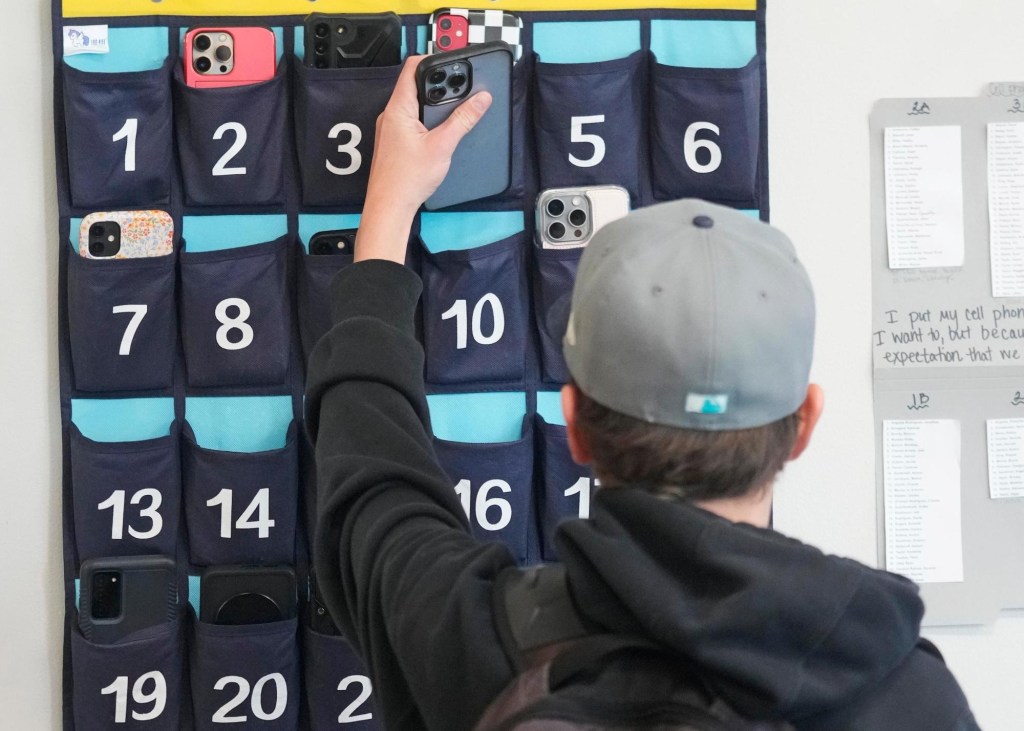
Sophie Rivera is only required to put her cellphone away during class time, but the Freedom High School senior said she wouldn’t mind if the devices were banned for the entire school day.
“I think it brings students closer together,” Rivera said, arguing that cellphone restrictions mean students interact more with each other and also build better bonds with their teachers.
Bethlehem Area School District implemented its districtwide cellphone restrictions this school year, and other Lehigh Valley districts are considering their own proposals as state legislators have advanced a “bell-to-bell phone-free policy” that, if passed, could take effect in the 2027-28 school year.
Bethlehem’s policy requires pre-K to eighth grade students to keep their devices silent and out of sight during the school day, while high school students must place devices in an approved location during class.
While the recently passed Pa. Senate Bill 1014 would be more strict, Rivera said BASD students’ experiences show that such a policy would be worth pursuing.
“Kids will be forced to make new relationships, talk to each other, because they will not have their phone to rely on,” Rivera said. “They’ll have to communicate, and I think that’s great.”
The Senate bill, which passed 46-1 on Feb. 3, has been referred to the Pa. House Education Committee, which has been working to develop social media literacy standards that would expand education on the mental health impacts of social media as well as strategies to use social media safely and maintain personal security on mobile devices.
Education Committee Chair Peter Schweyer, D-Lehigh, said a proposed statewide cellphone ban is one of many pieces of legislation under review.
“We’ll talk with our stakeholders and move forward with the best legislation we can as soon as we can,” Schweyer said via text.
Knowing state legislation could be coming soon, Lehigh Valley school districts are surveying their communities to determine how best to move forward.
Parkland School District is rolling out community surveys following a parent forum Jan. 8.
A recording of the forum can be found on the district’s website, alongside video interviews Superintendent Mark Madson recorded with students. In them, the students express doubts that being cut off from their communication devices would be a good thing, although they also identify cellphones as a distraction.
As students’ social identities have become tied to their digital profiles, online conversations fuel asynchronous conflict that can continue through the night as posts and screenshots are shared, leaving students no chance to reset and release their emotional charge, Parkland High School counseling department Chair Eric Roberts told the forum audience.
At the same time, fear of missing out drives students to constantly check in on their online dialogues to avoid becoming socially isolated, Roberts said.
“It is a major issue,” Roberts said. “The psychological pull is massive.”
How to limit device use
When phones are taken away, students refocus their energies on talking to each other, Rivera said, adding that group work becomes easier, even when interacting with students you don’t know well.
Successfully limiting device use means more than telling students to put cellphones away, Rivera said, noting that students have continued to hide phones and sneak in usage when not required to place devices in a designated area that removes the phones from students’ reach.
“Consistency is key,” Bethlehem Area Assistant Superintendent Maureen Leeson said.
The district looked into Yondr pouches and other options that would lock phones from use during the entire school day, but ultimately decided that older students need to be taught executive functioning and that meant allowing them to manage their device use outside of class, Leeson said.
If state legislators ultimately pass a bell-to-bell ban, districts will need to implement procedures such as housing devices in a secure location during school hours or locking the devices in pouches that aren’t opened until the end of the school day.
“At this point, our focus is on the outcomes, creating focused and supportive learning environments,” Leeson said. “If the legislation passes, we would carefully review the requirements and determine how best to implement them in a way that is supportive of students and staff. The bill includes exceptions for medical needs, IEPs, English learners, instructional use and special events.”
The true goal of all cellphone restriction policies is to build a focused learning environment, Leeson added.
“If we just focus on banning cellphones, we’re missing the point,” Leeson said, arguing that students learn better and teachers are more effective in classrooms with fewer distractions from mobile devices.
Lehigh Valley districts will need to follow BASD’s lead in updating school board policies in order to enact their own cellphone restrictions.
William Quinn, president of the Easton Area Education Association, spoke to his school board at the end of January, saying educators and parents have been left in a “precarious and dangerous spot” as they seek to limit cellphone use.
“Teachers in 2026 are competing with a device explicitly designed to hijack attention and designed by billion-dollar companies with armies of engineers who create algorithms to prey on teenagers with little willpower,” Quinn said.
Supporting a statewide cellphone ban would put Easton Area School Board in line with action that needs to happen, Quinn said.
“Between fights planned via text, mental health crises created from social media bullying and countless hours of lost academic time, restricting the use of cellphones during the day is good for all of our students and puts the focus back on academics in all of our schools,” Quinn said. “Our teachers need this. Our students need this. Quite honestly, our world needs this.”