
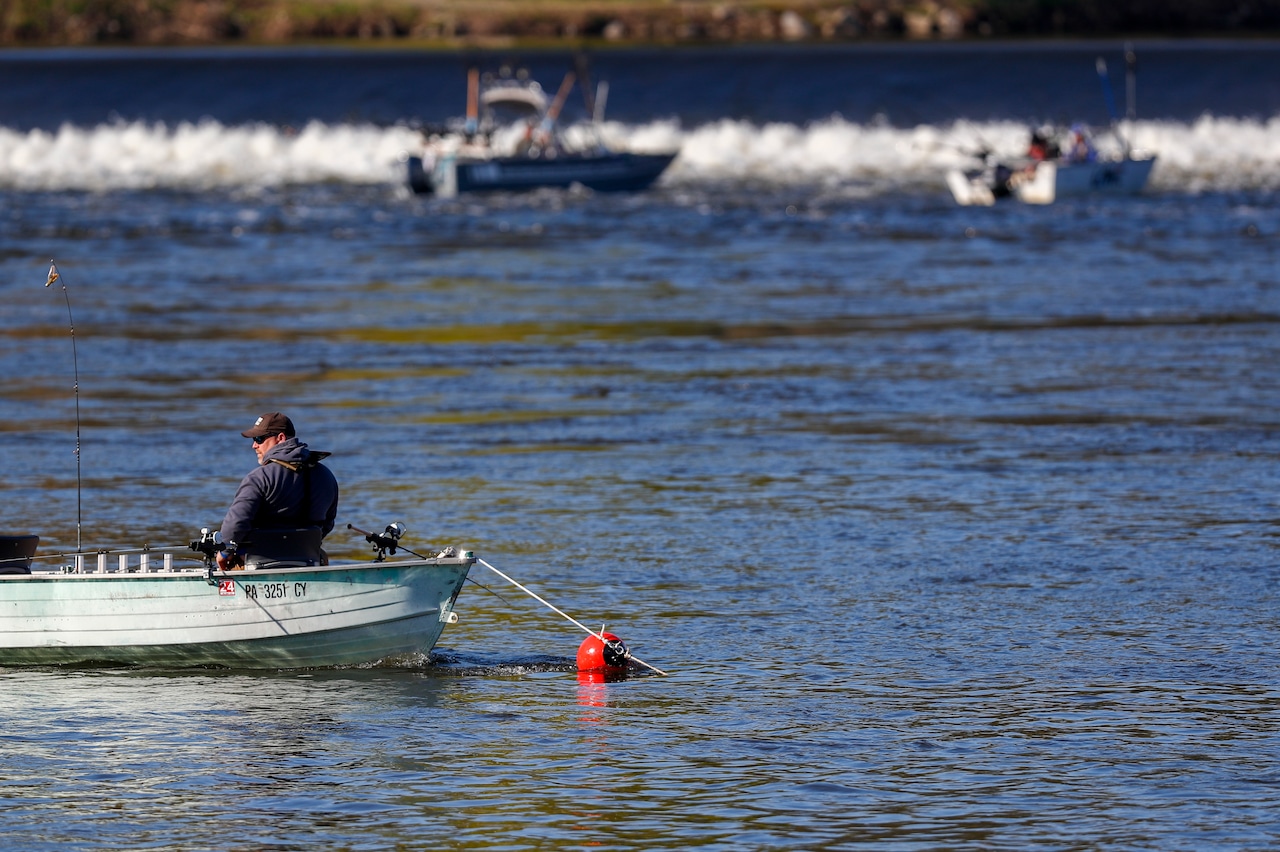
The Pennsylvania Fish and Boat Commission will receive $500,000 in federal funding to enhance public access and recreational opportunities along the state’s portion of the Delaware River and its watershed.
Commission officials on Tuesday, Feb. 10, announced the grant from the National Fish and Wildlife Foundation through the Delaware River Watershed Conservation Fund.
The state agency will provide $500,000 in matching funds and distribute sub-grants to local governments and nonprofit organizations to improve public boating facilities throughout the region.
“The Delaware River watershed is one of Pennsylvania’s greatest natural assets,” Fish and Boat Commission Executive Director Timothy Schaeffer said. “Thank you to our federal partners for their continued investments to improve public access, strengthen conservation efforts, and expand recreational opportunities for anglers and boaters across the region.”
The grant is part of a broader $4.3 million investment through the conservation fund in Pennsylvania projects in 2026. Combined with $4.7 million in matching funds from partners, the total investment in the state will reach $9 million. From 2020 to 2025, the Pennsylvania Fish and Boat Commission received $2.1 million in grants from the foundation, which generated more than $12 million in total investments in the Delaware River watershed.
Across the four-state Delaware River watershed, the Delaware River Watershed Conservation Fund awarded $12.5 million in 2026 to Pennsylvania, New York, New Jersey and Delaware. The U.S. Fish and Wildlife Service and National Fish and Wildlife Foundation announced the funding Feb. 4 to support 30 conservation projects in the watershed.
Also in the Lehigh Valley region, extending into northwestern New Jersey, other recipients of the Delaware River Watershed Conservation Fund grants include:
Sourland Conservancy, awarded $95,300 to restore degraded upland forest along 16.5 acres of the Lambertville Nature Trail impacted by ash decline and beech leaf disease, through the planting of native woody and herbaceous species, managing of invasive plants and the protection of regrowth from deer browse. This project requires $104,100 in matching funds. It aims to restore degraded riparian and upland habitat, reduce flooding and improve water quality.PEACE New Jersey, receiving $437,000 to restore a public park in Hackettstown by planting a riparian buffer with native plant species, stabilizing 305 linear feet of riverbank, installing seven pollinator gardens and completing design plans for ADA-compliant paths. This project requires $452,500 in matching funds and will benefit priority pollinator species and freshwater mussels, improve recreational access for the community and restore the park to a more natural condition.Wildlands Conservancy, awarded $164,300 to complete the design and permitting process for fish passage and stream restoration on two priority sites in the Lehigh Valley of the Delaware River watershed. Requiring $168,000 in matching funds, this project will assess 0.7 miles of stream, complete the required monitoring and assessment of 5 acres to restore aquatic and terrestrial habitat, complete the designs and permitting requirements for the two restoration efforts, and conduct community outreach to inform the community of the benefit of restoring natural stream function.
In all, the grants will generate nearly $17 million in matching contributions, bringing the total investment to $29.3 million for projects aimed at restoring fish and wildlife habitats, improving water quality, building resilience to natural disasters and expanding public access to outdoor recreation.
Projects funded across the watershed will open nearly 4,000 acres to public access, implement restoration plans on more than 11,000 acres of forestland, and restore wetlands and floodplains to reduce flooding and improve water quality.
The Delaware River watershed spans portions of its four constituent states in one of the most densely populated regions of the country, yet remains 50% forested. Around 400 miles of the Delaware River are classified as National Wild and Scenic River.
The total funding includes $250,000 from the USDA’s Natural Resources Conservation Service for collaborative forest management in New York and Pennsylvania, and $1.26 million from other non-federal sources, including from AstraZeneca to support beach restoration in Delaware Bay.