
In what could prove to be another battle between local universities and the Trump administration, a new report says that Carnegie Mellon University may be at risk of losing access to a tuition reimbursement offered to military service members looking to pursue their studies.
CNN reported late last week that the university, among dozens of others, was listed as a school that could be at “moderate to high risk” of being cut off from the reimbursement, the result of a new policy by Secretary of Defense Pete Hegseth.
In a statement sent Monday, CMU said it was “aware of reports indicating that Carnegie Mellon is among several universities whose eligibility to support graduate training for military officers may be under review. At this time, we have received no formal notification confirming that any such review is underway. As always, CMU stands ready to engage constructively with the Department on ways to strengthen and advance military education.”
It’s not clear how many students could be impacted by a shift in Pentagon policy. Defense officials do not appear to have released a formal list of the universities facing scrutiny and the possible loss of a tuition benefit: CNN’s list, which included Ivy League schools and CMU peers like MIT, was compiled based on one list generated by the Army. But Hegseth has made no secret of his plans to cull elite universities out of the tuition program.
In a statement that announced the end of tuition reimbursements at Harvard, Hegseth said, ”Unfortunately, America’s highly ranked universities no longer live up to their founding principles as bastions of free speech, open inquiry and committed to the American values that make our country great.”
Hegseth said that within two weeks, each branch of the service “will evaluate all existing graduate programs for active-duty service members at … other civilian universities. The goal is to determine whether or not they actually deliver cost-effective strategic education … when compared to, say, public universities and our military graduate programs.”
The Pentagon’s support for continuing education “no longer includes spending millions of dollars on expensive universities that actively undercut our mission and undercut our county,” he said.
The move follows a pattern of challenges to universities mounted by Trump’s administration since the start of 2025. Since last year, for example, Trump has reduced or threatened to reduce funding to universities, with some making deals with the administration to pay fines and change their policies after being accused of allowing antisemitism on campus. The administration specifically has targeted Harvard, attempting to cut off all federal contracts with the university and forbid international students from attending, though several of these moves have been challenged in court.
Trump also proposed giving certain colleges and universities easier access to federal money if they agreed to a list of conditions, which include restricting international students to 15% of undergraduates. He also threatened to revoke the visas of Chinese international students, a threat that hits close to home for schools such as CMU, whose reputations attract a significant share of students, many paying full admission, from abroad.
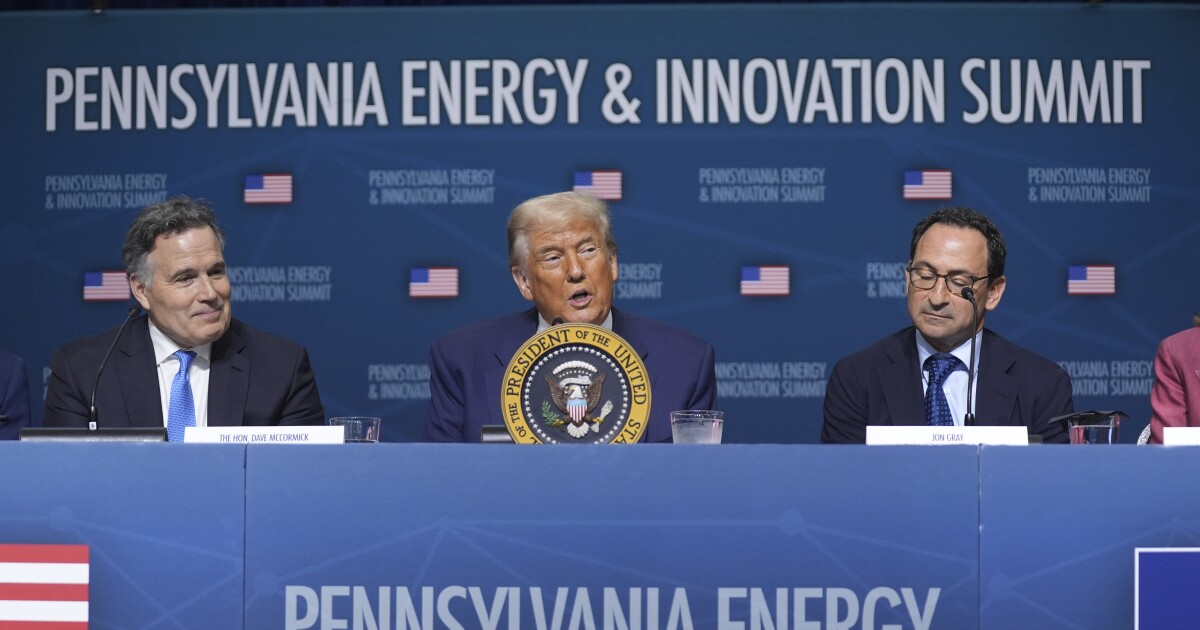
Still Carnegie Mellon’s inclusion on the list is notable. Last year, the school hosted a summit for leaders in the AI and energy industries, which Trump himself attended.
The “Pennsylvania Energy and Innovation Summit,” was organized by U.S. Sen. Dave McCormick (R-PA. And the school did its best to welcome Trump in the face of opposition and protests from Pittsburghers concerned about the environmental impact of AI, as well as other Trump administration policy decisions. School officials painted over a message opposing the gathering painted on a campus “free speech fence” in advance of the summit’s arrival.
McCormick told reporters on Monday that he had only just heard about the banned school list and CMU’s presence on it. He said he agreed that “ our universities have some work to do in terms of making sure that they don’t have an ideological bias,” but also believed military officers shouldn’t be completely isolated from civilian universities.
“ I have shared very publicly my concerns about Harvard, but I think we need to be careful about how we think about universities more broadly and their integration with our military,” he said. “ You don’t want a military that is totally separate from our universities, and our universities benefit from having our great officers there, and our officers benefit from being exposed to ideas that aren’t necessarily consistent with their own.”
Western Pennsylvania Congressman Chris Deluzio, himself a U.S. Navy veteran who formerly worked at the University of Pittsburgh, took a more critical stance. In a Monday statement, he said that it would hurt military readiness to keep military service members out of its classrooms.
“Carnegie Mellon has some of the most advanced and innovative research and programs of any university in the world—discoveries that our country and military both benefit from,” he said. “Banning our military from CMU would be foolish and hurt both national defense and Western Pennsylvania at the same time.”
Julia Fraser and Chris Potter contributed to this report.