
Photo by Spencer Platt/Getty Images
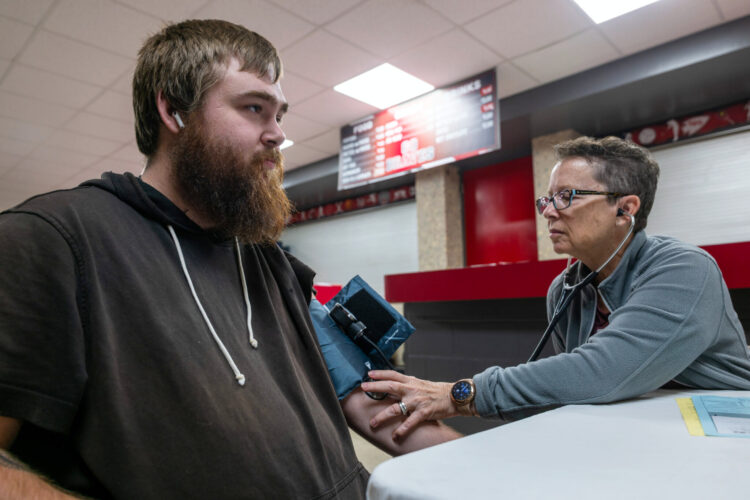
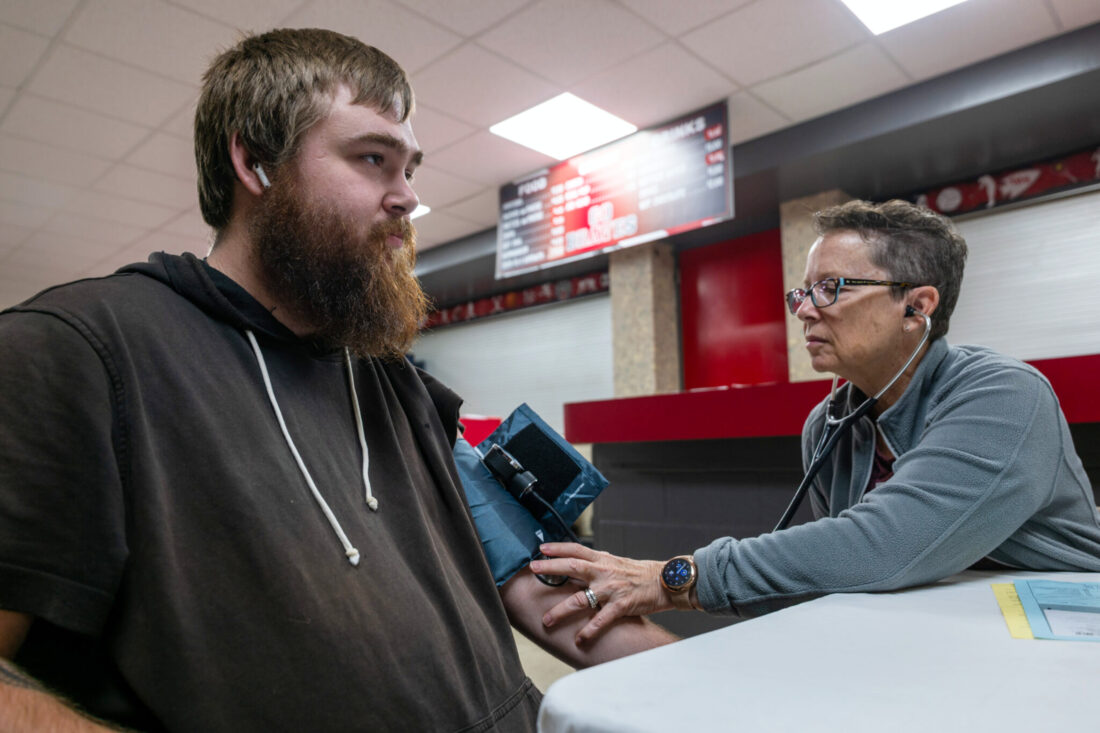
Gabriel Drapper, who didn’t have health insurance, has his pulse and blood pressure checked at a Remote Area Medical (RAM) mobile dental and medical clinic at Terre Haute South High School on August 02, 2025 in Terre Haute, Indiana.
Over the next five years, nearly $1 billion could be heading to Pennsylvania’s coffers earmarked for rural health investments. The federal dollars are designed to create an opportunity to invest in innovative ideas that typically don’t get dedicated funding.
The money is meant to ease the impact of deep cuts to Medicaid funding in the coming years under President Donald Trump’s signature legislation, the “One Big Beautiful Bill.”
But, some say it comes at a steep cost to the state.
Pennsylvania Department of Human Services Secretary Val Arkoosh put the commonwealth’s loss under Medicaid at $20 billion between 2028 and 2038, which dwarfs the funding the state hopes to get under the Rural Health Transformation Plan.
“This RHTP grant, at most, is going to bring in a billion — maybe a tiny bit more than a billion — over the next five years,” said Arkoosh. “We’re thrilled about it, and we’re going to be able to do some really exciting, transformative things with that money.
“But there is absolutely no way that $1 billion can replace $20 billion,” she added.
Arkoosh’s number is lower than an estimate from experts at the health policy organization, KFF, which projects that the state will lose between $34 billion and $57 billion. KFF also concluded that while the average rural American will see $157 in benefits from this proposal, rural Pennsylvanians will get $78 each.
One area of reduced spending restricts state-directed payments to hospitals and nursing facilities, a method of payment designed to leverage higher provider payment rates. The center-left group Third Way estimates cuts to hospitals will be $1 billion in the commonwealth, which comes at a time when some rural hospitals are closing their doors.
“And the really heartbreaking piece of this is that those Medicaid cuts are going to fall disproportionately on our rural hospitals, many of (which), very few of (which) are actually profitable today,” said Arkoosh. “And it is only going to further the economic pressure that these hospitals are facing, and we are certain that a number are likely to close because of these cuts.”
More than hospital funding
Federal rural health funds explicitly can’t be used to stabilize rural hospitals, forcing states to shift their approaches. Notably, Medicaid is the primary payer for most rural hospitals.
“The pressure is going to be on states to be able to perform. We’re not going to be just throwing money at rural areas of the country and hoping things improve,” said Joe Glinka, with Pittsburgh-based managed care organization Highmark Wholecare. “There’s going to have to be a concerted effort with creating a more recognizable and accessible ecosystem beyond hospitals.”
Glinka is the board president of PAMCO, or Pennsylvania Medicaid Managed Care Organizations, whose members contract with the state to administer Medicaid for the state’s three million enrollees. But he said that the federal government has “made it clear” that grant dollars “cannot just be a Medicaid plan.”
On the state level, Arkoosh said it was “fortunate” that the Shapiro administration was already focused on a rural health plan prior to the federal grant. She noted that listening sessions across the state informed different priorities included in the commonwealth’s plan.
But Glinka criticized the state approach for focusing too much on hospitals, and not on surrounding supports like clinical and community-based wraparound services. Socioeconomic impacts to health, including poverty, food insecurity and job availability, all tie into a person’s overall health, he noted.
“With the pressure on hospitals as it is, you’re not going to see a proliferation of hospital building in the rural health setting,” said Glinka. “We’re going to have to do things differently than what we’ve done before.”
More on the rural
health funding
In the rural health program’s first year, federal officials will be sending $193 million to the commonwealth, slightly less than the $200 million it requested in its initial application. That difference means Pennsylvania, and nearly every other state, will need to resubmit their budget plans for federal approval.
Arkoosh said Pennsyvlania was making “very minor tweaks” to accommodate for the $7 million difference, noting that none of the proposed programs would be eliminated.
Once submitted, the federal government will take another 45 days to approve, meaning funds aren’t expected to come to the state for roughly another month when the parties sign the final contract.
“I know everyone is so eager to get started, but we’ve got a little bit of waiting to do yet,” said Arkoosh about the deployment of funds.
With money in hand, the state will turn to its existing Partnerships for Regional Economic Performance. Those groups will create the Rural Care Collaboratives (RCCs) that prioritize and spearhead rural health initiatives on the ground.
RCCs in the eight regions (everywhere but Philadelphia and its collar counties) will hire a staffer to complete administrative tasks related to the funding, such as data collection and filing regular progress reports.
“Once the RCCs have a staff person, then they can start their local convenings and start to identify who should be at those tables — not only the health and health care leaders, but the business leaders and philanthropic leaders, local education leaders,” said Arkoosh. “All those pieces that we think are integral to success and sustainability of these projects, once that five years is up and the funding is spent.”
States are under pressure to deliver results early, as federal reviews begin in late summer and the next round of funding is set to be announced by the end of October.
But Arkoosh urged RCCs to think of the funding as seed money, identifying outside revenue to keep services sustainable beyond the program’s expiration date.
“If we’re able to create these projects in a way that the local folks have a plan to pick them up or make themselves sustainable … that is a real victory for rural health in Pennsylvania,” said Arkoosh.
——
Pennsylvania Capital-Star is part of States Newsroom, a network of news bureaus supported by grants and a coalition of donors as a 501c(3) public charity. Pennsylvania Capital-Star maintains editorial independence. Contact Editor Tim Lambert for questions: info@penncapital-star.com. Follow Pennsylvania Capital-Star on Facebook and Twitter.
LOCK HAVEN — Twenty-five fire and emergency medical services (EMS) companies in the 76th Legislative District …