
As the home of the nation’s first hospital and medical school, Philadelphia is considered the “cradle of American medicine.”
Yet the achievements of a group of local Black women in the nursing field don’t get nearly the same amount of attention.
However, a group of researchers is hoping to make those nurses’ stories more widely heard.
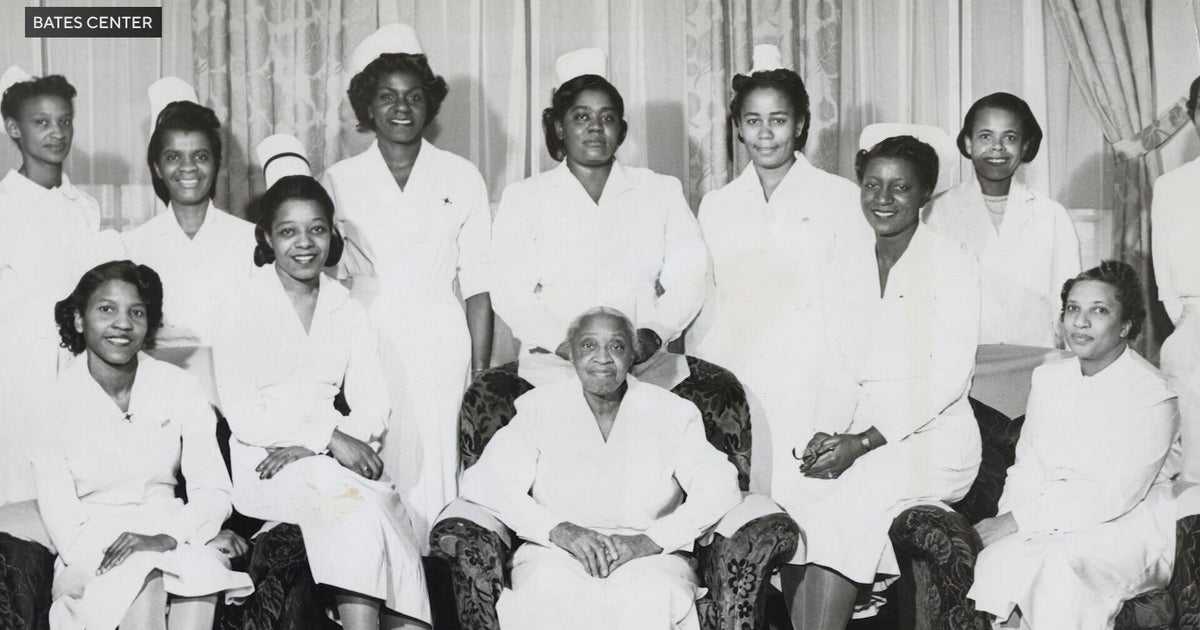
Spread across a large table inside Penn Nursing’s Barbara Bates Center, Margo Brooks Carthon, PhD, RN, FAAN, and Hafeeza Anchrum, PhD, RN, spent one morning browsing some of the center’s massive archive of photos that document life at the Mercy-Douglass Hospital School of Nursing, Philadelphia’s first training school for Black nurses.
“They were challenging racist ideas about who Black people were,” Anchrum said.
Anchrum, a postdoctoral fellow, interviewed former Mercy-Douglass nurses as part of her doctoral research.
“Ms. Geraldine Hatcher, she was so proud to be a Mercy-Douglass nurse,” Anchrum recalled. “She said, ‘I would have my head up high, you know, just strutting, you know, I was a Mercy-Douglass nurse.'”
“I loved our uniforms,” Hatcher said in a recording provided by Anchrum. “It was something to be really proud.”
Mercy-Douglass opened in 1948 following the merger of two Black-owned hospitals: Fredrick Douglass Hospital, which was founded in 1895, and Mercy Hospital.
In the racist era of Jim Crow segregation, Mercy-Douglass provided healing and hope to Philadelphia’s Black communities.
“These were women who faced tremendous odds,” Brooks Carthon said. “And they were able to overcome and persist.”
Mercy-Douglass’ academic culture traces back to its predecessors, where school administrators held students to a high standard by grading their knowledge of anatomy and operating room technique, as well as more subjective areas, like obedience and neatness.
Despite the strict environment, there was time for students to relax and participate in activities, like joining Mercy-Douglass’ basketball team.
Brooks Carthon said nursing proved to be second nature for Black womanhood.
“They were really called upon from the very inception to provide care and nurturing to society,” Brooks Carthon said.
In 1973, Mercy-Douglass shut down after years of financial struggles.
A community health clinic was built in its place at Woodland Avenue and South 50th Street.
As Raenette Fields waited for the bus to arrive, she fondly remembered her childhood spent sneaking into Mercy-Douglass and running around its hallways.
“The nurses probably remembered me because I was terrorizing the neighborhood coming up, but now, I’m sweet. I’m a nice woman,” Fields said. “It was the best hospital at that time.”
Besides leaving an indelible impact on residents like Fields, Anchrum said Mercy-Douglass’ nurses blazed a path for women like herself.
Before researching the history of Mercy-Douglass, Anchrum worked as a nurse in New York City.
“As a nurse, and as a Black woman nurse,” Anchrum said, “It’s given me a greater sense, I think, of identity.”
The Bates Center welcomes visitors to view their Mercy-Douglass archives. Those interested can click here for more information.