
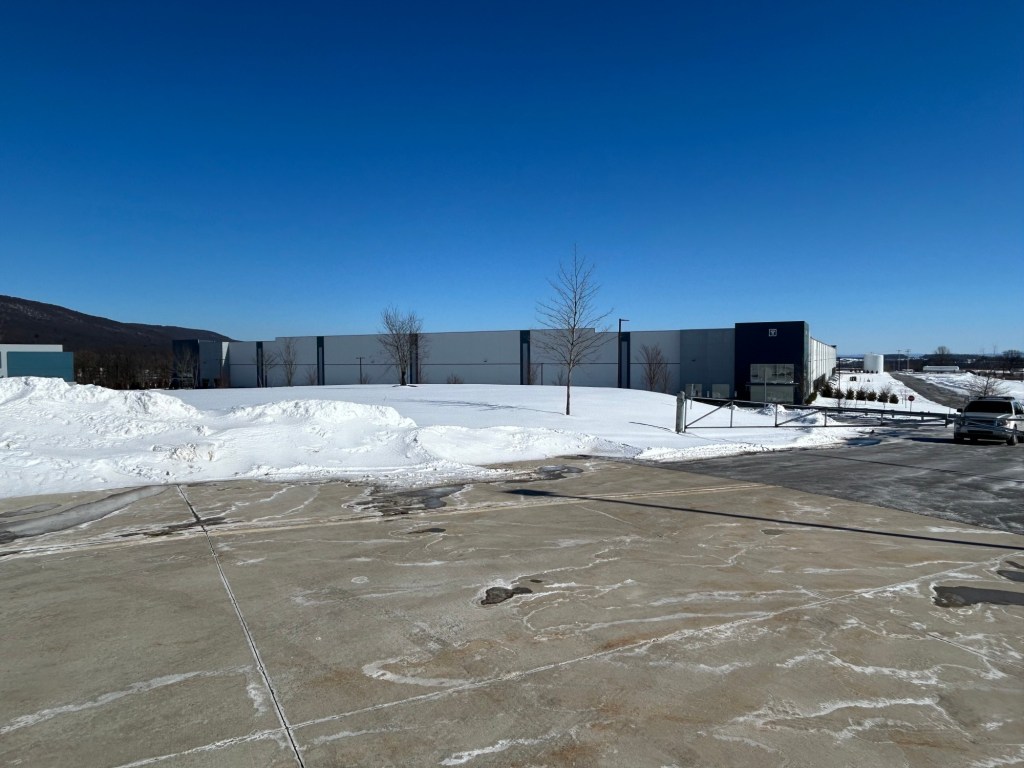
The recent sale of Berks and Schuylkill county warehouses to the federal government has left Lehigh Valley officials wondering how local and state authorities could block or regulate the operation of federally owned detention centers.
Legal options appear to be limited, but Gov. Josh Shapiro is asserting the state’s environmental review powers, and local officials are exploring their regulatory roles as opposition to detention center expansion grows.
After the $87.4 million sale of a 527,000-square-foot warehouse in Upper Bern Township and the $119 million sale of a 1.3 million-square-foot former warehouse in Tremont Township to the federal government, Lehigh Valley residents and politicians are closely monitoring Berks and Schuylkill counties to see how local and state officials respond.
It remains unclear what options remain after property sales are final, but officials have raised concerns, including questioning whether water and sewage infrastructure at the rural sites can handle a large influx of detainees and security staff.
The Shapiro administration sent a detailed letter to the U.S. Department of Homeland Security outlining how the proposed detention centers in Berks and Schuylkill counties would “violate legal requirements applicable to public drinking water, sewage and water pollution,” adding that “state authorities will not issue required permits that would violate these legal requirements.”
If similar proposed warehouse conversions were to expand into the Lehigh County Authority’s service territory, staff know they too could be called upon to help determine whether detention center operations will put undue pressure on local resources.
“LCA’s decision to serve any new development, including a change in use of an existing customer, is based on an engineering review of our system’s capacity to supply the water and sewer services requested,” LCA CEO Liesel Gross said in an email. “The specific uses that are allowed in any community are decisions that must be made at the municipal level after careful consideration and community dialogue.”
As Upper Bern Township has no municipal water system, state authorities there approved construction of an on-site water well to serve a limited number of warehouse employees, but further review is needed to authorize the well’s operation, the Shapiro administration’s letter states.
Federal government proposals to house up to 1,500 people at the now-vacant site would require more than 10 times the permitted pumping rate, the letter adds.
In Schuylkill County, installing a 7,500-person detention center in Tremont Township would triple the number of public water users and create an unreasonable demand on an already drought-burdened system, the Shapiro administration’s letter states.
Drought conditions in December and January forced the Schuylkill County Municipal Authority to seek emergency state permits to bulk haul drinking water, the letter adds, noting that the authority will soon complete a years-long effort to add a water source to its system and is unlikely to find another readily available additional source.
The letter also details concerns about sewage capacity at the Berks and Schuylkill county wastewater treatment plants that would serve the proposed detention centers, as well as outlining the limits of the emergency service departments that provide fire and police services to the rural sites targeted for warehouse conversions.
Safely converting a warehouse to a detention center would also mean allowing the Pennsylvania Department of Labor & Industry to ensure compliance with international building codes, the letter states.
Federal law requires the immigration enforcement agency to adhere to environmental regulations, the letter argues, stating that the Safe Drinking Water Act and the Clean Water Act are federal laws that make government agencies responsible for meeting federal, state and local requirements regarding safe drinking water and the control of water pollution.
The Pennsylvania Department of Environmental Protection would have to review the federal government’s plans to draw from public water systems, develop water sources or bulk haul water, the letter states. DEP officials deferred comment to the governor’s office.
Read the full letter from the Shapiro administration to DHS:
Although Pennsylvania officials, including U.S. Rep. Ryan Mackenzie, say they are still awaiting answers from DHS, New Hampshire Gov. Kelly Ayotte’s office published an agency memo it received titled “ICE Detention Reengineering Initiative” that claims the federal government has already addressed environmental concerns with its engineering reviews of the proposed new detention center sites.
ICE has conducted impact studies in line with the National Environmental Policy Act and has determined that engineering solutions exist to any current deficiencies in electricity, water and sewage capacity, the memo states.
In contradiction to Pennsylvania officials’ findings, the ICE memo states that selected facilities have sufficient water supply. The memo does acknowledge that larger proposed detention facilities will need waste water processing upgrades and states that agency engineers will engage local water authorities to plan infrastructure expansions.
“Our engineers believe the proposed solutions listed above, and the contingencies, will provide no adverse effect on the community and surrounding properties for each facility identified,” the memo states.
While Shapiro’s office has focused on state powers to enforce environmental regulations, further municipal or county regulatory authority could hinge on whether the federal government chooses to own and operate its new detention centers or whether it employs private companies.
In early February, Howard County revoked the building permit for a detention center in Elkridge, Maryland, citing state law that mandates public notice and hearing requirements for privately owned detention facilities.
Public pressure as strategy
Some elected officials who acknowledge their post-sale legal options are limited believe public pressure campaigns can restrict the expansion of detention centers.
Industrial property owners value their long-term relationships with municipal authorities, and elected officials can highlight the disgust their constituents feel regarding inhumane detention center conditions to discourage owners from selling to the federal government, Siegel said.
“The bully pulpit is probably the most important thing that we can really use,” Siegel said.
Oklahoma City provides one clear-cut example of Siegel’s strategy working.
After the U.S. Department of Homeland Security notified the Oklahoma City planning department of its intention to convert warehouse property into a “processing center” for ICE, city officials pushed back, requesting that federal officials participate in a public approval process involving resident input.
The city’s statement, published Jan. 20, acknowledged its limited legal authority, noting that “the Supremacy Clause of the United States Constitution has been construed to exempt the federal government from local land use and building code regulations” and that “federal law explicitly exempts detention centers from local zoning regulations.”
However, public pressure appeared to influence the warehouse property owners, with Oklahoma City Mayor David Holt confirming via social media nine days later that the owners had backed out of discussions to sell or lease to DHS.
“I commend the owners for their decision and thank them on behalf of the people of Oklahoma City,” Holt wrote on X. “As Mayor, I ask that every single property owner in Oklahoma City exhibit the same concern for our community in the days ahead.”
Whitehall Township Commissioner Taylor Stakes said he signed Siegel’s letter in part because he has seen levels of fear rise among his neighbors.
“We’ve politicized immigration in America so much that instead of reforming it, we’re just wreaking havoc on people’s lives,” Stakes said.
Whether or not township commissioners should endorse letters that oppose detention center construction has become a debate about free speech rights versus conflict-of-interest guidelines.
Lehigh County Commissioner Ron Beitler, who served as president of the Lower Macungie Board of Commissioners for eight years, has argued that endorsing such letters could create conflict-of-interest issues for township commissioners if they are then called upon to make zoning or permitting decisions regarding detention facilities.
Beitler cited the state Department of Community and Economic Development’s Township Commissioner’s Handbook, which states, “In a case appealing denial of conditional use and site plan applications, Commonwealth Court found the applicant’s right to due process was denied by the participation in the vote of one of the council members who had actively opposed the proposal before it was brought before the governing body. His actions included speaking in opposition to the proposal at public hearings, writing to constituents on official stationery, expressing opposition and encouraging the public to attend meetings to pressure council to defeat the proposal, and alleged ‘vote trading’ with another council member.”
Stakes said he didn’t seek legal guidance before signing the letter, but he’s confident he’s in the clear, saying he was exercising his rights as a private person rather than speaking from the dais. He called efforts to discourage such actions a “chilling effect on free speech.”
If further plans to convert warehouse space to detention centers do surface, township commissioners should look to utility boards to enforce what is allowed by local regulations, in the same way they’d assess the plans of private businesses, Stakes said.
“If it were any other business, we would immediately shut it down,” Stakes said. “The township would shut it down.”