
Neighbors from Hazelwood are feeling some relief after a Pittsburgh City Council committee approved a measure to create larger buffers between homes and garbage facilities.
The full council is set to vote on the ordinance Tuesday.
The measure was put forth by Councilmember Barb Warwick after she learned that Republic Services was pursuing an option to use its recycling center in Hazelwood as a waste transfer center. Such a building is used to gather municipal garbage before it is taken to a final disposal location. Warwick’s bill defines what a waste transfer center is and requires a 500-foot setback from homes and businesses — greater than the state requirement of 300 feet.
Several people who live or work in Hazelwood spoke in favor of the proposal during a public comment period last Wednesday. Many spoke about persistent problems from the recycling plant that they fear will get worse if the building also starts handling garbage, such as poor air quality, bad smells and rats.
Catherine Burke of Hazelwood said a transfer station could increase traffic on Second Avenue, which is already a busy road.
”Pittsburgh is, for starters, not known for its air quality. So, I’m concerned about making this worse by having a waste transfer station in Hazelwood,” Burke said.
Palak Shah, a student at the University of Pittsburgh School of Medicine who works in Hazelwood as a social medicine fellow, said the setback requirement would create “breathing room” for residents and lower the risk of negative health impacts.
“This bill is not just about zoning. It is about health, it is about dignity, and it is about whether we are willing to protect residents of neighborhoods like greater Hazelwood from preventable harms,” Shah said.
Shah said waste transfer stations are known sources of air pollution, noise, odors, truck traffic and pests. Those factors can translate into higher rates of asthma, heart disease, stress-related illnesses, and missed school or work, she said.
Owner of Dylamato’s Market, Dianne Shenk, said she needs to constantly safeguard her business from the challenges that come with being on a busy road, close to an industrial facility. Those challenges include rats and noise, as well as dust and trash that she said are carried on the wind from the recycling center.
“ My concern with a solid waste transfer station is that all of those challenges will be exponentially harder to manage as a food facility,” Shenk said, noting that she is currently renovating the space to expand the market’s offerings.
Shenk said her 10-year-old business is an example of investment in the neighborhood. She has a “triple mission” to provide “ healthy food at reasonable prices, create a positive social space in the neighborhood, and grow wealth by sourcing as much as possible from local farmers and producers.”
Representatives of the recycling center defended their business.
Lori Kolczynski, general manager of the Republic Services subsidiary that owns the Hazelwood recycling center, said the setback requirement targets her business, which is trying to be a good neighbor.
“The facility we just purchased last year, where we’ve invested heavily to improve the health and safety of the sites, including reducing rodents, avoiding smells and everything that goes along with the things that we’re hearing as problems that were at this facility previously,” Kolczynski said.
Currently, solid waste is driven to landfills in Imperial or Monroeville, and Kolczynski noted the city’s own planners have determined the need for a waste transfer center within city limits. She said her center could save Pittsburgh $1 million annually due to less fuel use and fewer equipment maintenance needs.
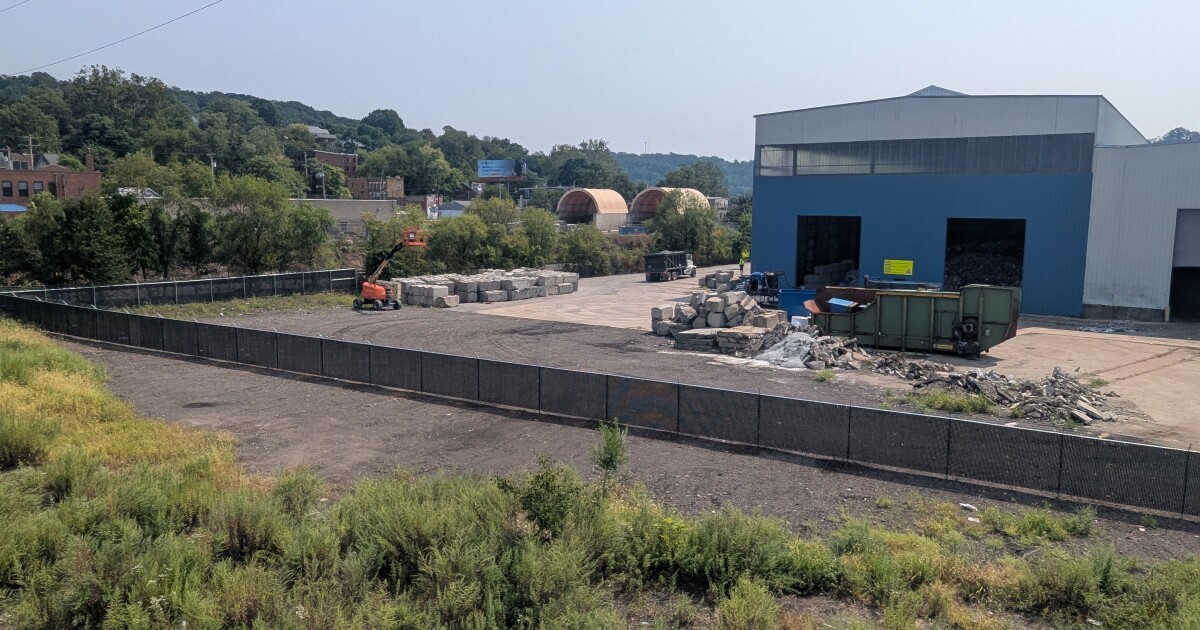
A recycling center in Pittsburgh’s Hazelwood neighborhood is looking to expand into garbage collection.
Sonya Tilghman, executive director of Hazelwood Initiative, acknowledged the city’s need for a waste transfer center, but said the impacts listed by residents “are not minor inconveniences. They directly affect quality of life and neighborhood stability.”
“As a city, it is our responsibility to solve the current logistical challenges without creating new harm. Efficiency cannot come at the expense of residents’ wellbeing, especially in communities like Hazelwood that already face disproportionate environmental burdens,” Tilghman said.
Warwick said the city has other options for a waste transfer center, including contracting with a center in McKees Rocks.