
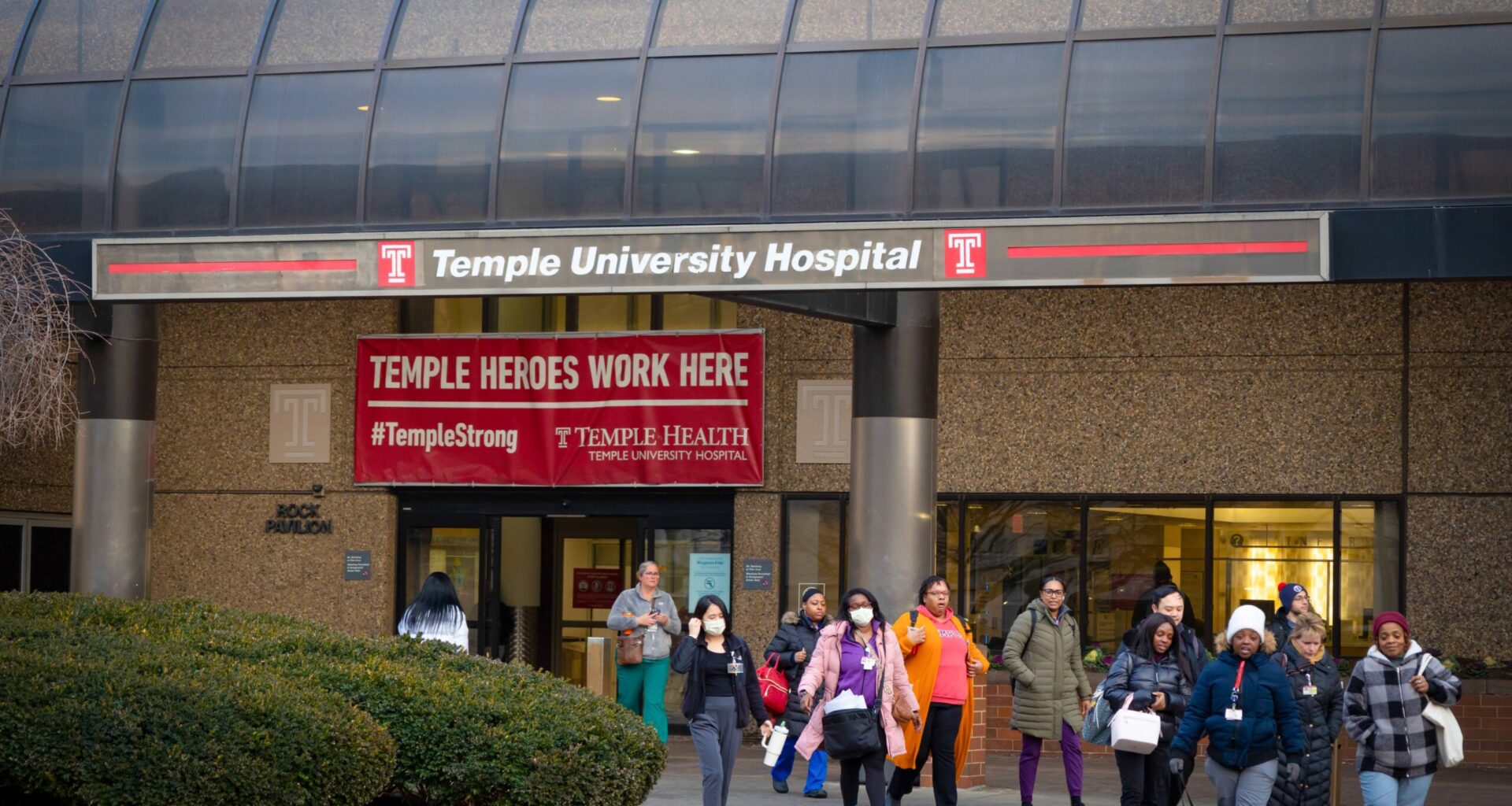
Healthcare workers leave the Temple Hospital University Hospital – Main Campus building. | JUSTIN ALEX / THE TEMPLE NEWS

More than a dozen hospitals across Pennsylvania are at risk of closure within the next five years, according to a Jan. 21 report from The Hospital and Healthsystem Association of Pennsylvania. The report identifies inadequate state support as a primary factor in poor healthcare funding.
Six of 10 hospitals in Southeastern Pennsylvania relying on Medicaid revenue have closed or reduced services since 2015. Temple University Hospital is one of two Medicaid-reliant hospitals in Philadelphia to remain fully open, the Philadelphia Inquirer reported.
Around 90% of Temple Health patients are covered by Medicare, a federally provided healthcare available to Americans older than 65-years-old, and Medicaid, a federal- and state-provided health insurance given to individuals based on factors like income, resources and disability.
Proper funding at the state and federal levels are essential for providing an effective safety net to hospital operations, a spokesperson for Temple Health wrote in an email to The Temple News.
“Our approach relies on flexible management teams, operational efficiency, expense management, and strategic growth initiatives,” the spokesperson wrote. “We successfully navigated major challenges during and in the aftermath of COVID and are confident we are prepared to meet these new realities. However, solving systemic national issues requires more than local solutions.”
The Temple Health system had around 1.6 million outpatient visits and more than 12,000 faculty members in 2024 across 63 locations in the Philadelphia area.
The anticipated funding cuts will cause more people to have difficulty signing up and maintaining their Medicaid plans, said Joanna Rosenhein, consumer engagement manager of the Pennsylvania Health Access Network, a patient advocacy organization.
Many Americans on Pennie, the state’s official online health insurance marketplace, will see their insurance payments drastically increase. These rising prices will predominantly impact rural, low-income and elderly patients, Rosenhein said.
“Right now, people are paying a lot more for their health coverage through Pennie than they have in years,” Rosenhein said. “Some people saw their premiums double, triple, quadruple.”
The HAP report found that Pennsylvania hospitals are financially hindered by high costs associated with medical liability litigation and harsher restrictions by insurers. These restrictions combined with comparatively lower hospital reimbursements from Medicaid puts Pennsylvania hospitals on stricter budgets, according to the report.
Philadelphia has also seen the closure of multiple maternity care clinics. Thirteen of 19 maternal care facilities in Philadelphia have closed since 1997, creating a regional health access crisis, the Temple Health spokesperson wrote.
The state budget for Pennsylvania passed in November after a five-month delay, The Temple News reported. The state budget plans to allocate around $20 billion to cover healthcare and other resources provided by the Department of Human Services.
Included in the final budget is an additional $10 million in funding to support rural hospitals and $187 million for Pennsylvania’s Rural Health Transformation Plan.
Despite the benefits that the new state budget proposes, it will not be enough to cover the shortfalls that Medicaid will face in its budget deficits, Rosenhein said.
The passage of the Big Beautiful Bill by the Trump Administration in July cut and changed Medicaid, adding stricter requirements for eligibility and reducing states’ funding for Medicaid services.
Temple Hospital gets more than two thirds of its patient revenue from public programs like Medicare and Medicaid, according to Pennsylvania Association of Staff Nurses and Allied Professionals. Cuts to these services would increase debt and accelerate the rates of hospital closures, according to a PASNAP fact sheet.
PASNAP President Maureen May believes that the greatest risk of inadequate funding is to the patient, as the commercialization of the healthcare and pharmaceutical industries put patients and funding further at risk.
“I think that we need to be able to have the funding to provide proper care without massive profits in another blanket,” May said. “The massive profits should not take away the care of the patients. And that’s why funding needs to happen and that needs to be monitored.”