
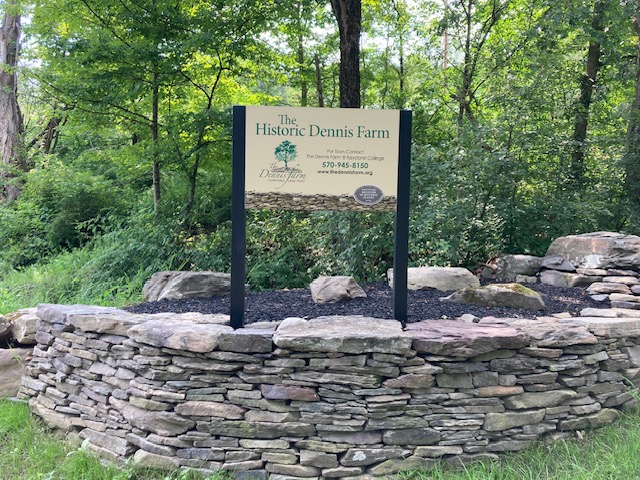
Entrance to the Dennis Farm. Photo courtesy: M. Denise Dennis
By Constance Garcia-Barrio
The Dennis Farm, located on 153 acres of rolling hills and blooming meadows in northeastern Pennsylvania, represents a remarkable chapter in African American history.
An audience of students, teachers, historians and civic leaders, learned about the farm’s unique history during an annual forum held at the Museum of the American Revolution on February 7 entitled, “It Begins with Each of Us: Fostering Racial Understanding.”
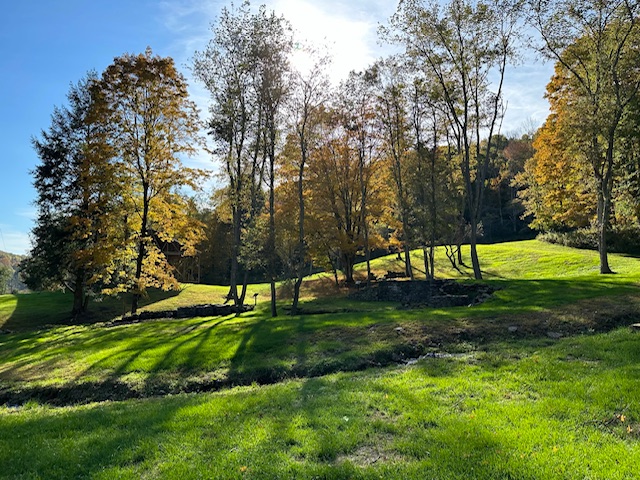
The lower tier of the Dennis Farm.
Photo courtesy: M. Denise Dennis
The museum and the Dennis Farm Charitable Land Trust (DFCLT) co-hosted the event.
The forum, held for the ninth year, is dedicated to the memory of Lonae A. Moore, an eighth-generation direct descendant of the Perkins-Dennis family, owners of the land for more than 200 years.
Forum participants spoke of the farm’s past, plans for its future, and the need to make history attractive and accessible to everyone, especially young people.
Prince Perkins, a Black Revolutionary War veteran, moved from Connecticut to Pennsylvania’s scenic Endless Mountains and bought the land in 1793, the year George Washington became president. Perkins was free at a time when only 10% of African Americans had that status, said M. Denise Dennis, a founder and president of the DFCLT, which preserves the farm and shares its history through education, programs, and cultural heritage tourism. The Dennis Farm is listed on the National Register of Historic Places.
The site stopped being a working farm in the early 1900s, but it welcomes visitors. The farmhouse, built around 1825, is being renovated as an interpretive center.
By the late 1790s and early 1800s, Prince Perkins had become known in Susquehanna County, not only as a prosperous farmer but a skilled musician.
“Documents show that he was paid 11 shillings, 6 pence for fiddling at a Fourth of July celebration in 1800,” Dennis said. “He also played on election days and at other important events.”
While the Dennis family is documented in Susquehanna County records, the DFCLT collaborates with many educational institutions to heighten public awareness of the farm.
“A graduate student from Winterthur–University of Delaware’s Program in Art Conservation wrote her master’s thesis on the layers of wallpaper in the Dennis Farmhouse,” Dennis said, noting that for much of the 19th century, wallpaper was a considered a luxury item in rural settings, according to the student. “Not everyone could afford it in the 1800s,” she said.
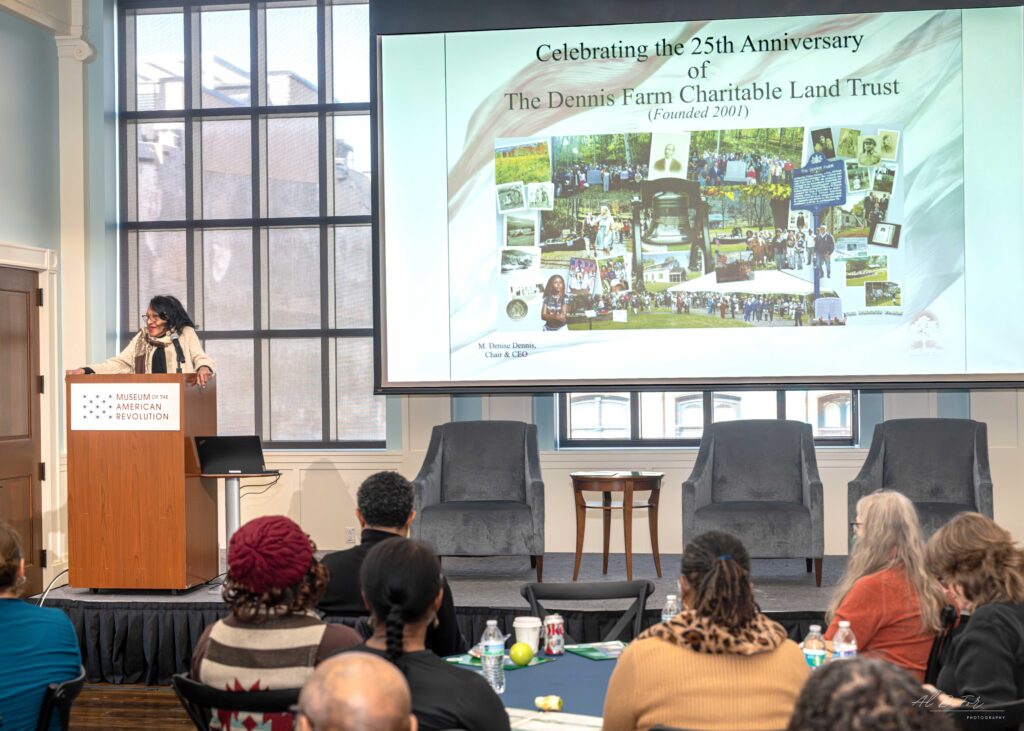
The Dennis Farm Charitable Land Trust 25th anniversary forum held at the Museum of the American Revolution.
Photo courtesy: Museum of the American Revolution
The farm has also partnered with high schools, colleges, and universities. In 2008 through 2009, students from the state University of New York (SUNY) at Binghamton uncovered many artifacts during an archeological study of the property.
In addition, some 30 artifacts from the farm are in the permanent collection of Smithsonian Institution’s National Museum of African American Museum of History and Culture, Dennis said.
Dennis, formerly an editor at MacMillan Publishing in New York City, has also made the farm more widely known as a guest speaker at the Smithsonian and the Historical Society of Pennsylvania. The five books she’s written include two for children.
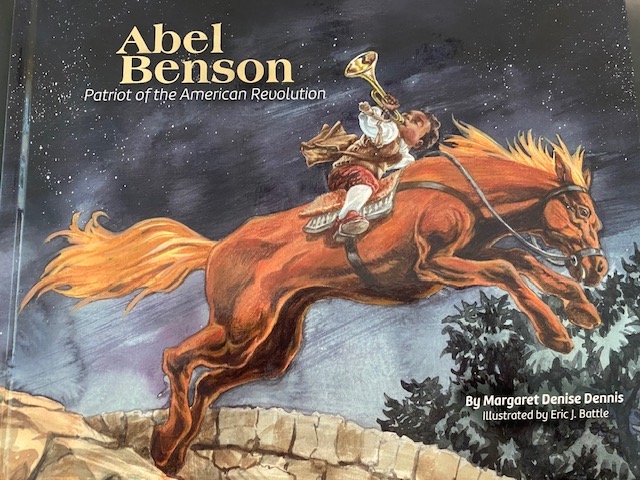
One of those books, “Abel Benson: Patriot of the American Revolution,” tells the true story of a Black boy from Framingham, Massachusetts. A good trumpeter, Abel was asked to ride on the night of April 18, 1775, like Paul Revere, to warn American colonists in Middlesex County, Massachusetts, that British troops were coming to confiscate weapons stockpiled at Concord.
The forum’s panel discussion covered other aspects of history. Led by Adrienne Whaley, the museum’s director of education and community engagement, panelists spoke about preserving historical sites and making history compelling and available for everyone, especially young people.
Panelists included Lawana Holland-Moore, director of grantee impact and engagement for the National Trust for Historic Preservation’s African American Cultural Heritage Action Fund, and Alex Edgar, co-founder of Youth250, a national initiative elevating youth leadership as the nation nears its 250th birthday celebration this year.
Edgar is also the youth engagement manager at Made By Us, a coalition of more than 500 cultural institutions using history to inform and inspire Gen Z, or Zoomers, the generation born between 1997 and 2012.
“Money is the number one challenge that historic sites face, especially the smaller house museums, Holland-Moore said, mentioning how much she enjoyed a recent visit to South Philly’s Marian Anderson Museum. “These sites allow us to inhabit the spaces our forebears occupied. Go to your local house museum and buy something at the gift shop, even if it’s only a $3 magnet.”
Alex Edgar emphasized that young people are hungry for history. He also spoke of the frustration of many Gen Z Americans.
“Most young people [in the U.S.] have never seen a democracy that works for them,” he said. “We live in an incredibly age-segregated society. The media often push a narrative of intergenerational conflict, exacerbating the issue. We’re constantly fed the idea that different generations are at odds with each other.”
Edgar also stressed the importance of not talking down to young people and giving them some power.
“Bring young voices to the table,” he urged.
While Holland-Moore and Edgar and the Dennis family acknowledged the nation’s current challenges, they expressed the hope that the afternoon’s presentations had heartened the audience.
“I hope that people come away inspired,” Denise Dennis said.
It appears that the forum succeeded in that respect.
“It has empowered me to act,” said Brittany Mohamad, a media and communications major at Rosemont College. “I learned history today. It has made me more optimistic.
For details about the Dennis Farm, about two-and-a-half hours from Philadelphia by car, visit: https://thedennisfarm.org/. One may also make donations and order M. Denise Dennis’s children’s books through the website.
The Museum of the American Revolution, an independent, nonprofit organization, is located at 3rd and Chestnut Streets. For more information, visit: www.AmRevMuseum.org or call: (877)740-1776.