
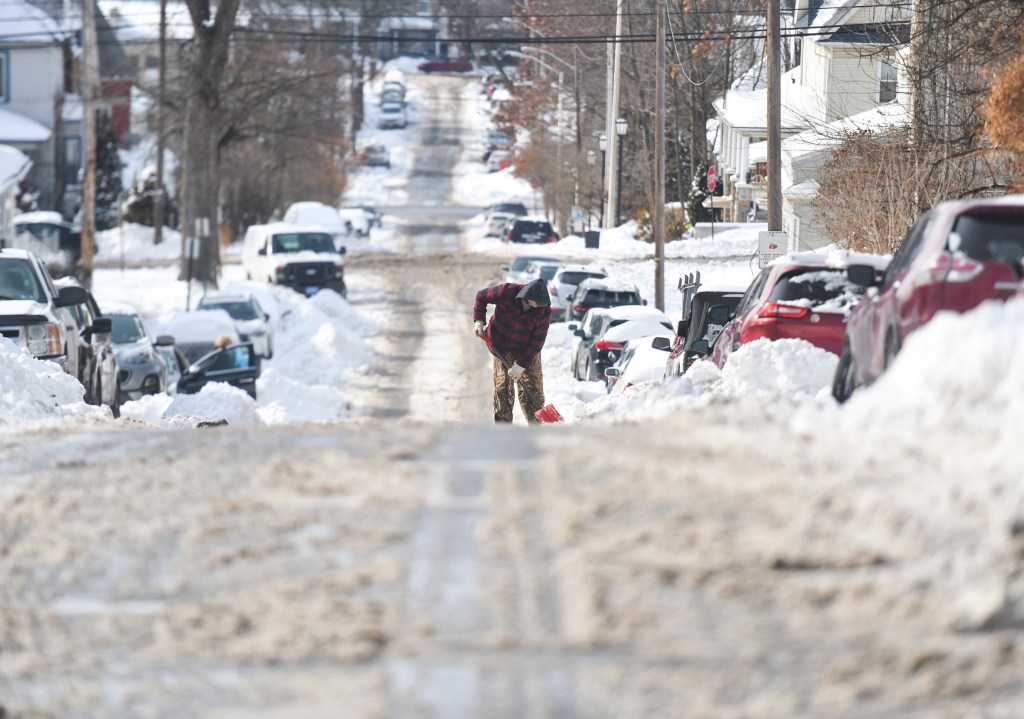
The 40 Scranton Department of Public Works employees who called off work during a snowstorm in late January was the highest number of DPW callouts in a single day over the past six years, according to a city report on the response to the storm.
“Disciplinary action and ensuring compliance with calls for overtime is under consideration at this time,” said the report from the administration of Mayor Paige Gebhardt Cognetti to council.
The storm of Sunday, Jan. 25, into Monday, Jan. 26, dumped 9.7 inches of snow on the city. The 40 callouts that occurred Jan. 26 were followed by 34 callouts on Tuesday, Jan. 26, which was the fourth highest number since 2020, according to the “After Action Report” on the storm posted Tuesday on the city’s website and also provided directly to Scranton City Council.
After the storm, council asked for a written report from the mayor on the city’s preparation for the storm that had been forecast for some time leading up to the event, as well as the snow plowing and removal response. Council also called for a caucus on the storm response, but the administration offered to discuss it in an executive session. Council members balked at having such a closed-door, private session because it would be confidential. At the Feb. 17 council meeting, Councilman Sean McAndrew repeated council’s stance that it wanted a written report, and he raised the prospect of council potentially issuing subpoenas to administration officials. Last week, the administration said it was still preparing the written report for council.
The administration produced the report Tuesday, shortly before the council meeting, Sean McAndrew said. He did not comment substantively about the report because they he not have time to review it, according to an Electric City Television simulcast of the council meeting posted on YouTube.
“I’ll go through it and look into it,” Sean McAndrew said. “I appreciate them for finally coming together and putting that report together for us. We all want to learn and work together. I think this would be the best step forward for future storms.”
The five-page report from the city Business Administration Department echoes what the administration previously said about the response being hampered by staffing shortages from high numbers of callouts on the Monday and Tuesday of the storm. The administration concluded the callouts during the storm were not related to the DPW working under an unexpired labor contract during all of 2025 and into this year as contract negotiations remain ongoing.
Reached by phone Wednesday, DPW union President Larry Wynne declined to comment on the report because he had not yet reviewed it.
The Times-Tribune asked Wynne if he could comment on whether the 40 and 33 callouts were orchestrated or coincidental. Wynne replied that no workers intentionally called off because of the storm and the callouts were not orchestrated.
Some of the information in the report includes:
• The storm from Jan. 25 around 6 a.m. to 12 a.m. Jan. 26 brought 9.7 inches of snow. The city has 263 miles of roads that needed to be plowed and cleared of snow. A cold snap immediately followed the snowstorm, with temperatures and windchills dropping to between -6°F and -18°F, respectively from Jan. 25 to Jan. 31, “further complicating snow removal and plowing efforts.”
• In anticipation of the storm, Cognetti and City Controller John Murray issued an emergency declaration from Jan. 24 to Feb. 3 “to ensure that the City had sufficient resources to obtain services and supplies necessary to clear public roadways.”
• Equipment: The city fleet has 18 plow trucks, including four, four-wheel-drive mountain trucks; two, two-wheel-drive mountain trucks; and one tandem dump truck, all requiring a commercial driver’s license (CDL); and 11 Ford F550’s that do not require a CDL.
• Staffing: DPW staff has 77 members, including mechanics, and of which 34 of the 77 of have CDLs. There also are additional management personnel and/or clerical union staff. The city previously said DPW has 90 personnel. Plowing duties may be performed by operators, chauffeurs and/or laborers who possess a CDL. The city also maintained two mechanics on duty at all times during the storm event to ensure vehicles would be repaired if necessary.
Response: Throughout the entire snow event, the city “deployed DPW staff to the fullest available capacity.” For every overtime shift, the city issued a minimum call-out list of 15 plow truck drivers, two mechanics and one operator. The report said in part that “insufficient staff reported for overtime” to put in use all available plow trucks during most shifts, “despite the City’s attempts to reach full capacity” for all shifts. Only two of the various shift over several days “were fully staffed to ensure all available vehicles in the City’s fleet were in use, namely Sunday, January 25, 2025 and Sunday, February 1, 2026. “It is notable that staff receive double-time rates for work performed on Sundays.” Of 33 total available drivers during the storm, five did not work any overtime shifts (an additional driver was out on medical leave), and six drivers worked only Sunday shifts, earning double-time pay. To supplement available manpower pursuant to the emergency declaration, the city retained outside vendors for snow plowing and removal and which is estimated to cost between $400,000 and $450,000 once all bills are received and processed.
• Actionable Items: Technology and Communications: the city recently implemented a new payroll processing platform for more-efficient callouts and tracking of regular and overtime shifts. Before the storm, the city used GeoTabs to track fleet locations. The city has acquired equipment for real-time GPS tracking and awaits installation by a vendor on all trucks in the fleet. This data will capture driver behavior, fuel efficiency and routing. Based on data received, routes can be mapped in GIS and include critical information such as school bus routes, COLTS bus routes and main arteries leading into hospitals. Information gained from this tracking will result in the development of a dashboard that can be shared with appropriate city public safety personnel.
• Labor: Maintaining adequate staffing levels was an ongoing concern. “Significant callouts occurred throughout. This issue is not isolated to this particular period, as supported by available data. Of note, January 26, 2026, recorded the highest number of absences among DPW staff from 2020 through 2026, with 40 recorded absences. This figure was far greater than the average daily absences recorded by month, which ranged between 10 and 15 absences on any given day, which was consistent year-over-year. DPW most often experienced between 11 and 20 employees absent on any given day since 2020.
• “Data further supports that contract status with the DPW union has not had a material impact on the volume of call outs. In fact, callouts averaged slightly higher during the term of then-current Collective Bargaining Agreements, as opposed to periods of negotiations for new Collective Bargaining Agreements.”
• To address staffing shortages due to callouts, the administration is exploring its options to ensure essential services are being performed to protect the health, welfare and safety of residents and infrastructure. “Disciplinary action and ensuring compliance with calls for overtime is under consideration at this time. Additional training and identifying alternative labor staff on a part-time basis to ensure the needs of residents are met are also being evaluated.” If staffing shortfalls continue as they have been trending, the city may consider having one or more vendors available to perform snow plowing and/or removal.