
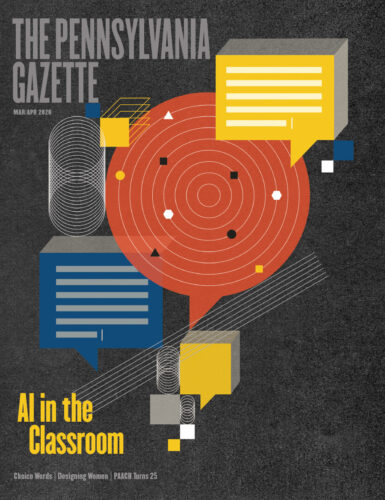
When he emailed me the draft of this issue’s cover story, “Hyper Text,” senior editor Trey Popp called it “a dispatch from the front.” He interviewed more than a dozen students and a few faculty members, sat in on classes, and otherwise immersed himself in getting a sense of how AI is working its way into the classroom and being used to help master concepts, conduct research, and write papers, etc. He also heard students describe their hesitations and questions about the technology, both in terms of their work on campus and in pursuing their future professional goals: the line between tool and crutch, and the fear of being tripped up by AI’s unreliability, among other issues.
It’s hardly worth noting that Penn students can be extraordinarily reflective and articulate, but I was still struck by how insightful their comments were—many from participants in the freshman seminar, “How Is AI Changing Higher Education?” that Trey visited multiple times through the semester.
I tend toward a doomy view of AI, so a comment by the mathematician and Andrea Mitchell University Professor Robert Ghrist, who has thoroughly embraced the use of AI in his teaching and beyond, was especially clarifying as a counterweight. He compared it to the advent of microscopes and all the new things they made it possible to see. “I believe we are at a similar moment—not for categories of life, but for categories of intelligence, maybe categories of consciousness,” he told Trey. And eventually, “we’ll get used to it.”
While it might not destroy us all, AI may yet deliver the final blow to the dictionary industry, finishing the job that search engines started a couple of decades ago. In his recent book, Unabridged: The Thrill of (and Threat to) the Modern Dictionary, Stefan Fatsis C’85 mixes a history of the premier US dictionary maker, Merriam-Webster, and the industry overall; his experience embedded with the firm’s dwindling staff of lexicographers; and additional reporting that reveals the challenges facing the field and the value of dictionaries’ essential work tracing language development.
I talked with Stefan about Unabridged in an interview that accompanies an excerpt from the book, titled “Paper Record.” That piece takes a look back to the analog age, paying tribute to the firm’s “Consolidated Files,” in which decades worth of word discoveries and debates among Merriam staffers—an estimated 16 million items in all—have been preserved on slips of paper. (But for how much longer remains to be seen.)
Also in this issue, “A Degree Too Late” highlights the first women to be awarded degrees in architecture from Penn. The most prominent figure among them—Lin Huiyin [“The Story of Liang and Lin,” Nov|Dec 2019]—was awarded her degree posthumously by the Weitzman School in 2024, which sparked a further investigation. Authors Sidney Wong and Annie Liang-Zhou GFA’26 (Lin’s great-granddaughter), who have clearly combed the archives, share the stories of some other pioneers.
And in “The Eye of Denise Scott Brown,” Jon Caroulis traces the life and career of the iconic planner and architect, with special attention to the influence of her photography. A recent book, Encounters, brings together some 400 images from the 1950s through the 1970s, several examples of which are included in the article.
—John Prendergast C’80
Editor
