

 Illustration by Jonathan Bartlett
Remembering Penn’s first women in architecture.
By Sidney Wong and Annie Liang-Zhou
 Download a PDF of this article
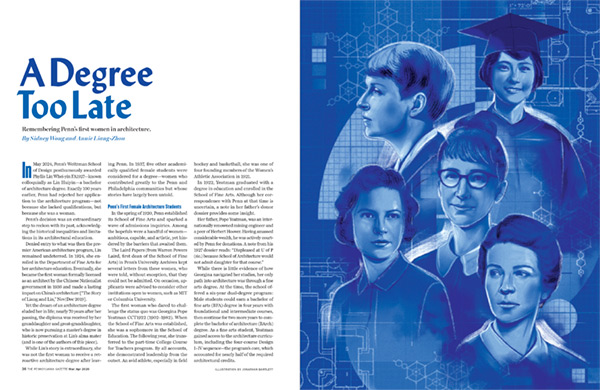
In May 2024, Penn’s Weitzman School of Design posthumously awarded Phyllis Lin Whei-yin FA1927—known colloquially as Lin Huiyin—a bachelor of architecture degree. Exactly 100 years earlier, Penn had rejected her application to the architecture program—not because she lacked qualifications, but because she was a woman.
Penn’s decision was an extraordinary step to reckon with its past, acknowledging the historical inequalities and limitations in its architectural education.
Denied entry to what was then the premier American architecture program, Lin remained undeterred. In 1924, she enrolled in the Department of Fine Arts for her architecture education. Eventually, she became the first woman formally licensed as an architect by the Chinese Nationalist government in 1936 and made a lasting impact on China’s architecture [“The Story of Liang and Lin,” Nov|Dec 2019].
Yet the dream of an architecture degree eluded her in life; nearly 70 years after her passing, the diploma was received by her granddaughter and great-granddaughter, who is now pursuing a master’s degree in historic preservation at Lin’s alma mater (and is one of the authors of this piece).
While Lin’s story is extraordinary, she was not the first woman to receive a retroactive architecture degree after leaving Penn. In 1937, five other academically qualified female students were considered for a degree—women who contributed greatly to the Penn and Philadelphia communities but whose stories have largely been untold.
Penn’s First Female Architecture Students
In the spring of 1920, Penn established its School of Fine Arts and sparked a wave of admissions inquiries. Among the hopefuls were a handful of women—ambitious, capable, and artistic, yet hindered by the barriers that awaited them.
The Laird Papers (from Warren Powers Laird, first dean of the School of Fine Arts) in Penn’s University Archives kept several letters from these women, who were told, without exception, that they could not be admitted. On occasion, applicants were advised to consider other institutions open to women, such as MIT or Columbia University.
The first woman who dared to challenge the status quo was Georgina Pope Yeatman CCT1922 (1902–1982). When the School of Fine Arts was established, she was a sophomore in the School of Education. The following year, she transferred to the part-time College Course for Teachers program. By all accounts, she demonstrated leadership from the outset. An avid athlete, especially in field hockey and basketball, she was one of four founding members of the Women’s Athletic Association in 1921.
In 1922, Yeatman graduated with a degree in education and enrolled in the School of Fine Arts. Although her correspondence with Penn at that time is uncertain, a note in her father’s donor dossier provides some insight.
Her father, Pope Yeatman, was an internationally renowned mining engineer and a peer of Herbert Hoover. Having amassed considerable wealth, he was actively courted by Penn for donations. A note from his 1927 dossier reads: “Displeased at U of P (sic.) because School of Architecture would not admit daughter for that course.”
While there is little evidence of how Georgina navigated her studies, her only path into architecture was through a fine arts degree. At the time, the school offered a six-year dual-degree program: Male students could earn a bachelor of fine arts (BFA) degree in four years with foundational and intermediate courses, then continue for two more years to complete the bachelor of architecture (BArch) degree. As a fine arts student, Yeatman gained access to the architecture curriculum, including the four‑course Design I–IV sequence—the program’s core, which accounted for nearly half of the required architectural credits.
After her petition to pursue a degree in architecture was denied, Yeatman left Penn in 1924. Archival records indicate that she had completed 18 architecture courses, including Design I through III.
Yeatman continued her education at MIT, where she took additional architecture courses, including Design IV, landscape architecture, and town planning. She eventually earned her degree in architecture from there in 1925.
Lin Huiyin (1904–1955) was the second woman to study architecture at Penn and the school’s first female student from abroad. She arrived from China several months after Yeatman had left, making it unlikely that their paths ever crossed.
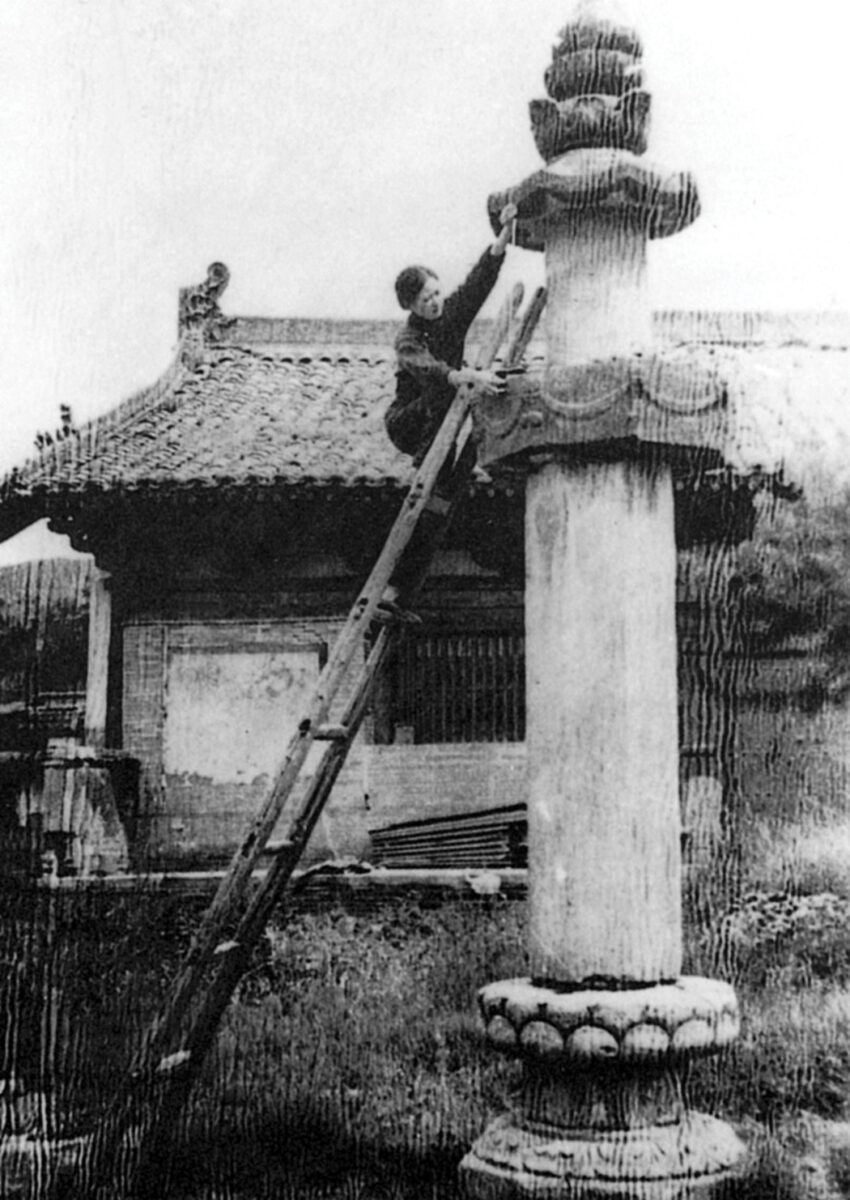 (Above) Lin Huiyin conducting an architectural survey of a stone pillar (jīng chuáng) at Foguang Temple, Mount Wutai, Shanxi, 1937; (below) Commemorative Stamp for the Monument to the People’s Heroes, issued in May 1958.

Lin’s matriculation was more colorful and better documented. In November 1923, Mrs. T. D. MacMillan, secretary of the Committee on Foreign Study for Chinese Women in Peking, wrote to Penn to inquire about her admission as a special architecture student, signaling Lin’s awareness of the exclusion policy.
Laird suggested that Lin consider applying to MIT, Columbia, or Cornell. Alternatively, he proposed that she could enroll as a fine arts student and take architecture electives: “Miss Lin’s motive might be met by a broad course in the Fine Arts with a strong architectural flavor.” Lin did not accept Laird’s suggestion as final.
Around the same time, her father, Lin Changmin, a Chinese politician, asked the Chinese Legation in Washington to advocate on his daughter’s behalf. Minister Sao-Ke Alfred Sze, a friend of the Lin family, spoke directly with Laird.
In his second reply to MacMillan, Laird stated that Penn’s trustees had barred women from required architecture courses in building construction and general lectures, including mechanics, statics, carpentry, masonry, heating, plumbing, and material strength. He added that omitting such courses would not impede Lin’s pursuit of architectural design. As for her request to be admitted as a special student or auditor, Laird agreed to recommend it to Penn’s admissions office.
After completing three Cornell summer courses, Lin entered Penn as a freshman in 1924 with advanced credits and was promoted to a junior standing the following year. She completed 23 architecture courses, the most by any woman before formal admission. She was the first woman to finish the full Design I–IV sequence, earning two “distinguished” and two “good” marks on her report card.
Lin earned a total of 90 undergraduate and one graduate credits, accumulating 67 in architecture and 24 in non-architecture, well beyond the 72 required for the BFA degree. She graduated in February 1927, completing the BFA a year and a half ahead of schedule.
In recognition of her achievement, Design professor John Harbeson Ar1910 GAr1911 hired her to teach Design I and II as an instructor in 1926 and 1927. In the summer of 1927, Lin worked in Penn’s star professor and Philadelphia architect Paul Phillipe Cret’s office, a dream job for most aspiring architects—male or female—at the time.
The third woman to study architecture at Penn was Gertrude Howard Olmsted Nauman FA1927 (1901–1973), who came from a prominent family in Harrisburg, Pennsylvania. She and Lin entered the Fine Arts program together in the fall of 1924. Olmsted proved to be an exceptionally talented student, earning distinguished grades in Design I through III. In a letter dated September 30, 1926, Laird described her to a professor of mathematics as “one of the most capable of our students.” That fall, Harbeson appointed her as an instructor for Design I.
In the spring of 1927, due to health and family circumstances, Olmsted transitioned to partial student status, leaving Design IV incomplete, and later discontinued her academic studies. Records show that she completed 13 architecture courses and left three unfinished. Although she did not accumulate enough credits to graduate at the time, she was retroactively awarded a BFA in 1932, dated as of 1927, in recognition of the quality of her academic performance.
In the same year Lin and Olmsted arrived on Penn’s campus, Doris Joy Derbyshire Ar1929 (1905–1990), a future Penn basketball team member, enrolled in the newly established Landscape Architecture program. She then found herself increasingly drawn to architecture and transferred to the Fine Arts program in the fall of 1925.
Joy completed 13 architecture and one landscape architecture courses, including Design I and II, but left before completing Design III. In 1927, she followed Yeatman’s path to MIT, where she completed Design III and IV and additional architecture courses, including town planning. She earned her architecture degree there in 1929.
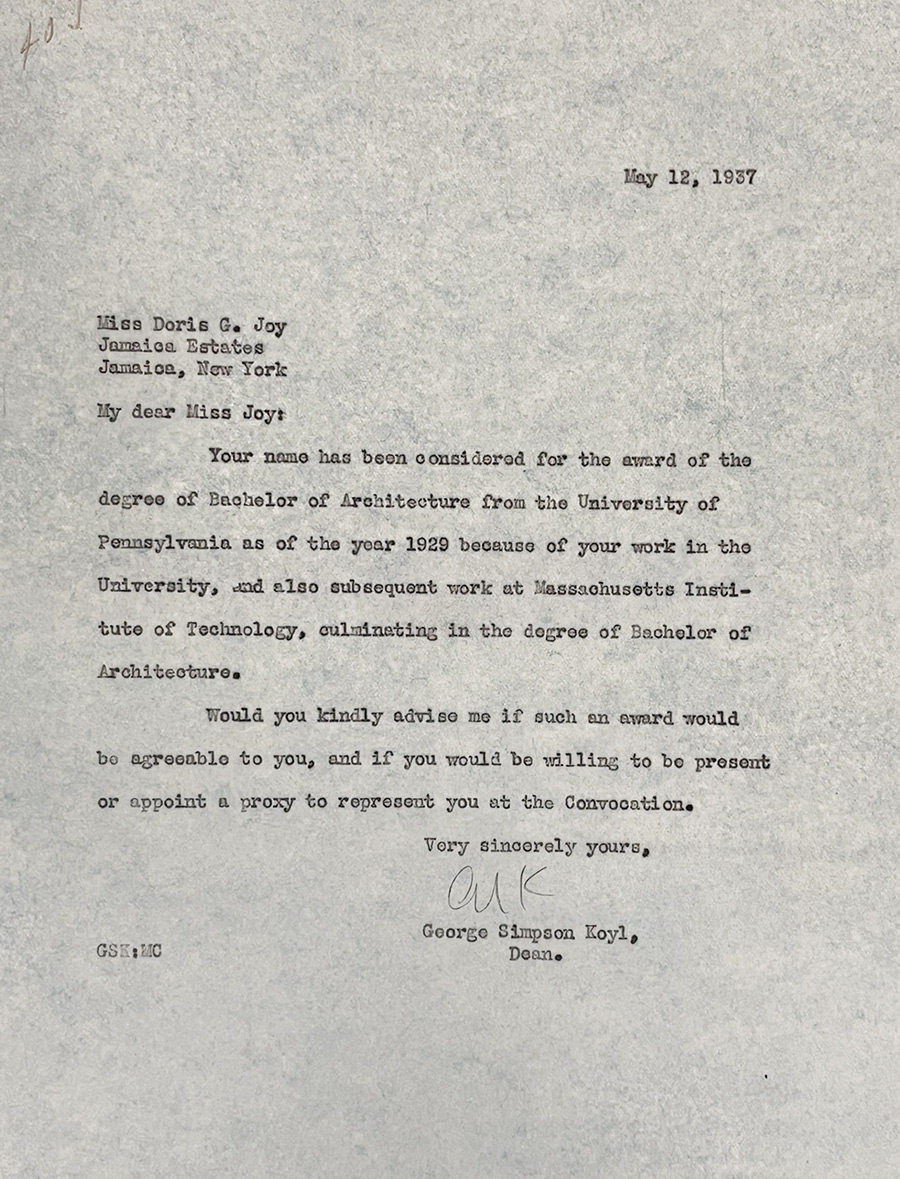 Doris Joy Derbyshire completed 13 courses in architecture and one in landscape architecture at Penn before completing her degree at MIT. In 1937 Penn awarded her a degree in architecture retroactive to 1929.
Jane Harper FA1930 (1908–1964) was the fifth to join the ranks. She began her studies in landscape architecture in 1925. Like Joy, she switched to Fine Arts to pursue architecture and in June 1926, successfully petitioned the Executive Committee to take five building construction courses.
Over her five-year tenure at Penn, she completed 20 architecture courses, including Design I and II, and attempted Design III without finishing it. In addition, she took five courses in landscape architecture, including its own Design I and II sequence. She also served as an assistant instructor in Elements of Architecture and Design I from 1926 to 1929 and eventually earned a BFA in 1930.
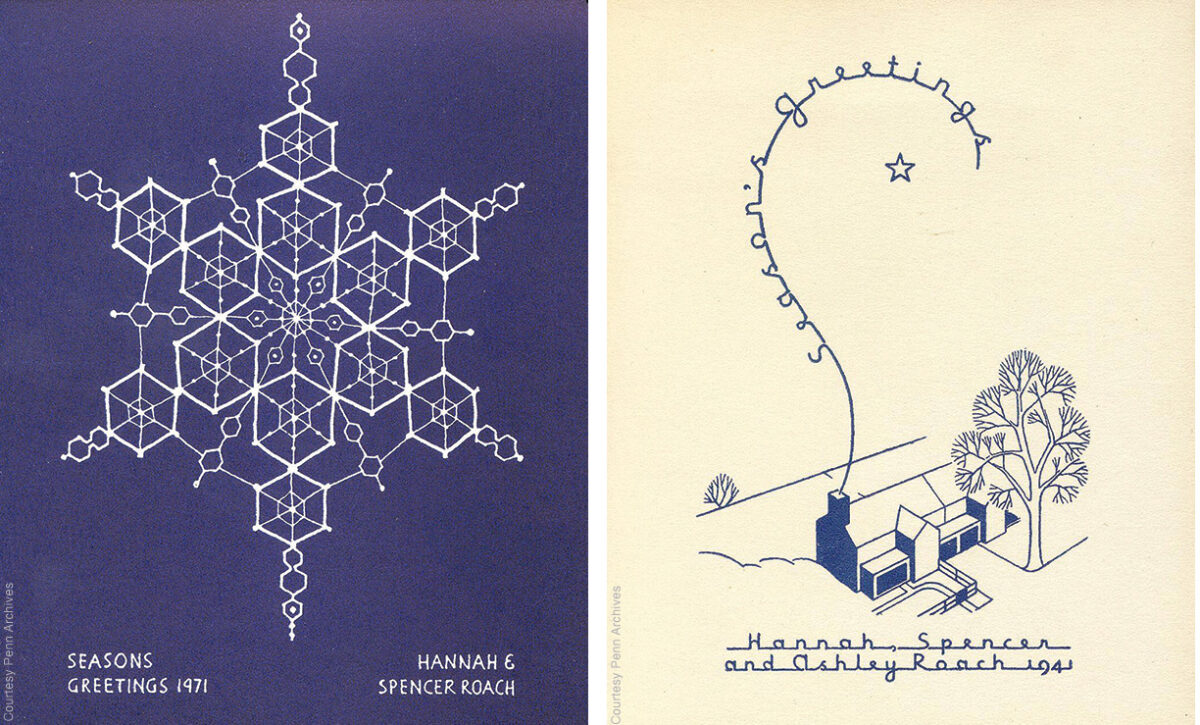 Christmas cards designed by Hannah Benner Roach and her husband and fellow architect Franklin Spencer Roach. Penn Archives.
The sixth woman to study architecture at Penn was Hannah Benner Roach FA1929 (1907–1976). She enrolled in the Fine Arts program in 1926, and her academic path closely mirrored Lin’s—except, like the other five, she did not take the three architectural history courses that Lin had completed. Benner earned her BFA in 1929. After Penn admitted women to architecture, she returned to the School in January 1935 for one additional semester to take supplementary courses and was retroactively awarded a BArch in 1937. In total, she completed 19 architecture courses and became the second woman to finish the full Design I–IV sequence.
Except for Yeatman, these exemplary women overlapped with Lin at Penn, united by a shared ambition to become architects.
Career Journeys Shaped by Ambition and Expectations
The intertwined journeys of these women, through either their shared academic training or their passion for architecture, led to remarkably diverse trajectories. Each was shaped as much by the structural barriers they encountered as by their own tenacity and talent.
The most visible breakthroughs were achieved by Georgina Yeatman and Lin Huiyin. Denied an architectural degree at Penn, Yeatman returned to Philadelphia and established the city’s only independent women’s architectural practice. She joined the AIA, led Philadelphia’s Department of City Architecture as the only woman in the mayor’s cabinet, and advocated for housing reform. She ultimately pursued a career of civic and professional leadership that spanned multiple states.
Lin cofounded one of the earliest architecture programs in China at Northeastern University. Despite persistent ill health, she played a foundational role in documenting and preserving the nation’s architectural heritage and pioneered the development of a framework for architectural periodization. After World War II, she became a founding member of Tsinghua University’s Department of Architecture and Planning and later emerged as a leading advocate for historic preservation and regional planning in Beijing.
Their trajectories reflect women who not only persisted in the profession but also reshaped the architectural and cultural landscapes of their respective countries.
Others navigated careers that blended architectural practice with family responsibilities, public service, and intellectual pursuits. Hannah Benner, admitted belatedly into Penn’s architecture program, married Franklin Spencer Roach Ar1928 and balanced work with her husband’s projects. She later became a scholar in genealogy and Pennsylvania history, demonstrating a career that evolved from professional design to historical research.
Jane Harper pursued a cosmopolitan path: Trained in Philadelphia and Paris, she combined teaching, museum service, and the operation of a Philadelphia art gallery specializing in modern European work, embodying a creative career that bridged architecture, languages, and the arts.
Still others saw their trajectories shaped primarily by the social expectations of marriage and domestic life. Doris Joy left architectural practice after moving to Detroit in the mid-1930s and focused on raising her family, while Gertrude Olmsted married early and became a prominent society figure, remembered less for her professional work than for her considerable wealth and social commitments.
Viewed through a common lens, their stories reveal a generation of women negotiating opportunity, discrimination, marriage, talent, and circumstance—some advanced boldly in the profession, while others practiced quietly or shifted into new disciplines, and some charted hybrid paths that reflected the complex realities of being a woman in early 20th-century America.
From Admissions to Retroactive Degrees
When Laird told Lin in 1924 that several required courses were closed to women, that was only a partial truth. The deeper barrier lay in gendered perceptions: Faculty were uneasy about a handful of unchaperoned women working alongside around 100 men in the drafting room, often late into the night. As a result, the few women who took Design courses were required to work in a separate room.
The life drawing course, which featured nude male models, sometimes fellow students, created an even more awkward situation. At the time, Beaux-Arts architectural training emphasized the study of beauty in nature and human form as a foundation for aesthetic expression in design. Faculty were deeply concerned about the possible impropriety and embarrassment of placing a woman in such a setting.
Yet, according to reports at the time, MIT never experienced such an issue. In October of 1934, George Koyl Ar1909 GAr1911, the second dean of Penn’s School of Fine of Arts, received a letter from Wiliam Emerson, dean of MIT’s School of Architecture, that stated “[t]here has never been the slightest difficulty of any sort … and no unpleasant or embarrassing incidents have at any time occurred.”
While Penn took pride in its openness to Black and Jewish students, it was slow to admit women into its architecture program. By the time the School of Fine Arts was established, according to a study by MIT alumna Marilynn Bever, MIT had already matriculated 40 women into its bachelor of science architecture program, and its first female graduate, Sophia Gregoria Hayden, earned her architecture degree in 1890.
In 1928, the school undertook a self‑study in response to Penn’s creation of a university presidency and school‑specific boards. The following year, Leicester B. Holland Ar1902 GAr1917 Gr1919, a former faculty member, was appointed director of the Department of Fine Arts for a one‑year term, charged with reorganizing the curriculum and clarifying its relationship with other programs. In a report to the Board of Fine Arts, Holland observed that “most of the students enrolled in the Fine Arts courses are there because of the courses in Architecture offered through the Fine Arts Department.”
Concerned that underqualified [male] students were using Fine Arts as a backdoor into Architecture, Holland recommended closing the pathway into the three-year upper school of architecture. He also recognized that his recommendation would render architectural training almost impossible for qualified women, so he proposed opening the Department of Architecture to them. However, the school denied the proposal in a faculty poll conducted in April 1930, with eight members voting in favor and 12 opposed. Meeting minutes stated that the opposition “would be withdrawn if in the main classes for women were separate from those for men.”
The matter resurfaced in 1933. As the Great Depression deepened and enrollment fell, Penn established the College of Liberal Arts for Women, an administrative unit through which women could at last earn a liberal arts degree. That step made the continued exclusion in Architecture increasingly untenable, and the University administration pressed for reform in the School.
On November 15, the Executive Committee of Architecture passed a motion to admit women into the upper school via anonymous competitive examination, provided they had completed equivalent lower-school coursework. The following day, the faculty engaged in a lengthy discussion of the motion. While many opposed discrimination and affirmed the talent of female students, faculty nevertheless dwelt on the potential misconduct they feared could arise from men and women working closely together.
The December faculty poll showed 19 in favor of admission, with none opposed. Yet 16 members supported segregated instruction, with only four dissenting. The following March, the board approved the school’s decision but imposed a 10 percent quota on women in the upper school of architecture. On July 1, 1934, the department officially admitted women, though some courses remained segregated.
That fall, three women already enrolled in Fine Arts successfully transferred into the upper school. Betty Ray Bernheimer Rotenberg Ar1936 (1914–2001) and Halina Leszczynska Ar1936 (1900–?) earned their architecture degrees in June 1936, followed by Rebecca Biddle Wood Watkin Ar1937 (1913–2010) in February 1937.
The minutes of the Board of Fine Arts, together with the Koyl Papers dossier in the University Archives, provide valuable insight into the events leading up to the retroactive awarding of BArch degrees in 1937 to female students.
The initial recommendation by Penn’s Bicentennial Committee to grant Yeatman the degree was endorsed by the board but rejected by the Executive Committee of Architecture. Around the same time, a list of courses completed by Penn’s first five female architecture students (excluding Lin) was compiled for review. The school appeared to conclude that if Yeatman were to be honored, other qualified students should be considered alongside her.
Although discrepancies remain regarding the exact timing and details of the deliberation process, records show that the Executive Committee of Penn’s trustees ultimately approved the awarding of retroactive degrees to Yeatman, Joy, and Benner shortly before the University’s June 1937 commencement.
Reckoning with Its Past
The posthumous conferral of Lin’s architecture degree in 2024, exactly a century after her matriculation, marks not merely an act of restitution but a profound institutional reckoning. It acknowledges the historical barriers faced by women who sought architectural education at Penn. It also honors the extraordinary perseverance with which they pursued it despite systemic exclusion.
The stories of Georgina Yeatman, Phyllis Lin Huiyin, Gertrude Olmsted, Doris Joy, Jane Harper, and Hannah Benner together reveal how women, denied formal recognition, nonetheless shaped the intellectual and professional fabric of early 20th-century architectural practice.
The symbolic act of granting Lin her long-overdue degree reconnects Penn’s architectural legacy with the ideals of equity, inclusion, and historical accountability. It reclaims a lineage of women whose talent and determination helped expand the boundaries of the discipline before they were formally admitted.
Today, the gesture by the Weitzman School of Design bridges the past and present. It acknowledges that progress in design education is inseparable from the ongoing work of confronting its former prejudices and partialities. And for Lin’s descendant, who now continues her family’s architecture and preservation legacy at Penn, the degree stands as both closure and continuation: a restoration of dignity long deferred and a reaffirmation of architecture’s humanist qualities spanning generations.
Sidney Wong, a former member of Penn’s city and regional planning faculty, is a longtime researcher on Lin Huiyin and her husband, Liang Sicheng, as well as a practitioner in urban planning. Annie Liang-Zhou GFA’26 is a student in the Weitzman School of Design. She has a cultural practice documenting global heritage sites and is the great-granddaughter of Lin Huiyin.
