
Basketball stories, subways and beacons, out of office message.
McCaffery Was Always a Great Recruiter
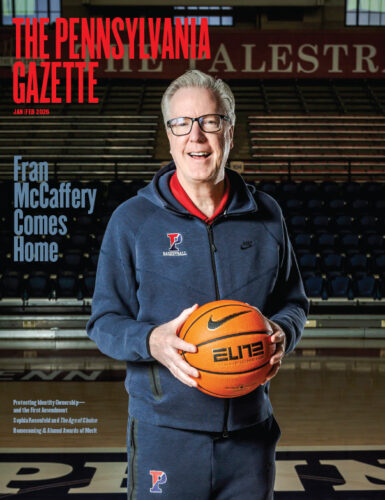
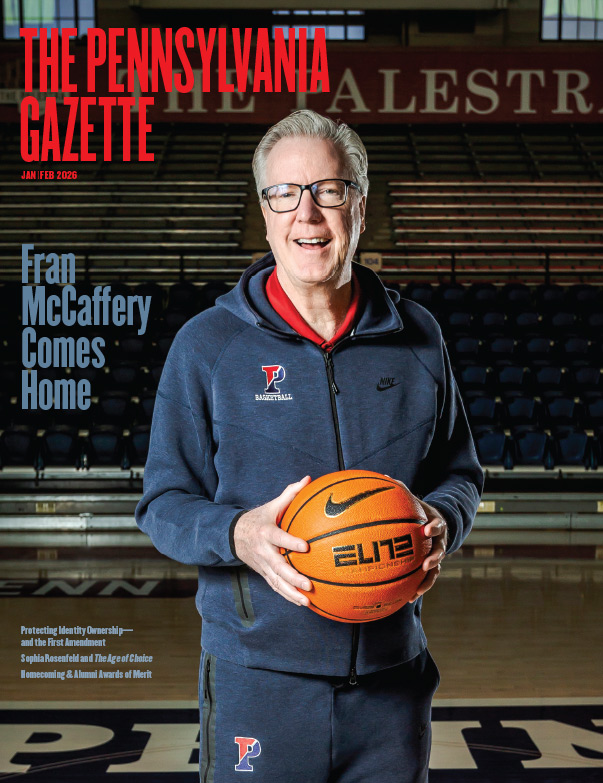
I graduated from La Salle College High School two years after Fran McCaffery [“Full Circle,” Jan|Feb 2026], but didn’t really know him at all, and am sad that I saw “White Magic” play in only a couple of high school games. I watched a lot of Big Five basketball on TV as a kid and played in one grade school game at the Palestra one Saturday morning, scoring just one basket at each end. After enrolling at La Salle High, I tried out three years for their basketball team but was cut each time. I had attended three years of summer basketball camps under La Salle University’s Paul Westhead and Dave “Lefty” Ervin and had developed a deadly accurate jump shot during my high school years, but my 5-11 height, foot speed, and ball handling were my weak points, which kept me from the squad. I settled for playing some CYO ball, but that was basically the end of my basketball “career,” if you could call it that. But when it came time to choose a college in the winter of 1979, I was accepted to six schools (Lehigh, Villanova, and Drexel among them), but I chose Penn—mostly because of the superior financial aid package they offered me (mom was a low-income widow). But maybe an almost equal factor was my excitement in watching Penn’s hoops team reach the Final Four and thinking I would perhaps be a firsthand witness to a Penn basketball dynasty during my undergraduate years. I remember feeling excitement when Fran transferred to Penn from Wake Forest. Even though my direct interactions with him were basically zero, I would have to list him as a contributing factor to both my interest in basketball at that time, and my matriculation to Penn.
Jim Finney EE’83, Cinnaminson, NJ
Behind the Scenes at the Suntory Ball
In the recent article about Fran McCaffrey, passing mention was made of the games played in Japan by Penn basketball in the 1981–82 season. The tournament was to be called the Suntory Ball. The reality is that those games, and the stories around them, are far more interesting than the writer of the article knew, or for that matter, everyone else as well.
In the summer of 1981 I was assigned to the athletic department by the Penn development office. I got that assignment partly because I had previously managed the J. William White Training House for Athletics, and also because my academic field of study at Penn had been Japan. Early on I offered my services to the athletic director at the time, referring to my Japan experience in particular. He assured me that everything was well in hand for the trip, and not to concern myself with it. Shortly after, it was decided by the development office that I should go to Japan ahead of the Penn delegation and arrange for Penn alumni there to be involved.
The size of the Penn travel group became rather enlarged. The team, coaches, trainer, equipment manager, and a medical doctor were to be joined by a half-dozen cheerleaders. The latter were to bring along a recording of Penn songs to be played at a welcome banquet, the games themselves, and a post game farewell event. Penn’s then vice president for development and his wife signed on, and a number of parents made their own arrangements. I continued to offer any assistance in the planning but was always reassured that everything was in order.
Two days before my own departure for Tokyo, the athletic director appeared and dropped all the passports for the Penn delegation on my desk with the comment that he had forgotten to arrange visas and would I kindly take care of the matter? To participate in an athletic event, or entertainment, required a special visa in Japan that normally might take several weeks. I had one day. I took the train down to Washington, DC, and made my way to the Japanese Embassy. Fortunately, I knew several people there, and they agreed to expedite the visas. They would be ready the next day … when I was in the air, already on my way to Tokyo. I arranged for a colleague at Penn to pick the passports up in my absence. Oh, and the captain of the team that year had an expired Jamaican passport. A Penn colleague had a relative working in that embassy, so a new passport was issued, and a visa entered, in remarkably short time.
I arrived in Tokyo and made first contact with alumni in the Penn and Wharton Clubs. I decided to pay a courtesy call to the organization that was sponsoring the tournament. Who were we to play? Louisville and Oregon State, both ranked in the top 20 in the country at the time. My visit to the sponsors raised immediate concern. I was told that as they had run out of money and had failed to reach the necessary levels of corporate sponsorship, they were about to cancel the whole thing! With the Penn delegation about to board a plane for Japan, I could not let that happen. I asked the organizers to give me 24 hours before they took any action. I immediately contacted Penn alumni, especially those from Wharton, and in less than 24 hours all the required financing was available, assuring that the tournament would go on as planned. No one was to be the wiser. That it might have all come apart was never mentioned.
There were, however, other issues to welcome the team. As originally planned, all the teams were to be welcomed to Tokyo by the governor at a reception at city hall. The organizers, however, had been unable to arrange that reception. I, fortunately, knew Tokyo’s governor, so the Penn delegation got an audience. I had even arranged for a ‘Liberty Bell’ with an inscription from the mayor of Philadelphia to be presented to the governor.
At the welcome banquet there was quite a crowd. Each team was brought to the front with their accompanying staff and parents, and the recorded music from their schools was played—but not Penn, because the cheerleader who was supposed to bring our recorded music forgot it in her dorm room. Unfazed, I had the Penn group assemble in the front and asked alumni in the crowd to stand. Nearly half those in the audience stood—we had a turnout. We all sang “Fight on, Pennsylvania” and “The Red and Blue.” None of the other groups sang along with their music, but the Penn family in the audience, and our delegation, all knew the words and the music.
Penn lost both games, but only by eight points to Louisville. But Penn left an impression that the others had not.
Thomas T. Winant G’69, Port Saint Lucie, FL
Well Done!
Really enjoyed “A Clockwork Orange,” the piece on the Glasgow Subway, which we’ve ridden [“Rabbit Hole,” Jan|Feb 2026]. The four-foot track gauge is, I believe, unique, not something that fell out of favor. We didn’t know of the new equipment fleet nor its automation.
Always enjoy hearing about Andrea Mitchell—whose receiving the Beacon Award from the Trustees Council of Penn Women was covered [“Gazetteer,” Jan|Feb 2026]—and whom I think of as a contemporary even though I didn’t know her when I was at Penn.
Well done!
Bill Mosteller C’71, Fairfax, VA
My Jaw Dropped
“Back to the Office—but Make It Better” [“Gazetteer,” Jan|Feb 2026] asserts that “companies should admit that they were too slow to bring employees back …”
Oh, were they? My jaw dropped when I read that. Even if that’s right on the social science, it’s dead wrong on the biological science.
The COVID-19 pandemic killed at least a million people in the United States alone in its first two years. Businesses were closed to reduce the mass death and disability, and they were kept closed or restricted to prevent even more. Like it or not, closing businesses was terrible for livelihoods, but it saved a lot of lives—never mind that so many lives were lost anyway. Rushing people back together before it was demonstrably safe to do so would have killed and disabled many more.
If in-person work was so critical, workspaces could have been made reasonably safe. But they weren’t. On average, mitigation was staggeringly poor throughout the Western world, improving haltingly at best even when more information emerged. And on top of that, people could have taken effective precautions to protect themselves and each other, but not nearly enough of them did. Although fewer people are getting sick and dying of COVID-19 since the acute phase of the pandemic, that is mostly because of luck and despite skill.
Saying offices should force people back together because it’s better for business ignores huge, inconvenient, tragic facts on the ground. I don’t doubt that the authors did good work—in fact, I used to work in Professor Peter Cappelli’s department, so I know he knows what he’s talking about. The problem is that the findings don’t match the real world, where human beings are prone to airborne illness, one of which was—and is—more dangerous than we all wished.
It would be nice to forget how devastating the pandemic was. But if we do, we dishonor the memory, and we do no better next time. As so many of us have learned the hard way, it is better to have public health and not need it than to need it and not have it.
Chris Drake GrW’13, Brookline, MA
Remarkable Resemblance
Rui Rui [“Arts,” Jan|Feb 2026] is a remarkable sculpture—but no mention of the resemblance to the moai statues of Rapa Nui (Easter Island)? All that’s missing is the stone hat for her Easter bonnet. Wish I could walk around it.
Peter A. Korn WG’63, New Rochelle, NY
See the online version of this story here, for a simulation of a walk around Rui Rui.—Ed.
