
From Philly and the Pa. suburbs to South Jersey and Delaware, what would you like WHYY News to cover? Let us know!
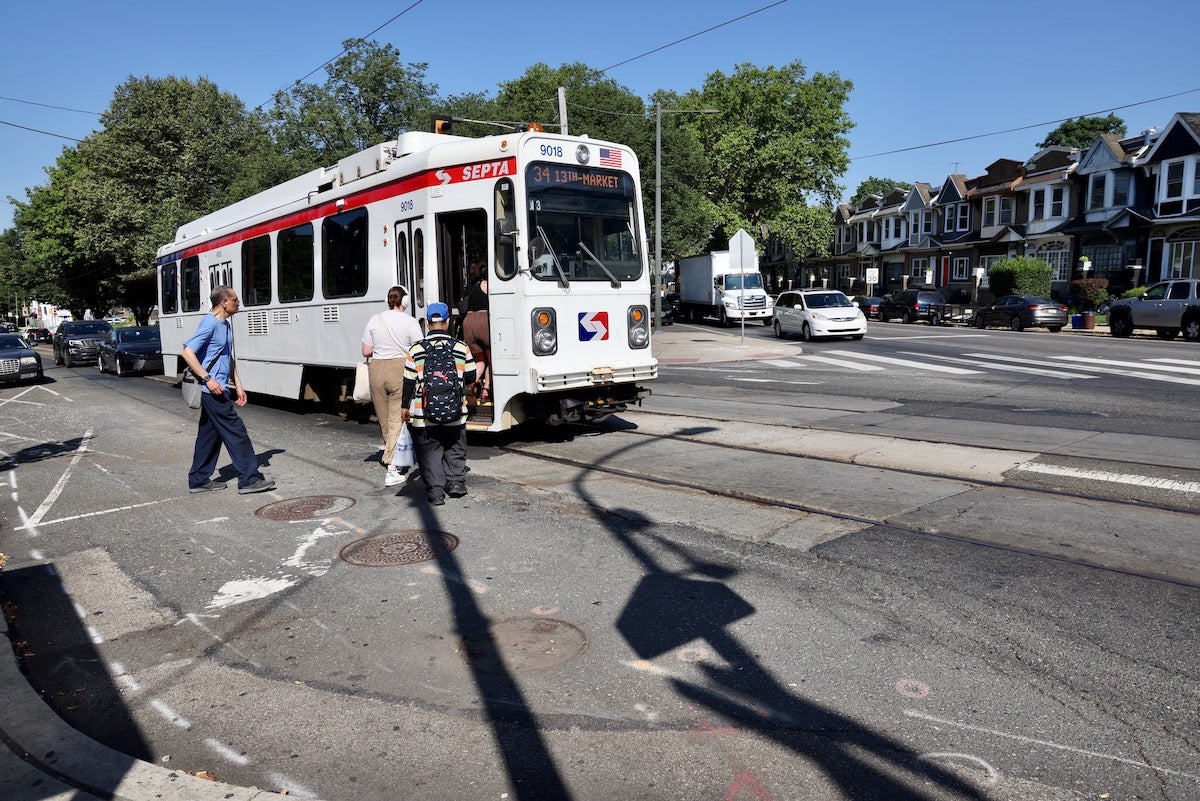
Starting Monday, SEPTA and the Philadelphia Parking Authority will install artificial intelligence cameras on trolleys across the city to catch instances of illegal parking that block trolley routes.
The cameras will help the PPA enforce parking violations for drivers who block trolley lanes and stops, which often cause delays for SEPTA vehicles, recording details of parking violations and sending them to the PPA for confirmation and enforcement. Philadelphia is the first city in the country to utilize this approach on trolleys.
“The trolleys are a really great use for this kind of enforcement because they can’t get around a parked car,” Matthew Zapson, a manager of planning programs at SEPTA, said, adding that SEPTA has seen a 3-6% decrease in travel times on bus routes with these cameras. “We’re really hopeful that on the trolleys it’ll be a really profound impact for riders.”
“A single illegally parked vehicle can disrupt service for thousands of riders and create unsafe boarding conditions that force passengers into moving traffic,” PPA Executive Director Rich Lazer said in a release.
The trolleys will soon feature two cameras to support enforcement. One uses AI to identify vehicles parked illegally, recording their license plate number and the date, time and location of the incident. A detected violation triggers a standard video camera, which records the infraction. The combined footage creates an “enforcement package” that is then sent to a PPA enforcement officer for verification. If confirmed, the driver receives a ticket, according to Zapson.
The video camera “only turns on when a violation is detected by the AI camera, [and] people’s facial features are automatically blurred out as well as the license plate of surrounding vehicles,” Zapson said, adding that riders should not be concerned about privacy.
The installation continues a partnership between SEPTA, the PPA and the city of Philadelphia’s Office of Transportation, Infrastructure and Systems, utilizing cameras from Hayden AI. SEPTA first piloted the initiative in 2023, testing the cameras on seven buses across two of its busiest lines. Over 36,000 parking violations were recorded in just over two months, Zapson said.
“That, for us, really helped articulate a problem that SEPTA and our riders knew was a big issue, which was that illegally parked cars make it difficult for people to safely and accessibly get on and off a bus or trolley at a stop, [and] can cause delays [and] get buses and trolleys off schedule,” he said.