
The business case for expanding medical care for kids is that it builds patient volume and potentially years of ancillary medical service utilization, such as sophisticated imaging and pediatric heart catheterization, generating revenue to fund operations.
A 2023 study in the Journal of the American College of Cardiology found that children after heart operations had significant long-term medical needs, even among those with less severe cardiac disease.
Patient volume at children’s hospitals is being driven by the shuttering of pediatric inpatient units at community hospitals in the U.S., which occurred at a rate of seven to eight times higher than the closing of adult units between 2008 and 2022, according to research that appeared in JAMA Pediatrics.
Doctors have generally embraced the shift, saying specialized pediatric care requires physicians who’ve undergone the extra training.
At the same time, distance to travel to get complex medical care is less of an issue for children than adults, Dr. Grogan says.
“There’s only so many places you can go for congenital heart surgery,” she says. “They’re going to travel.”
Most children’s hospitals are located in urban areas, so for parents living outside cities, the compelling nature of child illnesses can mean drives of 200 miles each way for sophisticated care, according to a 2022 study in the Journal of the American Heart Association.
The biggest challenge facing WVU Medicine’s bid to become a national player is attracting talent at a time when there are not enough pediatric subspecialists in cardiology, anesthesiology and other areas, says Mark Wietecha, managing director at the Washington, D.C., office of Manatt, a health care consultant.
“The challenge for WVU Medicine’s Children’s — and all kids’ hospitals — is can they actually field a clinical team? Can they get the pediatric nurses, the pediatric pulmonary? All of these subspecialties have become very hard to recruit,” he says. “Their ability to find pediatric anesthesia and recruit and retain people like that in Morgantown — they’re competing with CHOP and UPMC.”
The 230-some children’s hospitals in the U.S. are stressed by a widespread shortage of pediatric subspecialists, partly due to the longer training period required for doctors when compared to training for treating adults. Add to this, pediatric doctors face lower lifetime earnings because nearly half of the kids in the U.S. are covered by Medicaid, which has notoriously low reimbursement rates for medical care.
But the need is there. Only 10% to 20% of U.S. children see a pediatric subspecialist in a given year, reflecting both patient need and access limitations, according to a study published in 2023 by the National Academies Press.
A much larger adult patient population has Medicare coverage, which generally has a richer reimbursement — an attractive option for young doctors considering a medical specialty.
Pittsburgh competition
UPMC Children’s Hospital of Pittsburgh and the surrounding Lawrenceville neighborhood in 2020. (Andrew Rush/Post-Gazette)
UPMC Children’s Hospital of Pittsburgh, already well ahead of the Morgantown children’s hospital in clinical achievements and national rankings, is hardly looking over its shoulder at West Virginia — at least for now.
UPMC Children’s has made U.S. News & World Report’s top 10 Honor Roll list of pediatric hospitals many times, starting in 2007 when the list debuted; WVU Children’s has yet to break into the top 10, which typically favors larger, well-established hospitals.
The Pittsburgh hospital performed its first pediatric heart transplant in 1982. Two years later, surgical pioneer Thomas Starzl performed the world’s first pediatric heart-liver transplant there.
Construction costs for UPMC Children’s in Lawrenceville, where it moved from Oakland in 2009, totaled $665 million, which has been followed by hundreds of millions of dollars more in capital improvements and expansions since then.
UPMC Children’s has been an accredited Level I trauma center for more than 25 years, and UPMC Community Pediatrics, a primary medical care network for kids that feeds the hospital, is a formidable referral network, with 55 offices in Western and central Pennsylvania.
And that doesn’t include 11 UPMC Children’s Express Care clinics scattered around the state that have evening and weekend hours catering to busy families.
The Pittsburgh children’s hospital isn’t easing up on the pedal either.
It is scheduled to open an $85 million heart care center in June. The UPMC Children’s Heart Institute will occupy a 50,000-square-foot building on the Lawrenceville campus, where more than 24,600 operations are performed annually — about two-thirds more than WVU Children’s last year.
“It very much will be a destination for children but for adults as well” with congenital heart problems, UPMC Children’s President Diane S. Hupp says. “We continue to grow and to take the brand and excellence to the communities that need it.”
UPMC Children’s did miss the U.S. News & World Report’s 2025-2026 Honor Roll, after slipping to sixth place in 2022-23 and eighth in 2023-24. Only 10 U.S. hospitals make the Honor Roll each year.
The top ranking is based on exceptional multispecialty performance. UPMC Children’s doesn’t have the patient volume of the biggest children’s hospitals in the country, which is a factor in U.S. News’ Honor Roll ratings, Ms. Hupp says.
Regardless, UPMC Children’s was nationally ranked in all 11 specialties used by U.S. News.
“We remain a top-ranked hospital,” she says. “Our mortality rates in relation to risk factors are very strong. We take the sickest of the sickest, regardless of their ability to pay.”
“We have a legacy here.”
Start cardioplegia
Dr. Christopher Mascio monitors Korbyn’s vital signs during surgery. (Alexandra Wimley/Post-Gazette)
At 9:36 a.m., a wheeled heart-lung bypass machine next to Korbyn’s bed lights up, and clear tubes connected to his body jiggle, flooding with his blood. The three-person perfusion team jostles to life.
“OK, bypass going on,” a technician tells the surgical crew. “Going on bypass,” another technician says. “Everything looks good.”
“Start cardioplegia,” Dr. Mascio says, ordering the drug that will buy him enough time to cut into Korbyn’s heart without risking fatal blood loss.
At 9:44 a.m., Korbyn’s pulsing heart flutters, then stops. Big-screen wall monitors flatline.
The heart bypass machine hums; dials turn.
At 10:05 a.m., Dr. Mascio begins stitching a new valve into place.
By 10:33 a.m., the drug infusion has been turned off and Korbyn’s heart stirs, erratically at first and then as though finding an old friend as it captures an organized rhythm.
The pump is turned off a few minutes later.
Scattered chatter in the room breaks the silence.
‘So far, so good’
Dr. Christopher Mascio embraces Korbyn’s mother, Dawn. after the surgery. Korbyn’s stepfather, Tommy Weatherholtz, right, waits to hear how the procedure went. (Alexandra Wimley/Post-Gazette)
Later, Dr. Mascio greets Korbyn’s mom and stepfather in a waiting area. He has good news.
“Heart looks good,” he tells them. “The case went about as well as a case could go. Things went really well. So far, so good.”
Ms. Reynolds hugs Dr. Mascio.
Despite the good news, Dr. Mascio says the new heart valve will eventually fail. It might be a month; it could be years, which is typical in the treatment of heart valve defects.
The result will be another open-heart surgery and stopping Korbyn’s heart to make another repair, Dr. Mascio says. Or, if Korbyn’s lucky, a less invasive procedure will be able to switch out the valve without opening his chest again.
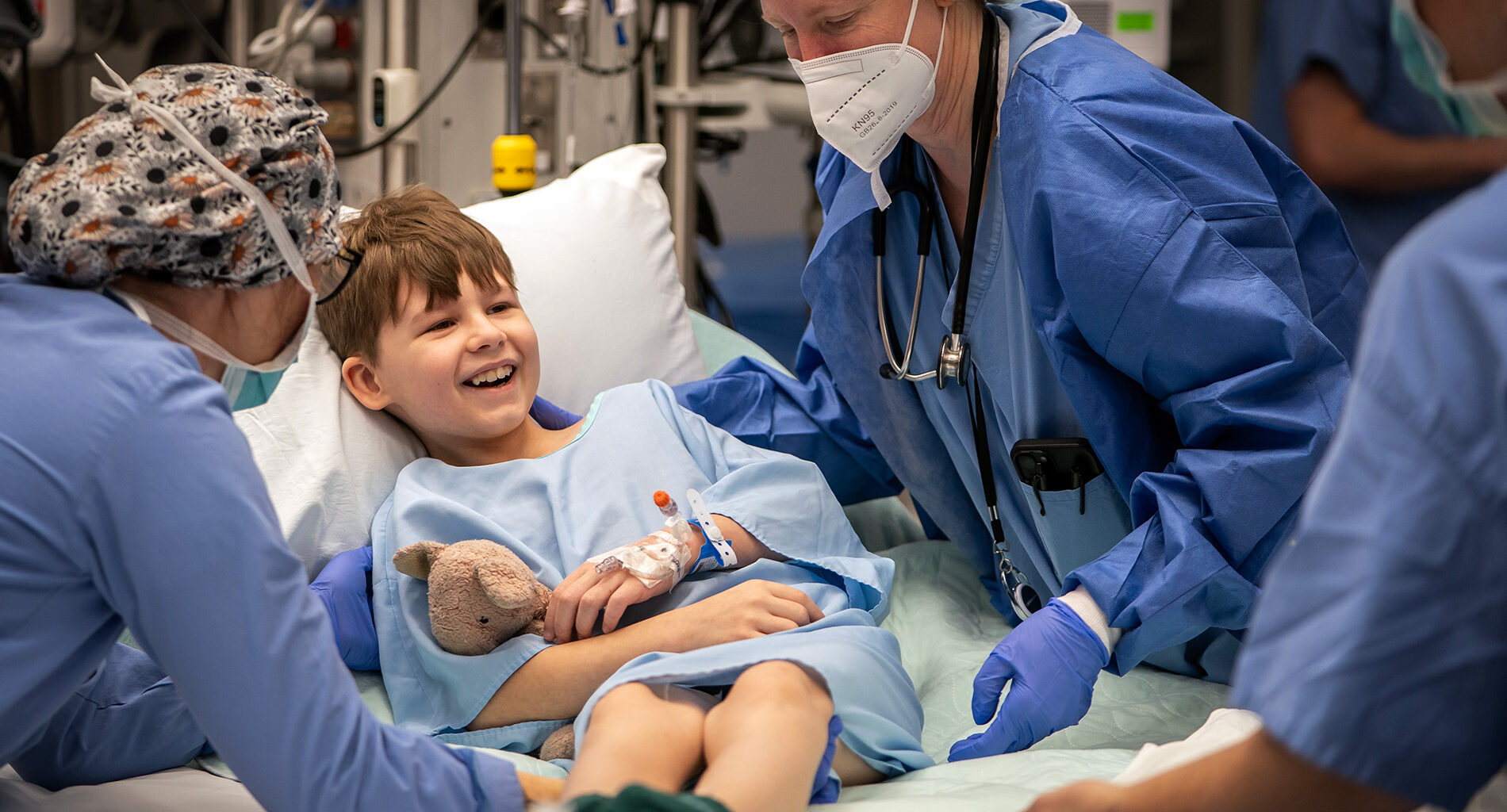
Three days after his admission and surgery, Korbyn goes home with Piggy and two dozen other stuffed animals he brought to the hospital in a backpack. He is the youngest of four children, and the family lives 2½ hours away in Inwood, W.Va., just south of Martinsburg.
Korbyn is a different kind of kid, his mother says. If he’s offered M&M’s candy, he won’t accept it unless there’s enough to share with others.
Hours earlier, she walked behind him as he was wheeled into surgery, out of view, so he couldn’t see her tears.
“I like to share,”Korbyn says, recovering at home three weeks later with Piggy.
Kris B. Mamula, kmamula@post-gazette.com.