
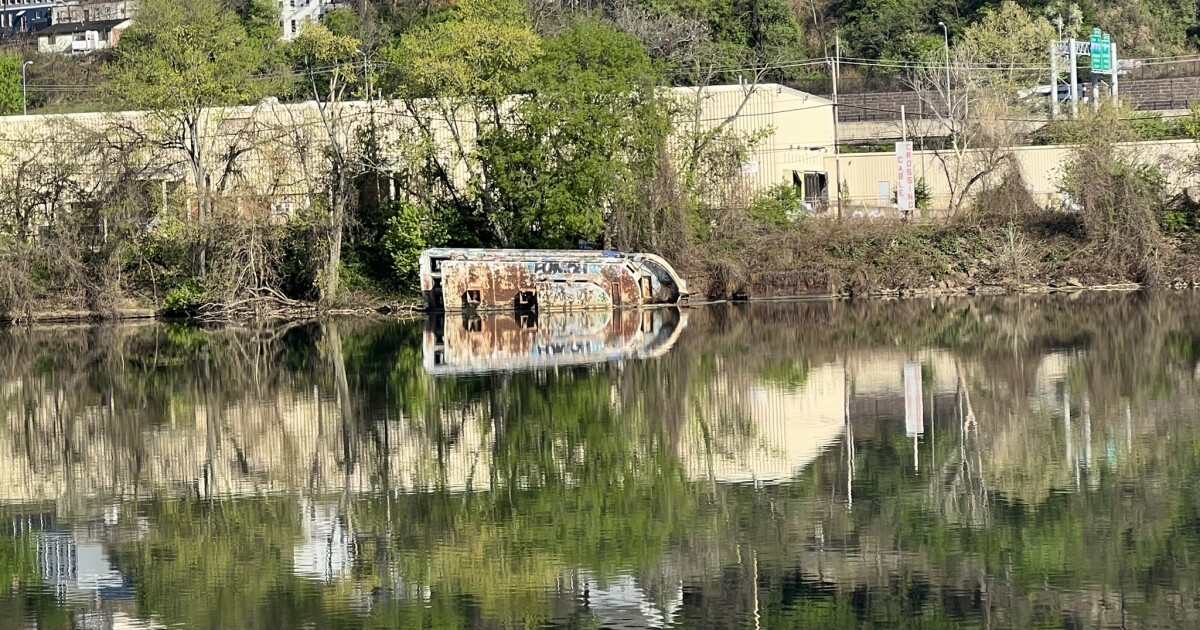
A 42-foot fiberglass houseboat left on the North Shore. A submerged steel barge underwater in the Monongahela River. A motorized recreational boat filled with fuel grounded on Sycamore Island where spiny soft shelled turtles swim. These are just a few of the around 25 abandoned and derelict boats on Pittsburgh’s waterways, according to a recent assessment by Three Rivers Waterkeeper.
Abandoned boats can make the rivers risky. Some break free and drift into river traffic along with floating coolers and life jackets. Paint and insulation break down and leach into water. Other boats leak fuel and other fluids. Those docked outside the stadium become public safety hazards for rowdy, curious crowds.
For years, local law enforcement and the Fish and Boat Commission struggled to remove them due to a lengthy legal process, liability risks to the municipality and only slight penalties for the boat owners. But last July, the state of Pennsylvania passed a law that gives municipalities the power to remove the boats and cuts down on the time from discovery and disposal. Owners face big fines if they don’t remove the boat and get stuck with the bill for its removal.
Local government, law enforcement, waterways organizations and marine salvage companies have been at work surveying the problem, prioritizing problem boats and sketching out what the removal process looks like at each stage. While they’ve taken out a few boats, finding the money to pay for the costly disposal remains a challenge.
The new law has “real teeth behind it,” according to Michael Hills, president of the Pittsburgh Safe Boating Council. “If you’ve abandoned your boat, you better be ready for it, because it’s gonna cost you. That’s the good stuff. The tough part is, a lot of people that have a boat like this, that decide to abandon it are abandoning it because they can’t afford to fix it.”
Streamlining removal
Act 28 lays out how to identify, manage and remove abandoned, at risk and derelict boats for municipalities and law enforcement. There’s a 14-day notice period and then owners have 30 days to remove the boat. If they fail to do so, they face misdemeanor charges of up to $2,500 and are responsible for the restitution charges of removing and disposing of the boat, which can range from $5,000 to $20,000 per boat, according to Hills.
The law also limits the liability municipality and law enforcement agencies previously could’ve faced when removing an abandoned boat, which is “huge,” according to Mark Sweppenhiser, director of boating at the Pennsylvania Fish and Boat Commission, the agency that oversees this process.
“No one wanted to take action and then find out that they have to buy someone a boat because they damaged a boat,” Sweppenhiser said. “It’s very counterintuitive for the municipality to take action if they’re gonna be held liable for all the damages that happened to a boat that would’ve happened otherwise if they didn’t take action. So it was kind of a catch-22.”
The Pittsburgh Safe Boating Council put together a committee including marine salvage contractors, the Port of Pittsburgh commission, legal council and local municipalities to identify what the process looks like and who handles each step.
“It’s one thing to have a law, it’s another thing to pull a boat and deal with it,” Hills said. “Raise the boat, tow the boat, barge the boat away, remove fluids, take it to a site, dismantle, destroy it and landfill it.”
So far, they’ve removed four boats in the Pittsburgh-area, according to Hills.
Digging up the money
Getting a boat to shore in many cases requires specialized equipment to resurface the boat and drag it to shore and tow it away. But not every community has those kinds of contracts and resources available, according to Sweppenhiser. And those salvers need to be paid.
“A lot of these places are small municipalities,” Sweppenhiser said. “They have limited funds and, and ability to do these things. A lot of these boats were junk and trashed. They have no value, so it ends up being a burden on the municipality.”
The biggest problem, according to Hills, is recouping the costs of pulling in those abandoned vessels. Hills is trying to raise $50,000 as seed money through grants and donations to set up a fund to pay salvers to pull up a steady stream of abandoned boats in the Pittsburgh area.
Some of the most contentious and visible derelict and abandoned boats sit on the North Shore wall at the confluence of the Three Rivers. Act 28 only applies to vessels on public property, leaving private property owners stranded. But the City of Pittsburgh has entered into an agreement with the Sports and Exhibition Authority to take over North Shore Riverfront Park, making it public property.
“Trust me when I tell you that those boats that are tied there right now will not be there for the [NFL] Draft [in April],” Hills said. “And our goal is to make sure they never come back.”
WESA’s Tom Riese contributed to this story.