
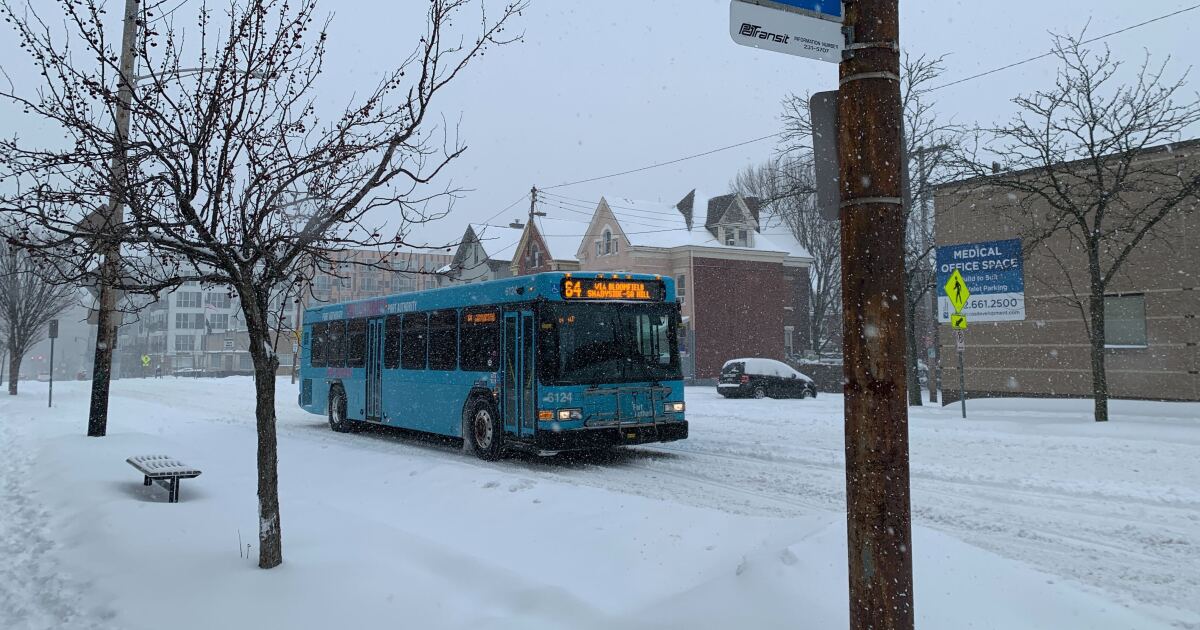
Pittsburgh Regional Transit’s latest draft of its updated bus routes aims to bolster its most popular routes and add more rides between communities throughout Allegheny County. The new plan would eliminate 13 current routes, but add nine new ones.
“It should look more like our existing network to our riders, especially for those routes that perform well,” said Emily Provonsha, manager of service development at PRT.
The new plan, called Bus Line Refresh, adds more routes with quicker service — 18 routes would have service every 20 minutes compared to 11 right now; 43 different routes would have buses arrive every half hour, up from 27 today. There’s new direct routes into Pittsburgh’s Oakland neighborhood from places such as Mt. Lebanon, Millvale and neighborhoods in the North Hills. The plan lifts stop restrictions on the West Busway on the 28X to and from the airport and travels onto the East Busway.
In September 2024, PRT released its first draft to reshape the system’s bus routes in order to boost ridership that plummeted during the pandemic; bus ridership is down about 45% from December 2019 to December 2025, according to PRT data. The plan also aims to make the existing routes quicker and more direct for regulars.
PRT held more than 60 public meetings and received over 12,000 comments from people weighing in on the proposed changes. Many found the changes confusing and overly complicated, but others welcomed new routes including more that led directly to Oakland.
This new draft prioritizes “connections to grocery stores, hospitals, and if we can’t do it on every route, then we at least need to reroute that route, either Downtown or to the East Busway or to the West Busway,” Provonsha said.
Compared to the first draft, more routes return Downtown — such as the 22 and the 44, although the 44 will be shortened in areas where there are very few riders. PRT received the most comments about the 71C route, which was shortened in 2023. The new plan turns the 71C into one of the PRTX — or bus rapid transit — routes, returning the route into Uptown and Downtown Pittsburgh.
Shortly after the public meetings for the first draft were held, the agency faced a $100 million budget shortfall that threatened massive cuts and fare increases unless it got more funding from the state, putting the redesign on hold. While PRT and other state transit agencies were unable to secure the additional funding, PRT got permission to use $107 million state funds for capital projects to plug the deficit over the next two years.
Bus Line Refresh is “cost neutral,” according to Provonsha, meaning it would cost the same to run as the current system and wouldn’t require additional funding to implement.
Laura Chu Wiens, executive director at Pittsburghers for Public Transit, a public transit advocacy organization, has only begun to look at the new 192-page plan released Friday. In this draft, Wiens is looking for clear links to “ridership and reliability.”
“How many more riders do they project that it will bring in?” Wiens said. “Can we set benchmarks for when that will happen? How will it improve service reliability?”
Riders can take a look at the changes to their routes on PRT’s website, which includes an interactive map.
PRT plans on holding more than 60 meetings across Allegheny County in the next few months, starting with one on March 10 in Braddock Hills, before deciding on a final draft to put before their board this fall. If approved, PRT plans to roll out the new changes in 2027.
Wiens does not want to see the plan implemented until PRT has consistent, stable funding in place, but thinks that some changes can be done right away.
“To address overcrowding, to improve frequencies and places where they know ridership is, they should just do that now,” Wiens said. “There’s no reason for them to wait for a larger implementation.”