
How Buro Happold’s integrated systems engineering kept the airport operating while building a resilient terminal for the future.
When Pittsburgh International Airport opened its new terminal in November 2025, it wasn’t simply unveiling an architectural statement. It was completing one of the most complex operational handoffs an airport can attempt: merging a 1990s‑era campus with an entirely new terminal without ever shutting the airport down.
For the Allegheny Airport Authority, this was the true success metric. And for the Buro Happold engineering team, led by US Aviation Director Jeremy Snyder, it was a chance to demonstrate how thoughtful engineering can protect day‑to‑day operations while enabling a new terminal to perform at its highest potential from hour one.
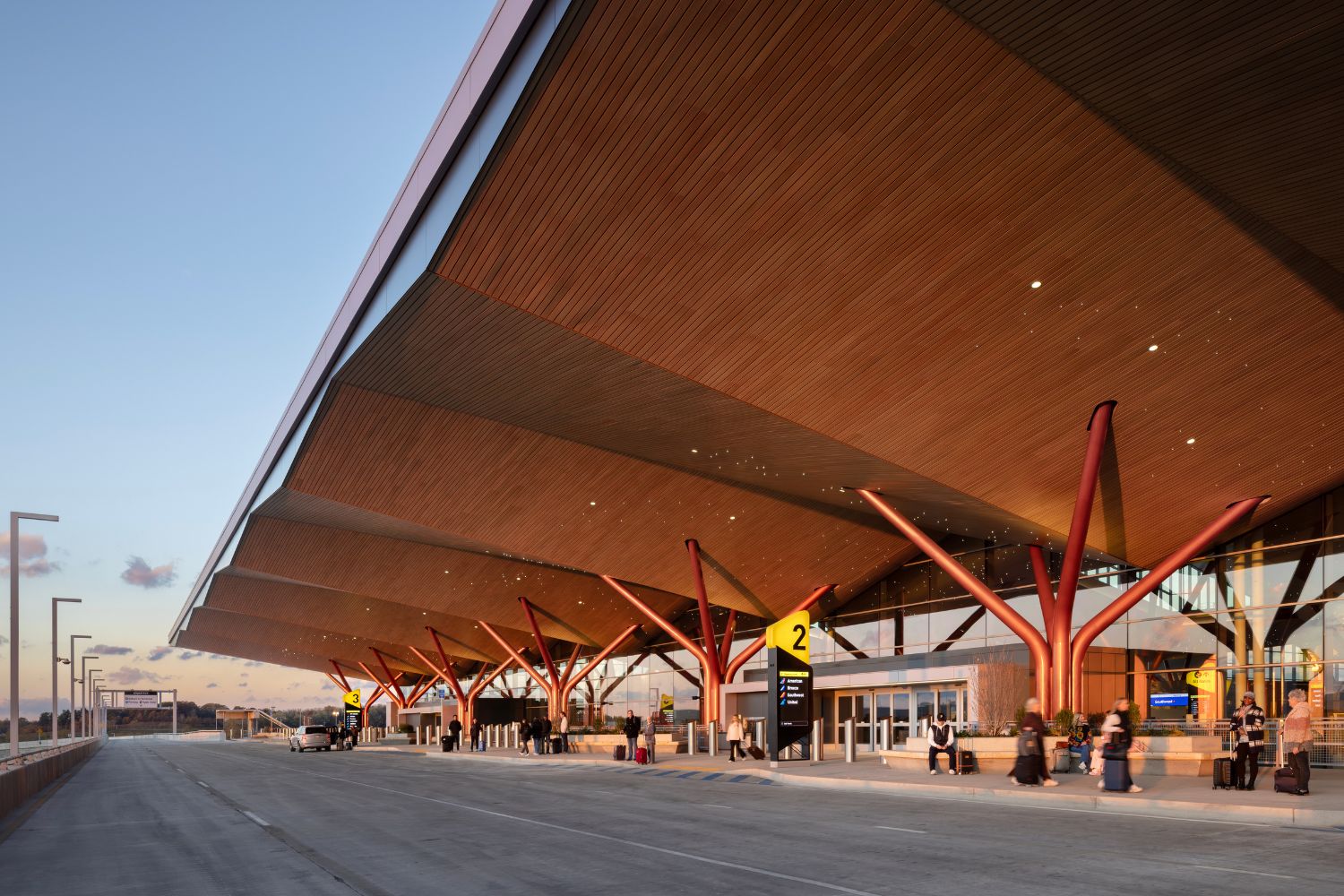
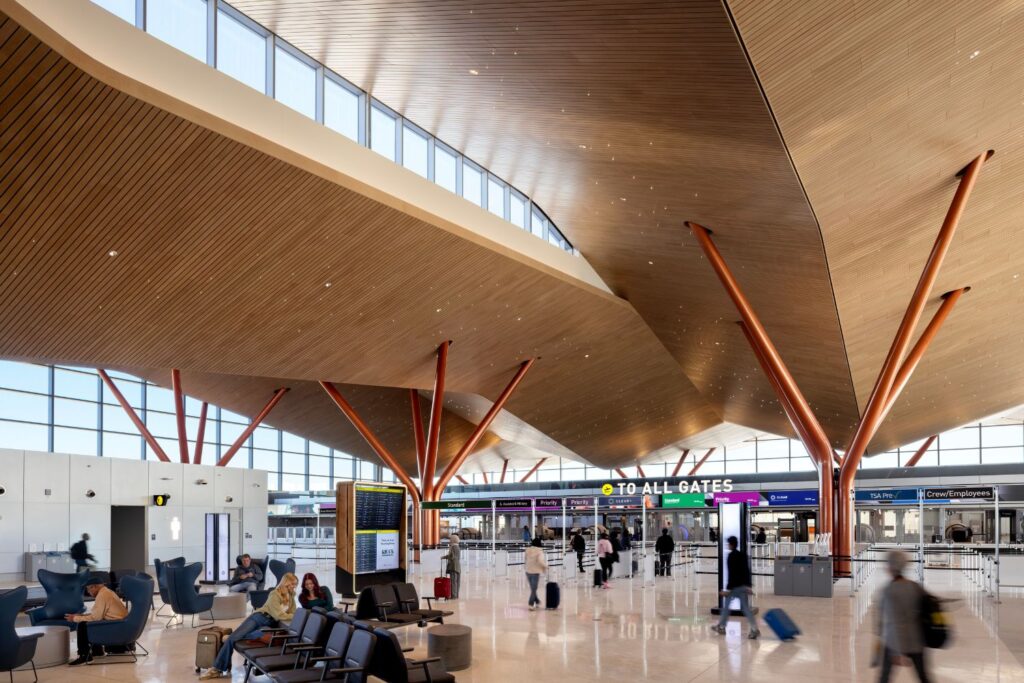 Image: Ema Peter.
The Terminal Modernization Program (TMP) introduced an 800,000 ft² landside building that transforms how passengers arrive, check in, and move through the airport. But achieving that seamlessness required more than designing new systems. It required strategically weaving new, high‑efficiency infrastructure into legacy systems that had to remain live – central plants, controls platforms, and the airport’s campus microgrid – and doing so in a way that eliminated risk, preserved safety, and set up the terminal for a multi‑decade lifecycle. Working closely with Gensler and HDR, in association with luis vidal + architects, Buro Happold embedded performance-based thinking into every decision.
Airports are complex machines, but they should never feel that way to the people moving through them. Our job was to make the complexity feel invisible so the terminal could feel simple, calm, and unmistakably Pittsburgh. That balance – clarity on the surface, sophistication underneath – is what makes this project special.”
Jeremy Snyder, US Aviation Director, Buro Happold
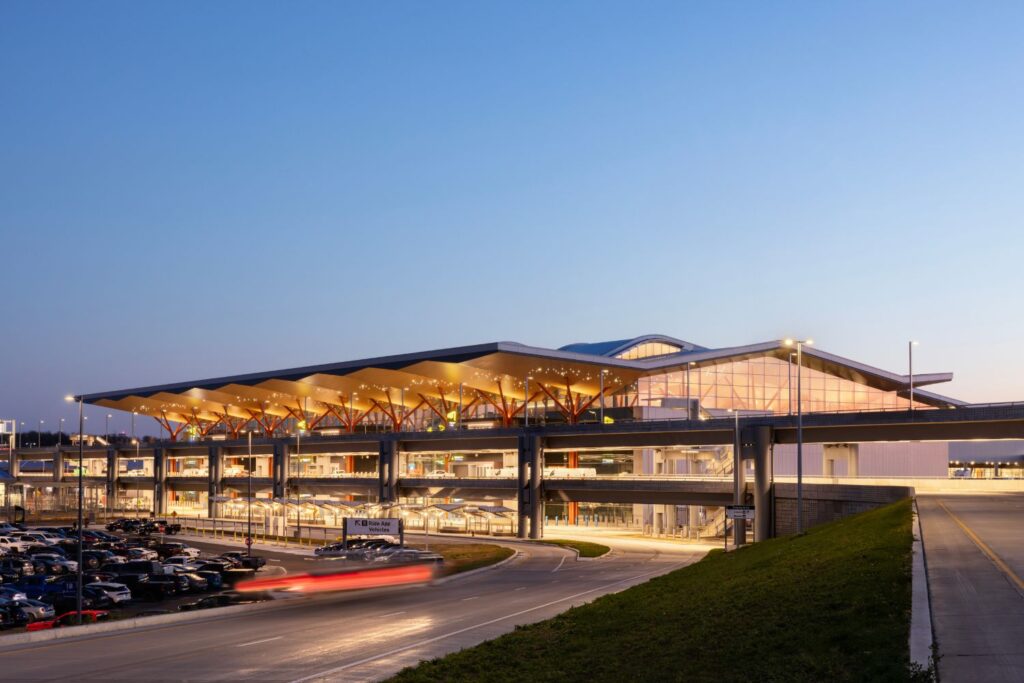 Image: Ema Peter.
The integration challenge: aligning a reimagined terminal with aging campus systems while keeping it running
Pittsburgh’s former ’90s hub‑era layout separated landside and airside buildings with an Automatic People Mover (APM). Transitioning to a compact, origin‑and‑destination terminal meant retiring the APM, expanding landside spaces, and simplifying the connection to the concourses – all while maintaining live airport operations.
This shift carried high stakes:
The terminal’s large open volumes and rolling‑hills roof demanded precise thermal strategies to manage Pittsburgh’s extreme seasonal swings.
Highly glazed facades risked glare, downdrafts, and condensation unless tightly integrated with HVAC and envelope systems.
Baggage hall geometry, dwell times, and stack-effect behavior required non‑standard solutions.
The existing 1990s central plant and controls framework had to stay active throughout construction and cutover.
In short: the airport couldn’t pause. Every system had to perform during the transition.
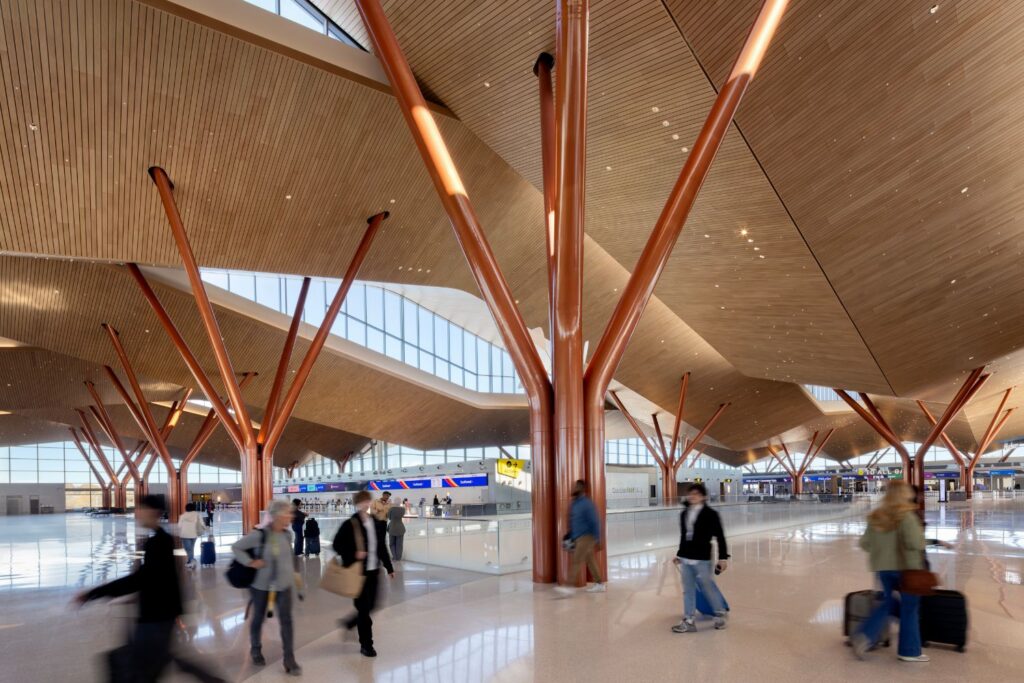 Image: Ema Peter.
The solution: precision systems engineering that fused legacy and new infrastructure
One analysis model, decisions grounded in data: We used whole‑building energy modeling and a Single Analysis Model to test loads, compare energy conservation measures, and calibrate systems to inform decisions and compliment the architecture. This analytical backbone set the stage for a clear, high‑precision basis of design.
Displacement ventilation that preserves the architecture: In tall, high‑volume areas (especially the baggage hall) we implemented displacement‑style ventilation (DV) with low‑level supply integrated into the baggage carousels and fixed elements. This preserved the open ceiling language, improved stratification control, consolidated maintenance to non‑public areas, cut fan energy, and created a calmer acoustic and visual environment. We validated comfort using computational fluid dynamic software (CFD) to manage stack effect at peak conditions and to place spot cooling where baggage tugs and facilities teams operate nearly 24/7, eliminating freezing risks and maximizing efficiency of baggage distribution.
Envelope‑aware strategies for comfort and energy: We paired an outside‑air economizer with total energy recovery wheels to maximize seasonal efficiency and trim peak heating and cooling loads. Custom finned‑tube radiators along the facade temper downdrafts; mid‑level finned‑tubes mitigate cold‑glass effects where glazing exceeds 16ft; pedestal finned‑tubes at skylight valleys prevent winter condensation. Automated shading protects comfort in long‑dwell and staff zones while reducing cooling energy.
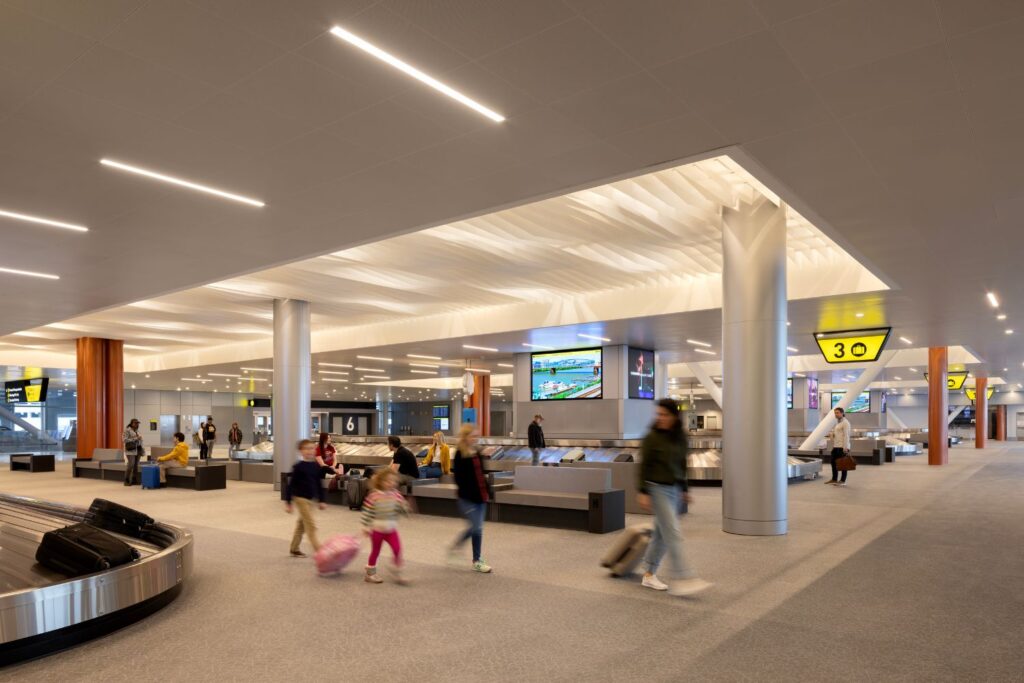 Image: Ema Peter.
Phased central plant strategy: We studied the existing chiller plant and recommended a measured replacement sequence that accounts for refrigerant leakage rates, global warming potential, energy cost, and payback. This enables upgrades over time – avoiding a capital spike – while maintaining reliability for the modernized terminal.
Legacy controls and a maintainable platform: We maintained clear separations between new and legacy systems where it made economic sense and worked with the airport to create a BMS that integrates legacy controls into a long‑term platform via open protocols. Parallel commissioning mirrored critical points (smoke control, pressurization, emergency lighting) to allow validation before sequence handoff, protecting operations throughout the cutover.
Power, resilience, and the microgrid: The airport’s campus microgrid provides independent, resilient power with islanding and black‑start capabilities. Our electrical integration synchronized new terminal loads and controls with generation and protection schemes, ensuring coordination, load‑shedding logic, and transfer sequences that safeguard life‑safety, security screening, baggage, and vertical transport during abnormal events.
We overlaid a modern BMS that interoperates with legacy platforms – preserving current operational consistency while unlocking optimization in the new terminal.
Jeremy Snyder
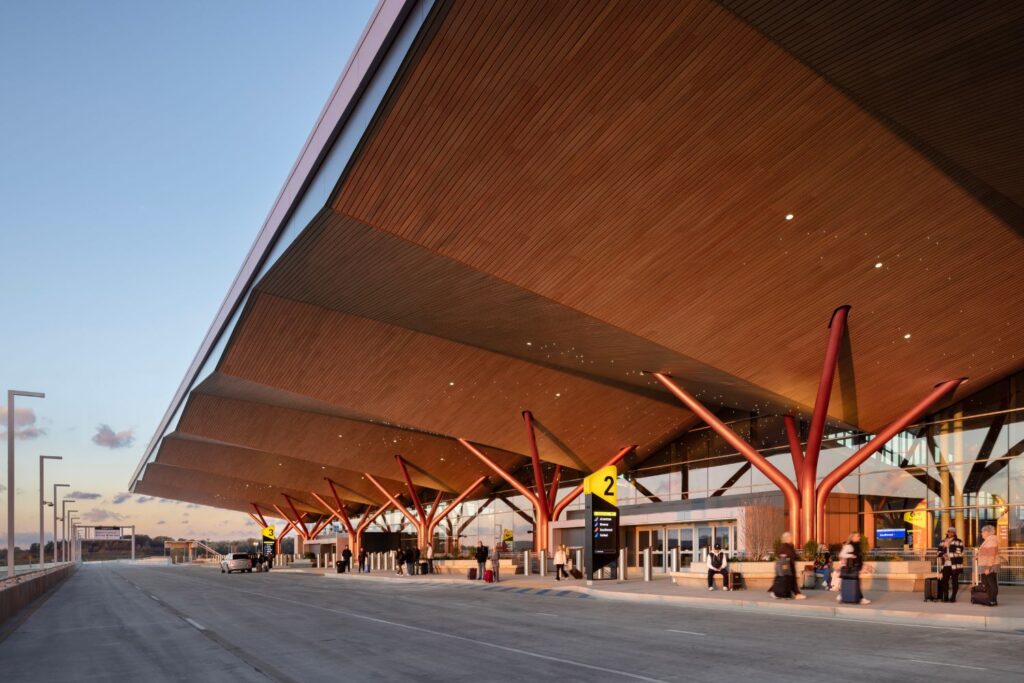 Image: Ema Peter.
Delivery in practice: Local presence and tight coordination
Our Pittsburgh‑based team collaborated side‑by‑side with the architects, the airport, and contractors from concept through construction and into commissioning. We used BIM to coordinate services tightly, organized air handling and power distribution around what must be shared between landside and airside vs. what should remain distinct, and routed life‑safety devices discreetly in public areas while keeping plantrooms and back‑of‑house routes clear and organized for operations.
Results: A terminal for Pittsburgh – and ready for tomorrow
The rebalanced landside‑to‑airside relationship eliminates the APM, reduces travel time, and simplifies operations. Architectural gestures echo Pittsburgh’s hills and river valleys — and the engineering ensures that the experience feels intuitive, comfortable, and calm.
And a modernized plant, integrated controls platform, and synchronized microgrid create long-term resilience.
DV and energy recovery reduce peaks and fan power.
Finned‑tubes eliminate downdrafts and condensation risk.
BIM coordination improved constructability and future maintenance.
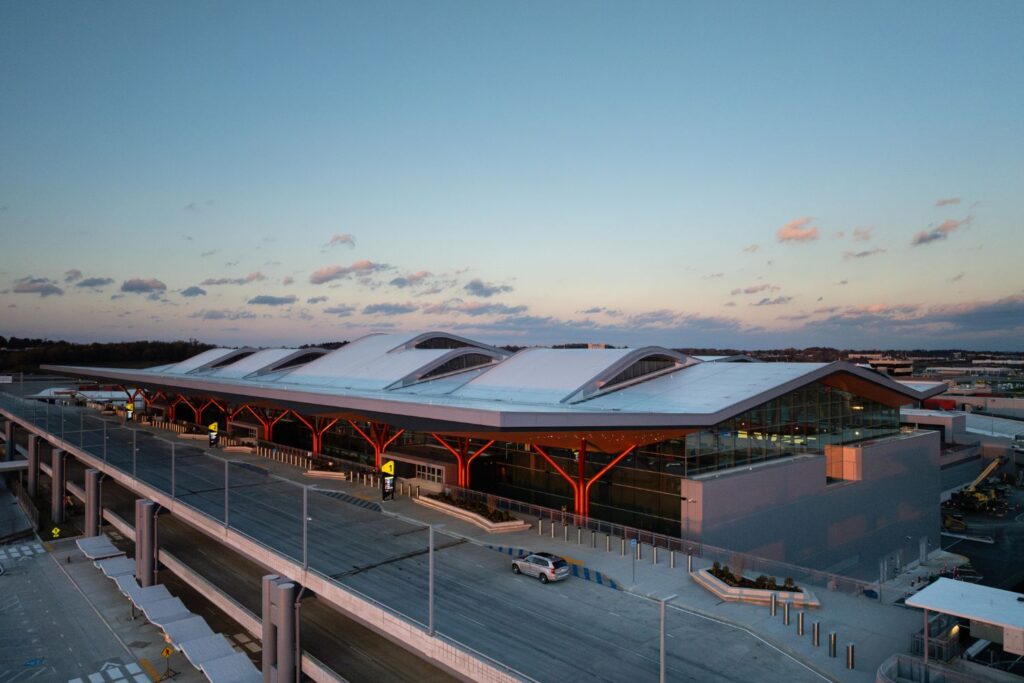 Image: Wendell Weithers.
We weren’t just installing systems – we were integrating them into a terminal that had to connect to a microgrid, reduce energy use, stay live during construction and perform on day one.
Jeremy Snyder
Opened November 18, 2025, the modernized terminal now stands as a benchmark for how integrated engineering can unite old and new systems – delivering clarity for passengers, operational reliability for the airport, and value for decades to come.